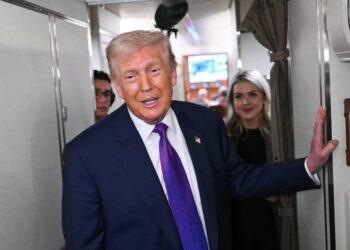
President Trump ordered marijuana to be rescheduled under federal law on Thursday, shifting it out of the most restrictive drug category. The move would make it easier to conduct medical research on the drug, though it stops short of federal legalization. It has reignited familiar arguments about whether cannabis is harmless or dangerous, medicine or vice, success or failure.
That debate misses the point. Instead of choosing sides, we should acknowledge that policy moved faster than the evidence on public health effects. The challenge is whether we are willing to adjust course when we encounter unintended consequences.
Broadly, state-level legalization of recreational marijuana, now in 24 states and D.C., did what it was expected to do. It made marijuana easier to obtain and more socially acceptable. Arrests for possession in states that legalized the drug for recreational use dropped sharply, and many fewer people are going to jail or prison for marijuana use. These outcomes should be celebrated.
But all policy decisions have trade-offs, and cannabis legalization is no exception. Recent studies show that while overall rates of severe mental illness have not surged, a growing share of new psychosis diagnoses involves people with heavy cannabis use. Other research suggests that impaired driving risk might have increased in some places, even as measurement of road safety effects and enforcement lag reality. Emergency departments are seeing more cannabis-related visits, often tied to heavy use and dependence. It’s estimated that nearly a third of adult users have reported symptoms consistent with cannabis use disorder, meaning they continue to use despite significant negative effects on their lives.
These harms are not evenly distributed. They cluster among heavy users, younger people and those who are already vulnerable.
I come to this not only as a policy analyst but also as a pediatrician and a parent. I still believe, as I wrote more than a decade ago, that marijuana poses fewer risks than alcohol for most people. I also believe both deserve serious attention, especially among young adults whose brains and habits are still developing.
Marijuana legalization exposes a familiar tension in public health policy. Policy decisions often have to be made in the absence of complete evidence on their potential public health effects, especially when existing laws are clearly doing harm. Legalization reduced arrests and incarceration, but it also created a commercial market faster than we built the systems needed to monitor health effects, educate consumers or manage risk.
The solution is not to call for a return to the old system but to acknowledge the need to make new policies that can address the unintended effects of legalization. Hopefully, the president’s action will permit more research in that direction.
This would be helpful because, when it comes to the health and safety effects of liberalizing marijuana laws, the evidence base is surprisingly weak. Much of that weakness is structural. For decades, cannabis was classified as a Schedule I drug, meaning the government believed it had a high likelihood for abuse without a medicinal benefit. This made rigorous research extraordinarily difficult. Mr. Trump’s push to reschedule marijuana as a Schedule III drug, which recognizes accepted medical use, should lower barriers to research and, hopefully, make it easier to study real-world risks, benefits and trade-offs.
So far, claims about the medical benefits of marijuana have often run far ahead of high-quality data. A recent Journal of the American Medical Association review concluded that evidence is insufficient for most proposed medical uses, such as for sleep and anxiety. (Notably, formal medical marijuana participation often declines after states legalize recreational cannabis and access no longer requires a medical justification.) There’s clearer support for a small number of pharmaceutical-grade cannabis products used for chemotherapy-related nausea, certain seizure disorders and appetite stimulation. More research could help us get a better understanding of which medical uses are real and which are just hype.
I’m asked all the time what science says we should do about the increasing use of and legal permissiveness around marijuana.
That’s the wrong question. Partly because the science isn’t that strong but more critically because science alone doesn’t dictate policy. Rational people can look at all the data and reach very different conclusions about what we might do.
What science can do is identify the areas of concern and suggest options for how we might tackle them.
One place to start is potency. Today’s cannabis products are far stronger than those studied a generation ago. High-potency products should face higher taxes, stricter labeling and tighter marketing limits, much as higher-proof alcohol does. Adults could still buy them, but the market should not push people toward them by default.
Public education also needs to improve. We must avoid scare tactics and wellness slogans. Today’s cannabis industry markets high-potency products aggressively, sometimes overstating benefits or downplaying risks. Good science communication would include honest messages that risks rise with potency, early use, frequency of use and certain mental health histories.
We need more research into how to best combat impaired driving. Blood THC thresholds do not reliably measure impairment. Officer training, including on how to observe signs of intoxication based on drivers’ behavior, and public campaigns focused on the risks of cannabis use combined with alcohol would help reduce harm.
If cannabis is going to generate tax revenue, it should help pay for the consequences it creates. Emergency departments, early psychosis programs and treatment for cannabis use disorder should not be afterthoughts.
Finally, we need better data. Legalization raced ahead of the surveillance of its public health consequences. States should be required to track cannabis-related emergency visits, poisonings and mental health crises. We cannot manage what we don’t measure.
This is where rescheduling matters. Moving marijuana out of its most restrictive federal category won’t settle the legalization debate. But that would make it easier to generate the kind of evidence needed to refine policy. The real lesson here isn’t even about cannabis. It’s about our capacity to learn and adapt. We can celebrate the significant reduction in incarceration while honestly confronting new challenges in vulnerable populations.
This requires all of us — policymakers, researchers, advocates and citizens — to reject ideological entrenchment. We need officials willing to adjust course based on new data, not just defend initial decisions. We need researchers committed to studying real-world outcomes, not just confirming prior beliefs. And we need advocates willing to acknowledge trade-offs, not just claim victories.
Aaron E. Carroll is the president and chief executive of AcademyHealth, a nonpartisan group that advances evidence-based health policy.
The Times is committed to publishing a diversity of letters to the editor. We’d like to hear what you think about this or any of our articles. Here are some tips. And here’s our email: [email protected].
Follow the New York Times Opinion section on Facebook, Instagram, TikTok, Bluesky, WhatsApp and Threads.
The post Trump’s New Marijuana Policy Offers an Opportunity appeared first on New York Times.