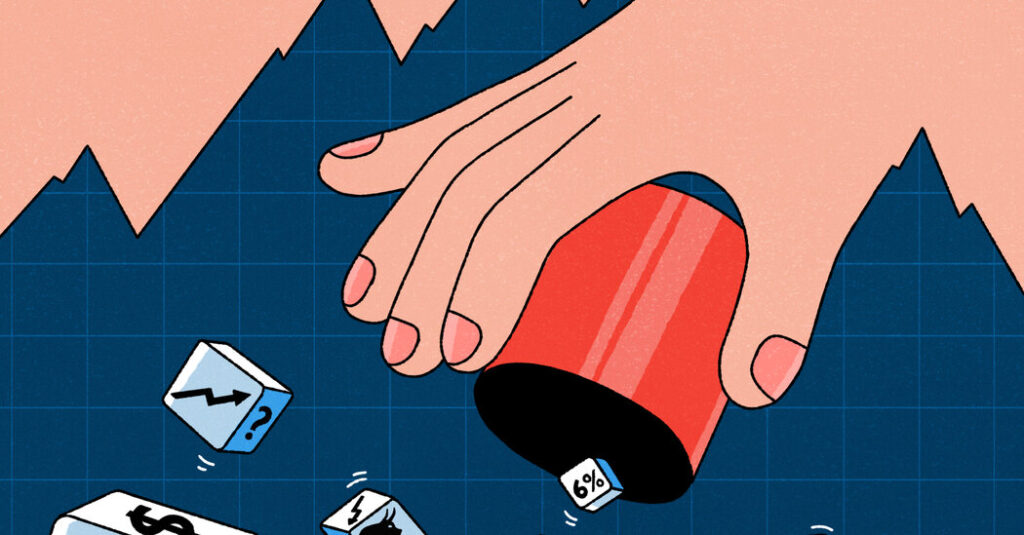
Wall Street experts are forecasting where the S&P 500 will close at the end of the next calendar year. Why shouldn’t I do the same?
You might object that I have no idea where the market is going, and you would be right. But so what? Nobody else knows, either, and that’s never stopped Wall Street.
The professional strategists are spewing out numbers in a preposterous annual ritual. These forecasts are almost always incorrect. When they’re right, it’s only by accident.
I figure I have as good a shot at being accidentally correct as anybody else.
With no pretense of accuracy whatsoever, I forecast that the S&P 500 will decline 16 percent next year.
There are plenty of reasons to worry about the stock market — including tariffs, share valuations and signs of euphoria about artificial intelligence. Yet there are also powerful factors in the market’s favor, like the momentum thrusting prices higher, along with strong corporate earnings.
Which side will dominate in 2026? We will find out after we have lived through it.
I do have some important advice, though: Whatever you do, please, don’t trust my bogus forecast.
Bad for Business
Unlike me, Wall Street is perennially bullish — which, not coincidentally, makes it much easier to get people to trade stock.
Consider this. If you were being told by a confident stockbroker that the market would decline next year, you might not be eager to buy and sell stock, options and futures contracts — all of which generate profits for investment houses.
Wall Street’s illustrious brokerages and investment banks — places like Goldman Sachs, Bank of America and Morgan Stanley — don’t warn that their forecasts are capricious, as I have. They make elegant presentations, fostering the illusion that they are clairvoyant.
In fact, their forecasting record is absurd.
Paul Hickey, a founder of Bespoke Investment Group, has been compiling these predictions for years. He has found that since Dec. 31, 2000, the Wall Street consensus has only ever predicted annual gains — every single year.
The market didn’t rise every year, of course. In 2022, for example, the S&P 500 fell 19.4 percent. The consensus forecast called for a gain of 3.9 percent — a discrepancy amounting to 23.3 percentage points. All told, through 2024, the S&P 500 fell in seven of 25 calendar years, or 28 percent of the time. The losses have sometimes been gargantuan, like the 38.5 percent crash in 2008.
If you look at just the overall averages, you might not see how ludicrously bad the professional stock forecasters really are. The average annual forecast of price gains for this entire period was 8.9 percent, not too far from the actual average performance of 7.7 percent for the S&P 500 annually.
But because the consensus was positive in all of the down years, and because many of the good years were far better than the consensus predicted, the Wall Street forecasts were off by an average 14.1 percentage points annually. In other words, on average, the error was more than 50 percent bigger than the forecast.
The mistakes were so large that they were like predicting warm, sunny weather before the arrival of a major blizzard.
I’d like to be kinder to the forecasters this year, now that I’ve made a prediction of my own. But, sadly, I’d compare the average Wall Street forecast to my own tennis serve. I often hit the ball too long, or too short; too far to the left or to the right. You could say that, on average, my serve is nearly perfect. But it would be more accurate to say it needs a great deal of improvement.
Try a Little Tenderness
The consensus is that the S&P 500 will rise 11 percent in 2026, Mr. Hickey found. So far, nobody in the survey is predicting a market decline.
That’s mainly why I’m predicting one. I don’t work on Wall Street. I’m not part of the herd.
Yet I readily admit that the strategists on Wall Street are an elite group. They are generally intelligent, well-educated and well-informed people. While their reports don’t deserve to be called forecasts, they often contain worthwhile perceptions about economics, politics and financial markets.
In past years, I’ve simply poked fun at the people who engaged in this futile effort. If they weren’t so highly paid — and leading investors astray — I might feel sorry for them. After all, making predictions is part of their job. It can’t be good for the soul to tell the world what the future will be only to be proved wrong, year after year.
I tried to put myself in their shoes this year, with help from Mr. Hickey. I imagined that I worked on Wall Street, liked my fat bonus and wanted to keep it. In that case, I’d have to construct a positive forecast for 2026, not the negative one I’ve come up with.
For one thing, a bullish outlook is what would be expected of me. What’s more, being positive has been correct — directionally, at least — about two-thirds of the time since 2000.
In those positive years, Mr. Hickey said, the S&P 500 has gone up more than 16 percent. In down years, it’s gone down a little under 16 percent. Annual performance has “almost been binary,” he said in a phone call.
In constructing any annual forecast, he said, “I’d probably start by deciding whether I wanted to say the market will rise or fall.” Because it’s been rising this year, he said, it might be reasonable to assume that it will keep doing so. Sticking with that assumption, he said, why not predict a big gain, one of 16 percent or more? That might help me win favor from my bosses on Wall Street.
He hastened to add that there were also many reasons to believe the market would decline — reasons that I’ve been pointing out all year and will address further in future columns. Mr. Hickey and I agreed completely on one thing: Neither of us had any idea of how the market would perform in 2026.
Nonetheless, in my guise as a model Wall Street analyst, I needed to be positive and self-assured. The safest approach would be to stick with something close to the actual average performance, a gain of around 7 or 8 percent each year.
But if I truly wanted to stand out as an independent figure, I would figure out what everyone else was doing and be truly contrarian. That’s what I decided to do in this column.
To a lesser extent, that’s also the approach taken by two well-known strategists, Byron Wien and Laszlo Birinyi, who both died in 2023. For decades, they regularly issued market predictions that made headlines.
In 2011, I spoke with both of them about why they persisted with forecasting. Mr. Wien, who had completely missed the crash of 2008 in his annual prediction, merely shrugged off this failure. He told me that he knew he had no ability to foresee the future. It was enough, he said, merely to be “interesting.”
Similarly, Mr. Birinyi, who also missed the 2008 crash but managed to predict the 2009 market rebound, said he just wanted to be provocative. Any prediction of his, he said, should be taken only as an “argument” — one that people needed to evaluate for themselves.
My forecast is intended as a provocative argument, too. I’m not saying the market will decline in 2026. How would I possibly know? I am making the case that it’s best to ignore forecasts entirely but invest anyway.
Putting your money down without being absolutely certain of the outcome is inherently risky. But because the economy is likely to keep growing over the long run, eventually rewarding people who buy shares of profitable companies, it makes sense for those with long horizons to invest in the stock market. Hedge your bets by holding low-cost, well-diversified index funds, along with an appropriate quantity of high-quality bonds, for safety.
If you are retired, your horizon is short for any reason or you want to stress safety on other grounds, you may want to emphasize bonds and pare back drastically on stock investing or avoid the stock market entirely.
I’ll be back next year with more thoughts on the markets.
In the meantime, hope for the best but protect yourself from unreliable forecasts.
Jeff Sommer writes Strategies, a weekly column on markets, finance and the economy.
The post Want to Know Where the Market Is Going? Don’t Trust This, or Any, Forecast. appeared first on New York Times.