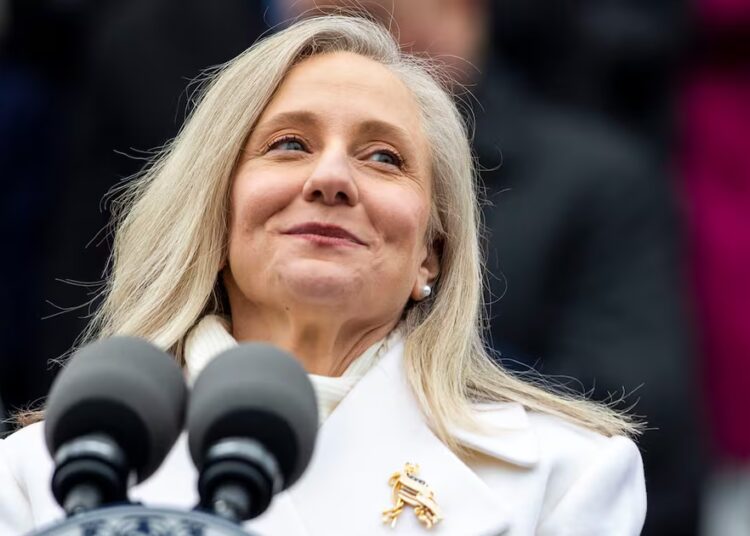
This June, like so many pop stars before her, Sabrina Carpenter graced the cover of Rolling Stone. She appeared nearly nude beneath a cascade of Rapunzel locks, in a sun-kissed portrait shot by the renowned photographer David LaChapelle.
As an astute connoisseur of pop’s past, Carpenter, 26, is likely familiar with LaChapelle’s most famous Rolling Stone cover: the one in which a 17-year-old Britney Spears wears a black push-up bra while lounging on fuchsia sheets, a purple Teletubby tucked under one arm. Carpenter didn’t experience that issue’s ensuing controversy in real time, though — because it came out a few weeks before she was born.
Carpenter is one example of what I’ll call the post-post-Britney pop star, one who cites Spears, now 44, as a formative influence with no firsthand memory of her rise. This year, a fresh cohort of post-post-Britney female artists — Carpenter, the TikTok influencer Tate McRae and the TikTok dancer turned electro-pop novice Addison Rae — signaled a subtle generational shift in pop’s mainstream.
Millennials like Taylor Swift (36), Beyoncé (44) and Lady Gaga (39) are all still enjoying refreshingly lengthy superstar runs, defiantly rebutting the sexist stereotype that a female pop act is past her prime once she is old enough to rent a car. But a rising class of Gen Z pop artists is also beginning to solidify, and its members share a demographic reality likely to make elder millennials shudder: None of them were alive when “ … Baby One More Time” came out.
Varied as their musical personalities are, the performers in this cohort have some other commonalities. All of them grew up online, at a time when the social internet was an inevitability — which means their digitized pasts and thoroughly archived former selves left visible trails. Videos of Carpenter hamming it up as a precocious child with uncanny comic timing, or of a 14-year-old McRae sharing an early foray into songwriting with the already established audience of her YouTube channel, are still easily accessible online, coexisting (somewhat unsettlingly) alongside more mature images of them as adults.
Because these ghosts of their adolescent selves live on online, the post-post-Britney pop star knows she must display a shrewd self-awareness of what it is like to be a young woman expressing her sexuality in public — projecting a de rigueur sense of empowerment while bemoaning society’s stubborn tendency to objectify female bodies. And so she has studied the tired, child-star-turned-sex-symbol career trajectory enough to know that all the hand-wringing is the culture’s problem, not hers. As Carpenter put it in a recent Variety profile, “It’s not my fault that I got a job when I was 12 and you won’t let me evolve.”
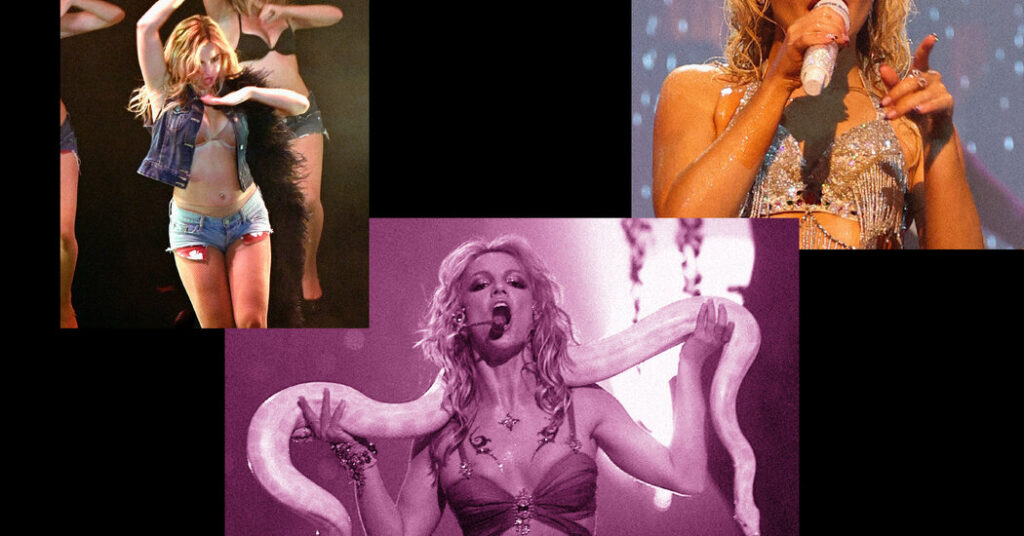
Like Spears, who was picked for the early ’90s iteration of “The Mickey Mouse Club” when she was 11, Carpenter’s big break came as a preteen when she was cast in 2014 as the wisecracking sidekick on Disney’s “Girl Meets World.” Perhaps as an acknowledgment of their shared career arcs, when Carpenter sang her risqué disco track “Tears” at this year’s MTV Video Music Awards, she seemed to pay homage to Spears. The performance ended with Carpenter dancing in the rain while wearing a gem-encrusted bra; fans were quick to interpret it as a nod to a memorable number from Spears’s 2001 Dream Within a Dream Tour.
Thanks in large part to this group of Gen Z stars, the nostalgic specter of Spears seemed to hover over the pop world this year like a glittering, benevolent fairy godmother. (The fact that a Spears biopic is reportedly in the works has also ramped up speculation about who should, or will, be cast to play her.) This too represented a shift: There was a time not long ago when Spears’s name would have been used to denigrate an up-and-coming pop star and imply that she was nothing more than a prepackaged automaton, or as a kind of cautionary tale of the price of fame. But — perhaps because they did not live through her earliest years in the public eye, and are too young to remember the darkest days of her celebrity — artists like Carpenter, Rae and McRae have all embraced Spears as a kind of trailblazing older-sister figure and a major aesthetic touchstone.
Spears’s influence is most direct in the 25-year-old Addison Rae (born the year of “Oops! … I Did It Again”), who, like Spears, is a bubbly, preternaturally telegenic blonde from rural Louisiana who got her start as a dancer. As she explained on an episode of The New York Times Popcast this June, Rae has idolized Spears for as long as she can remember. “It gave me a sense of this looming inspiration,” she said of her predecessor’s journey from Louisiana to Los Angeles. “Like, OK, she completely transformed her life, and she’s from this small town.”
Even before Rae made the leap from blandly appealing TikTok influencer to a post-“Brat” pop provocateur, she cultivated an aspirational connection to Spears: In a widely circulated and possibly staged paparazzi shot from 2023, she was photographed reading Spears’s memoir “The Woman in Me” while strolling around Beverly Hills. She’s also been seen wearing a graphic tee that reads, in all caps, “Calling Britney Spears a product doesn’t make you deep.”
When Rae released her surprisingly idiosyncratic debut LP, “Addison,” in June, it was clear that Spears was a major sonic influence, too. With Rae’s penchant for digital experimentalism and enough breathy vocals to fog up an entire glass house, “Addison” swirls together the aesthetics of Spears’s electro-pop “Blackout” era with the suggestive huff of her early aughts Neptunes-produced hits. (The video for Rae’s glimmering single “High Fashion” features multiple Spears references, including some cheeky product placement of her “Fantasy” perfume.) On Popcast, Rae cited Spears’s 2001 hit “I’m a Slave 4 U” as a touch point and called the singer’s famous, snake-draped V.M.A. iteration “obviously one of the best performances of all time.”
I also hear the slithery beats and whispery, come-hither sensuality of “I’m a Slave 4 U” all over “So Close to What,” the third album by McRae, 22 (she was born the same year that Spears released “Toxic”), and particularly on her irresistible hit “Sports Car.” (Yes, there are mash-ups.) McRae was a former contestant on a preteen season of the competition show “So You Think You Can Dance,” and her pop career had been simmering somewhere beneath the mainstream for a few years; her muted and moody 2022 debut, “I Used to Think I Could Fly,” was a somewhat uninspired attempt to introduce her as the next Billie Eilish.
But as McRae described it in a recent Rolling Stone profile, an aha-moment before her second album helped her find her identity as an artist: “I’m going to be a dancing pop star,” she declared. The kinetic music video and live performances that accompanied her 2023 breakout hit “Greedy” allowed McRae to express both sides of herself — and to begin garnering comparisons to Spears (which she has called “flattering and scary”). She made the connection in the clip for “Sports Car,” in which she dances with a silver chair nearly identical to the one Spears used in her “Stronger” video. This year, “So Close to What” cemented McRae’s staying power and proved her to be a sort of throwback pop star with a flair for acrobatic, turn-of-the-millennium choreography — including the art of the chair dance. Ironically, it was only through channeling her inner Britney that McRae became more herself.
In many ways, these young stars are paying homage to a decidedly idealized version of Spears and what she represented at the peak of her powers. While her musical and aesthetic influence was especially potent in 2025, Spears’s present reality complicated all of this glorified nostalgia. She continued posting somewhat inscrutable messages on Instagram. She briefly deleted her account entirely this fall, after her ex-husband Kevin Federline published a salacious book full of disturbing claims about her well-being.
Though she was released from the conservatorship overseeing her financial and personal affairs in 2021, Spears has been keeping her distance from the music industry. “I’m pretty traumatized for life,” she wrote on Instagram in 2022, adding that she “won’t probably perform again.”
Does the fact that younger pop stars want to emulate Spears mean that the lessons learned by her rise, fall and shaky reclamation of peace have already been forgotten? It’s probably too soon to say, but it’s just as likely that they have learned from Spears’s own struggles that kneejerk reactions to controversies about female pop stars’ sexuality usually do not age well.
Even though Carpenter, Rae and McRae did not live through “ … Baby One More Time” and its immediate aftermath, they did live through another crucial moment in Spears’s story: the more recent re-evaluation of how cruelly she and other young female celebrities of the early 2000s were treated. The publication and popularity of Spears’s 2023 memoir was a watershed moment, too, and Rae’s use of it as a prop signals her interest not just in Spears’s aesthetic, but in her story.
All three of these women also project a hard-fought sense of agency when it comes to crafting their own images, and an instinct to push back on criticism that blames the star, and not the system for her own objectification. McRae does as much in “Purple Lace Bra,” a moody but barbed track off her latest album that seethes to an insensitive man, or perhaps to society writ large, “You only listen when I’m undressed.” Similarly, in her Rolling Stone profile, Carpenter rejected the reductive idea that “all she does is sing about” sex. “But those are the songs that you’ve made popular,” she countered. “Clearly you love sex. You’re obsessed with it.”
The post-post-Britney pop star is not that innocent. But, she counters in a tone unafraid to rankle, neither are you.
Lindsay Zoladz is a pop music critic for The Times and writes the subscriber-only music newsletter The Amplifier.
The post Gen Z’s Pop Breakouts Danced in Britney Spears’s Footsteps in 2025 appeared first on New York Times.