A recent article in Art in America magazine offered readers a primer on “Five Essential Books About Anti-Fascist Art History.” Timing is everything, of course, as pundits debate whether our current era is actually fascist. But if you were to look around the art world today, who would be included, 50 years from now, in such a history?
Maybe Nicole Eisenman, whose powerful and unsettling exhibition “STY” at 52 Walker in TriBeCa includes sculpture, video, painting and drawings. It follows a retrospective of their work (the artist uses they/them pronouns) and a 2024 piece in Madison Square Park in which a toppled construction crane served as a small rejoinder to the supertall buildings proliferating in Manhattan.
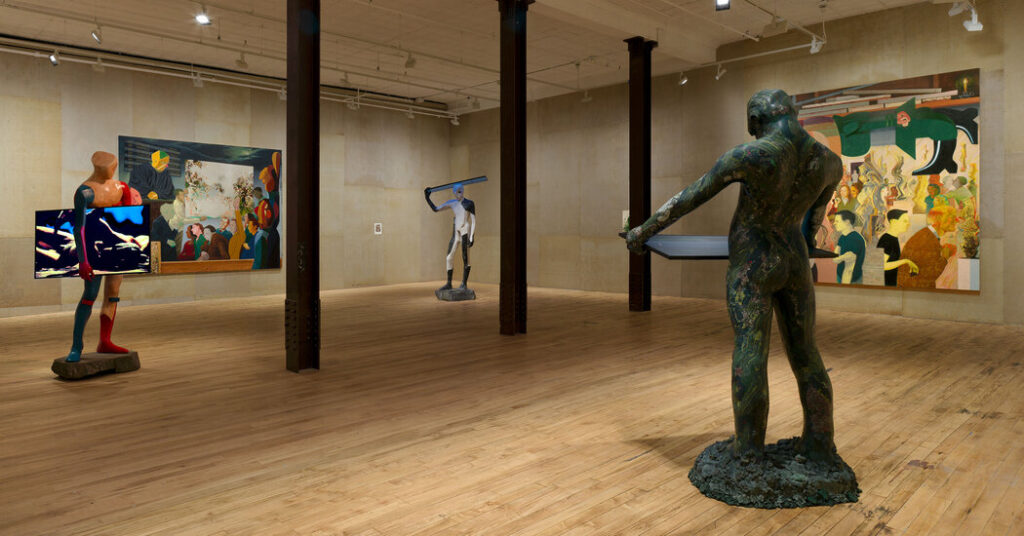
At 52 Walker, Eisenman returns to the subject with which they found fame in the 1990s: human — or humanoid — figures. The first things you see upon entering a specially constructed space in the gallery, lined with rough cellulose fiber on the walls, are three intimidating figures carved from scagliola, a plaster composite that imitates marble. The figures recall aliens and robots in 1950s science fiction films but also the fascist penchant in the 1920s and 1930s for neo-Classical sculptures with bulging muscles and oversize hands and feet. (The masked ICE agents currently deployed in many cities also could be a touchstone.)
Collectively titled “There I Was” (2025), the three figures also carry monitors running videos made with iPhones, science fiction and horror films, and imagery generated by artificial intelligence. One of the videos depicts a descent into a tunnel — or perhaps a bunker — its walls covered with cartoonish human silhouettes. Prehistoric cave art has become popular among contemporary artists looking at the origins of image making (or as an escape from the present), but Hitler’s bunker, where he holed up in the last days of his reign, also comes to mind.
The paintings in the exhibition, populated with figures inspired by art history as much as by hokey Americana, focus on the relationship between the artist and the collector and the role of the artist working under fascism. In “The Auction” (2025), an auctioneer wearing a black judge’s robe presides over a showroom. Nearby is a sheet torn out of a book and tacked on the wall, reproducing “For the Life of Me, I Can’t See Any Swastikas” (1984), an abstract painting by the German trickster artist Martin Kippenberger.
Kippenberger’s painting critiques how so-called radical abstract art often ignored or repressed politics. Meanwhile, across the room is “The Bunker” (2024-25), a painting featuring an angular cartoony figure wearing a beret — a cliché of artists, perhaps implicated under fascism.
More pointed references to art history appear in the painting “Archangel (The Visitors)” (2024). Here, Eisenman, 60, has reproduced the papier-mâché pig’s head stuffed into a German army uniform and called the “Prussian Archangel.” That sculpture appeared at the First International Dada Fair in Berlin in 1920.
In Eisenman’s painting, the archangel hovers over a gallery filled with visitors looking at abstract modern sculpture, while one reverent art viewer (and possible collector) has his pocket picked. Also in this painting is a detail from a photograph of Joseph Goebbels, the Nazi propaganda minister, viewing the 1937 “Degenerate Art” exhibition, the notorious show that tried to discredit avant-garde art and its antifascist leanings.
Three folders at the gallery’s front desk are filled with preparatory drawings, sketches, cartoons and photographs — gestures that underscore Eisenman’s alliance with 20th-century artists who critiqued war, imperialism and fascism and were targeted by figures like Goebbels.
Anyone following art-world politics over the last couple of years will know how this relates to Eisenman personally, as an artist who has vocally protested Israel’s military strikes in Gaza. For everyone else: In October 2023, Eisenman, along with dozens of other art world denizens, signed a public letter calling for a cease-fire in Gaza. Published in Artforum, the original letter made no mention of the Hamas-led massacre of Israelis on Oct. 7; the letter was later revised, with some, including Eisenman, removing their signatures.
The fallout from the letter was swift. Eisenman, who is Jewish, reported being pressured by collectors to retract support for Palestinians and had the “feeling of being threatened by people who I had thought of as allies in the art world.”
But the relationship between artists and their patrons is often fraught, whether it’s Michelangelo hiding from the Medici family after supporting a republican resistance in Florence, or the critic Clement Greenberg citing the “paradox” of avant-garde artists who are tied to “ruling class” patrons by “an umbilical cord of gold.” This relationship is revealed particularly in moments like the present, rife with military conflict and authoritarian governments.
Ultimately, Eisenman’s exhibition serves as a necessary exercise in soul searching. What is the role of the artist in dark times? What is the role of the critic, collector or average art viewer? Should they sit by and watch history unfold, or speak out and put themselves at risk? Eisenman sides with the Dadaists and other artists who have protested war and oppression. What about you, dear viewer?
STY Through Jan. 10 at 52 Walker, 52 Walker Street, Manhattan; 212-727-1961, 52walker.com.
The post Art on the Wall That Echoes Protests From the Streets appeared first on New York Times.