Earlier this month, when billionaire tech mogul Larry Ellison needed more money to bolster Paramount’s hostile takeover bid for Warner Bros. Discovery, he and his family turned to a lucrative source: Saudi Arabia.
The kingdom’s sovereign wealth fund backed a $24-billion financing package in support of Paramount Skydance’s $78-billion play for Warner, which had already accepted an offer from Netflix for its film and TV studio, HBO and HBO Max.
Less than a week earlier, it was reported the same sovereign fund would scoop up nearly all of Redwood City-based gaming giant Electronic Arts in a proposed $55-billion deal — the biggest leveraged buyout on record.
Saudi Arabia’s prominent role in some of the most consequential Hollywood deals in a generation is just the latest and perhaps the most audacious move by the kingdom to expand its footprint in the U.S. entertainment and sports arenas.
The deals underscore how dramatically Saudi Arabia has changed the narrative from only a few years ago, when it was deemed a pariah by many in Hollywood.
The gruesome murder of journalist Jamal Khashoggi seven years ago did little to dispel the kingdom’s image as a repressive theocracy, where beheadings in public squares took place and where, until 2018, women were prohibited from driving and movie theaters were banned.
Suddenly, however, the Saudis and — more specifically their money — are everywhere in the U.S. entertainment industry.
Inside the kingdom’s gilded palaces, industry players are mingling with princes and executives, while celebrities stroll red carpets at festivals, concerts and sporting events from Riyadh to Jeddah. Even Comcast Chairman Brian Roberts visited the kingdom last month, reportedly on theme park business.
The willingness to re-engage with the Saudis has has been driven by several forces, first and foremost: Hollywood’s insatiable need for new funding sources.
Studios have been squeezed on multiple fronts following the pandemic, strikes by actors and writers, media consolidation and upheaval caused by streaming. All of which has made the kingdom’s vast resources an enticing destination to bankroll film and TV projects.
“Hollywood has never been shy about taking other people’s money, and now they need it more than ever because of the completely new set of business challenges production companies are facing,” said Gabriel Kahn, a professor at the USC Annenberg School for Communication and Journalism.
Saudi Arabia itself has assiduously courted investment in U.S. sports and entertainment industries in a yearslong effort to soften its image and diversify its economy, which is heavily reliant on the oil industry.
Last year, 17.5 million movie tickets were sold worth $225 million in box office revenue, according to the Saudi Film Commission.
They want “to be part of this global cultural exchange, which they’ve never been part of before,” Kahn added. “That’s classic soft power.”
The political climate has also contributed to the high wattage normalization of Saudi Arabia.
The Trump administration has openly embraced Saudi Crown Prince Mohammed bin Salman. Trump recently hosted Bin Salman at a dinner at the White House attended by several notable entertainment and tech moguls, including his friend Larry Ellison, who is backing the Paramount bid led by his son, David.
President Trump‘s son-in-law Jared Kushner’s private equity firm, Affinity Partners, is part of the funding consortium for the massive EA deal.
“The stigma of some of their human rights abuses has worn off. [Executives] don’t care as much about Khashoggi, versus the need for funding,” said Andrew Leber, a nonresident scholar at the Carnegie Endowment for International Peace.
Rolling out the red carpet
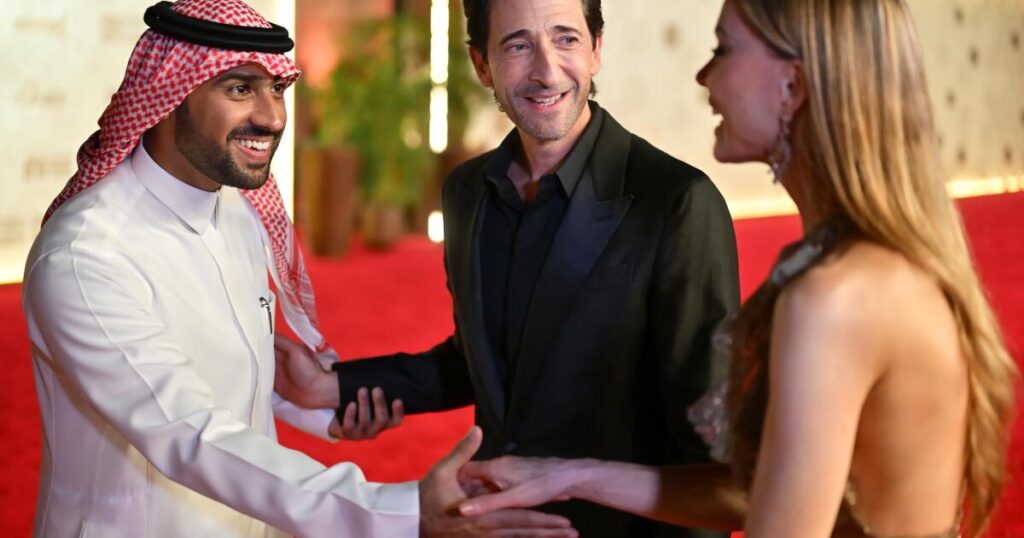
The new normal was apparent during the opening ceremony of this month’s Red Sea International Film Festival. Jury head Sean Baker, who won four Oscars last year, including best director, for “Anora,” said he was “incredibly excited” to be in the country, which he compared to the “early days of Hollywood.”
“As a cinephile whose world is movies, the leaps and bounds happening here are insightful, inspirational and heartwarming,” he said.
Baker joined a constellation of stars at the festival’s fifth edition that included two-time Oscar winner Adrien Brody as well as Kirsten Dunst, Vin Diesel and Queen Latifah. Michael Caine and Sigourney Weaver received tributes.
Representatives for those actors did not respond to requests for comment.
During the festival, many A-listers expressed their admiration for the event’s support of an array of voices and applauded the kingdom’s efforts to champion movie-making.
Actress Dakota Johnson said she felt “inspired” and praised the country’s movie business, saying it had “renewed my faith in cinema.”
While it is unclear how much this year’s attendees were paid, in past years it was reported that many earned seven figures. Director Spike Lee was said to have pulled down $3 million to head last year’s jury. Two years ago, Will Smith reportedly received $1 million, while Gwyneth Paltrow earned $1.6 million, according to her biographer Amy Odell.
A representative for the festival did not respond to specific questions about compensation for attendees, but said in a statement to The Times: “We on occasion engage with talent on a contractual basis for work we ask them to do at the festival, which includes labs, in conversations, mentorship sessions with emerging regional talent.”
“There’s definitely been some pushback,” said one publicist who was not authorized to speak publicly. “I have some clients that won’t go. But most of them, if you pay them enough money, they forget about human rights.”
The Red Sea Film Foundation — which runs the film festival and was founded by Prince Badr, the kingdom’s first culture minister — has increasingly played a role in financing Hollywood films, which has also helped secure splashy top talent to its red carpet.
Two years ago, the foundation announced investments in three films, including Michael Mann’s “Ferrari,” which had just premiered there.
The film, which cost $95 million, had a bumpy road to financing. Mann and his lead stars Adam Driver and Penélope Cruz took salary cuts to get the film made.
“At the 11th hour, Red Sea came in and gave him some finishing money for the film,” said an individual familiar with the film who was not authorized to speak publicly, adding, “that was sort of, OK, we do this and you’re going to try to make it to the festival.” Unable to attend that year, Mann was at the festival in 2024, where a special screening of his movie “Heat” was held.
A kingdom of opportunity
Saudi investment in Hollywood isn’t new. Prince Alwaleed bin Talal, whose grandfather was Saudi Arabia’s founding monarch, helped bail out Euro Disney in the 1990s and two decades later.
The kingdom’s latest push began in 2016, when Bin Salman launched the country’s ambitious modernization project: Vision 2030, to diversify the kingdom’s economy beyond oil and enact a spate of social and cultural reforms, with entertainment projects a high priority. It was a vision driven largely by the prince’s personal interests in movies, gaming and sports. As a child, Bin Salman (or MBS as he is more familiarly known) learned English by watching films.
The Saudis soon announced plans to spend $64 billion over several years on movies, cinemas and concert venues, with some $10 billion earmarked for movie investments.
Two years later, the first ever Saudi delegation arrived in Cannes, promoting its mission with the tagline: “A Kingdom of Opportunity.”
That spring, the crown prince went on a three-week charm offensive selling his vision of a reform-minded, post-oil Arabian paradise, meeting with power brokers in Washington, Wall Street, Silicon Valley and Hollywood.
In Los Angeles, producer Brian Grazer and his wife Veronica feted Bin Salman, alongside a galaxy of executives including Amazon’s Jeff Bezos, Disney’s Bob Iger, Patriots owner Robert Kraft, the late Kobe Bryant and Endeavor Chief Executive Ari Emanuel.
At Rupert Murdoch’s Bel-Air estate, the prince rubbed shoulders with then-Universal film Chairman Jeff Shell and actors Michael Douglas and Dwayne “The Rock” Johnson.
Soon after, Emanuel finalized a deal for Saudi’s wealth fund to take a 5% to 10% stake in Endeavor for $400 million. America’s largest movie theater company, AMC, also announced a partnership with the fund, through its subsidiary Seven, to launch cinemas in the kingdom.
The country celebrated ending its 35-year ban on movie theaters with a gala screening of “Black Panther” in Riyadh, with 500 invited guests. Men and women were allowed to sit together.
Six months later, however, the partnerships and growing relationship between Hollywood and Saudi Arabia unwound. Washington Post columnist Jamal Khashoggi was murdered inside the Saudi consulate in Istanbul at the hands of the crown prince’s operatives, according to U.S. intelligence. The prince has denied his involvement.
With Saudi Arabia’s reputation in tatters, proposed projects fell apart and promotional appearances were canceled. Most notably, Ari Emanuel pledged to sever ties with the kingdom and returned its $400-million investment.
Bin Salman, however, was determined to hold onto his Hollywood dreams.
The country continued to spend billions on cinemas, concerts and sporting events. It embarked on building Qiddiya, a planned entertainment and tourism megacity, three times the size of Paris.
In 2020, the kingdom’s sovereign wealth fund, known as the Public Investment Fund, made massive investments in Live Nation and Disney, purchasing shares worth $500 million in each. It later sold its stakes in both.
It spent more than $2 billion more to establish LIV Golf, a golf league to rival the PGA, poaching major players by offering them huge contracts like Phil Mickelson, who received $120 million. The Saudis are reportedly in the process of launching an international basketball league to compete with the NBA.
The WWE, one of the few entertainment ventures not to cut ties with the kingdom after the Khashoggi murder, recently announced that in 2027, WrestleMania will be held in Riyadh — the first time the professional wrestling giant’s signature pay-per-view match will take place outside of North America. WWE is part of the recently formed TKO Group, owned by Emanuel’s Endeavor.
The country began repairing its reputation in 2018, soft-launching its image with a multimillion-dollar marketing campaign. The Saudi tourism board, through a program called Gateway KSA, began inviting influencers and others to visit the country and post about their all-expenses-paid adventures.
While the initiative was met with criticism — influencers were blasted as propagandists who were whitewashing the kingdom’s various abuses — it had the desired effect of laying the groundwork for shifting perceptions.
Working with influencers
Influencer.com, a British marketing agency, began partnering with the Saudi Tourism Authority in 2019 to bring influencers to the kingdom. Between 2022 and 2023, it arranged trips for 300 content creators. “60% of the audience who viewed our campaign content would now consider booking a holiday to Saudi, when they hadn’t done before,” touted the company on its website.
The influencer brigade helped open the door for more celebrity visits.
In 2019, Victoria’s Secret model Alessandra Ambrosio and actors Ryan Phillippe, Ed Westwick and Armie Hammer attended the MDLBeast Soundstorm music festival.
Since then, the trickle of celebrities has become a flood.
This month, MDLBeast Soundstorm kicked off Coachella-caliber headliners like Post Malone and Swedish House Mafia alongside Benson Boone, Halsey, Pitbull and superstar dance acts including Anyma, DJ Snake and Calvin Harris.
“There’s not very much, if any, significant pushback in the music industry about performing in Saudi Arabia. It seems like it’s become easier to dismiss backlash as noise coming from online haters,” said Dave Brooks, head of live music and touring at Billboard.
“It’s been absolutely normalized,” said another top Hollywood publicist, referring to the parade of celebrities traveling to the kingdom. “It’s as though Mr. Khashoggi never existed.”
Saudi Arabia’s foothold in Hollywood got another leg up in October when former Lionsgate executive Erik Feig announced the launch of Arena SNK Studios, with $1 billion in financing to produce movies, TV, gaming and live events.
Feig declined to comment.
A person close to his company said the Saudi investment was appealing because of constraints on traditional Hollywood financing and because of Bin Salman’s enthusiasm for the movie business.
The current acceptance for Saudi Arabia and its money has been helped along by President Trump, who has made deepening relations with the kingdom a centerpiece of his administration.
During a White House visit by the crown prince last month (capped with a state dinner), Trump dismissed concerns about the Khashoggi murder during a press conference, blasting a reporter who asked about it, saying, “A lot of people didn’t like that gentleman that you’re talking about. Whether you like him or didn’t like him, things happen.”
Perhaps the clearest sign of the dramatic shift in the Hollywood-Riyadh relationship came in September, when a roster of comedians including Dave Chappelle, Kevin Hart, Bill Burr and Louis C.K. came under fire for headlining the 14-day Riyadh Comedy Festival, with many reportedly being paid $1 million and up to perform.
Free-speech advocates upbraided the comedians, who they said turned a blind eye to “cancel culture” and censorship by agreeing to avoid sensitive topics in their sets, including making jokes about Islam and the Saudi royals, in exchange for a big payday.
“How much cognitive dissonance can you sustain and which values do you care about? There are ways in which people rationalize it or just don’t think about it,” said the Carnegie Endowment’s Leber.
“From the folks that brought you 9/11,” blasted Marc Maron about his fellow funny men and women performing in Saudi Arabia.
But many of the participants pushed back. On “Real Time With Bill Maher,” Louis C.K. said it “just feels like a good opportunity. And I just feel like comedy is a great way to get in and start talking.”
Bill Burr denounced the criticism as “sanctimonious,” saying “everybody is phony about this stuff.”
The post Once a pariah, Saudi Arabia is now Hollywood’s hot cash source appeared first on Los Angeles Times.