It might seem a little stodgy for a group that glorified the spontaneous and the illogical to be celebrating its centenary. But remember that contradiction is baked into Surrealism’s bones.
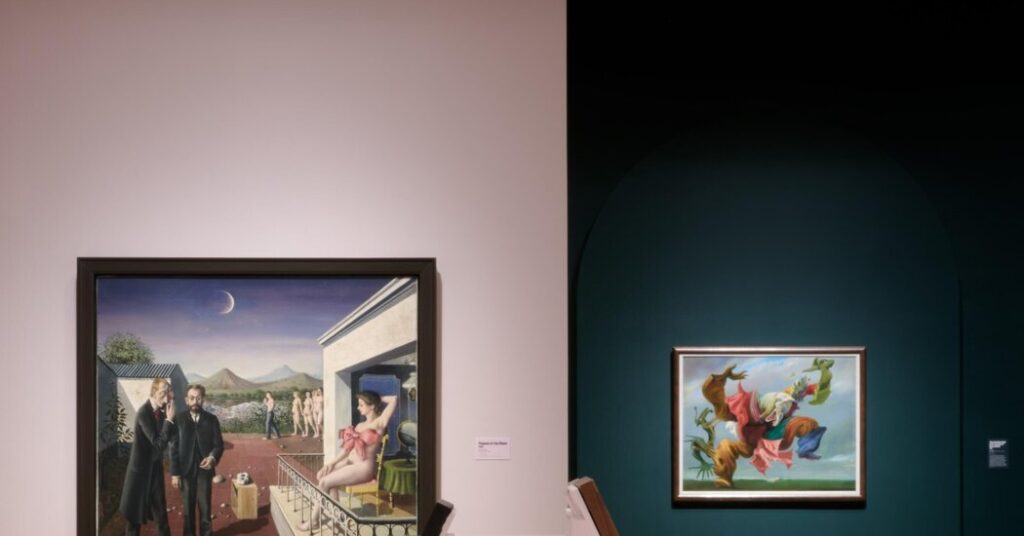
Today when people talk about the movement, they think first of visual artists, especially Salvador Dalí. and René Magritte. Both painters are represented in “Dreamworld: Surrealism at 100,” an ambitious exhibition at the Philadelphia Art Museum, its final (and only American) stop in a five-city tour that opened in Brussels in February 2024.
Very different from its previous iterations, the exhibition of nearly 200 works draws heavily on Philadelphia’s own superlative Surrealist holdings, the finest in an American museum, which are complemented by first-rate loans, many from the Pompidou Center in Paris. Handsomely installed by Philadelphia’s curator of modern art, Matthew Affron, with informative wall labels, the show is organized thematically to display topics that obsessed the Surrealists: visions that come in dreams, glimpses of the uncanny in the natural landscape, premonitions and consequences of World War II, the practice of magic, and, most of all, the inescapable pull of sexual desire. It’s a lot to cover, and while there are inevitable omissions (I looked in vain for the distinctive visions of Meret Oppenheim, Dora Maar and Wols), the sprawling show offers a lively overview of Surrealism’s achievements and shortcomings.
An outgrowth of the rambunctious, absurdist Dada movement that flared up in reaction to the First World War, Surrealism began as a literary project. There is something off-key in regarding Magritte’s solemnly witty illustrations and Dali’s finely detailed landscapes and creepy sexual jokes as the quintessential Surrealist works. By applying a painstaking craft to produce their hallucinatory images, these artists undermined the goal of directly untapping the unconscious, which André Breton laid out in the defining “Manifesto of Surrealism,” published in 1924 (the cause for the anniversary hoopla).
Breton’s initial mechanism for releasing the suppressed imagination was automatic writing, the skeins of words that unspool when men (the founding Surrealists were almost all men) descend into a dreamlike state with pen and paper at the ready. Although Breton later found ways to enlist visual artists in the cause, it was always an awkward fit, as some critics pointed out early on.
One fruitful approach to the disruption of rational order was collage, with its jarring juxtapositions. The German-born Max Ernst was a master of the medium, and two cutout assemblages (reproduced in his 1930 illustrated book, “A Little Girl Dreams of Taking the Veil,” which is also in the show) are standouts: a girl assaulted by doves in what looks like a gigantic slit drum lampshade; and a suited man seated at a table and drinking straight from a decanter, apparently unconcerned that he is metamorphosing into a clump of Turkey Tail tree mushrooms that are being broomed by a puff-cheeked angel.
Breton and his colleagues, most of them poets, reveled in incongruous mash-ups. They hoped to create something that, in the words of one of their patron saints, Isidore Ducasse — the self-styled Comte de Lautréamont, who died in 1870 at age 24 — would be “as beautiful as the chance encounter of a sewing machine and an umbrella on a dissecting table.” Their two favorite creatures, which they portrayed in word and image, were the Minotaur, with the head and tail of a bull and the body of a man, and the chimera, a composite of lion, goat and serpent. (Ernst had a particular fondness for chimeras and portrayed one in 1928, in a painting once owned by Breton, as an amalgamated stone sculpture of woman and bird.)
Central to Surrealist practice is the parlor game known as “exquisite corpse.” It began as a literary exercise in which the players would take turns writing on a sheet of paper, folding it to hide their contribution before passing it on. An early result — “The exquisite corpse will drink the new wine” — thrilled its intellectually inebriated participants and lent a name to the procedure.
The Surrealists then made the exquisite corpse visual, by folding a paper and having a different artist embellish a section without seeing what came before. There are several on display in the exhibition, including one from 1925 that Breton produced with, among other collaborators, Yves Tanguy, one of the best Surrealist painters. In order from top to bottom, it depicts a cartoon version of a woman, an anatomical drawing of a heart, a volcanic form striped with chevrons, and etiolated feet. A weird little scribble, it doesn’t add up to much, certainly nothing as evocative as the sentence that christened the game.
The Surrealists believed that in an artwork, the concept is more important than the execution. Too often, they forgot that when art becomes too schematic, it can’t provoke the revolutionary shift in consciousness that they desired. A Magritte painting of a woman whose head and upper chest have been peeled off like cardboard to reveal a dozen bells within a metallic cavity, or a Dali dreamscape of the head of a woman in which the lips have been replaced by a swarm of ants forming a labial pattern — for me, the literalness of those images closes off the imagination. Breton came to feel much the same way about Dali; in 1939, disgusted by the artist’s flirtation with fascism, he derided Dali’s “profound and absolute monotony” as nothing more than “entertainments on the level of crossword puzzles.”
Far more successful was Joan Miró, whose mysterious paintings, replete with fantastic creatures and abstract shapes, seem to have issued involuntarily from the depths of his mind. For that reason, in Breton’s judgment “he could perhaps pass for the most ‘surrealist’ of us all.” Miró had to work to create this effect, sometimes by making collages as studies, which he did for “Painting” (1933), one in a series that he produced that year. Beautifully colored, with biomorphic forms sporting hairy protuberances and concavities, both this canvas and “The Lovers” (1934) teeter between childlike naïveté and pornographic graffiti.
Surrealism took many cues from Freudian psychology; it seethes with sexuality, seeing the erotic in the everyday. A photographer could use lighting and framing to bring such subtexts to the surface in an instant, and no one did that better than Lee Miller. Two of her suggestive landscape photographs from the 1930s depict boulders that swell sensuously and pendulously, like breasts or buttocks. They are even more provocative (and sexy) than the distorted nudes that André Kertész made in 1933 with the help of a parabolic fun house mirror in an amusement park, or the elegant Brassai shot of a pair of metal scissors that resembles the torso of an African sculpture of a woman.
Grappling with politics by making tempestuous alliances with the Communist Party, the Surrealist movement navigated a tortuous path through the nightmare of mid-20th century world events, until the German occupation of Paris in 1940 forced most of the poets and artists to flee the city that had been its epicenter. (Notwithstanding its Parisian origins, Surrealism, as revealed in a splendid 2021 Metropolitan Museum show, by that time had already spread across the globe.)
The Philadelphia exhibition concludes by glimpsing how Surrealism coped with its wartime geographical displacement. Leonora Carrington, the British painter and novelist who moved from Paris to Mexico in 1942, is featured prominently. Six of her paintings are on display, including “The Pleasures of Dagobert,” with hybrid monsters indebted to Hieronymus Bosch; the picture set an auction record for the artist last year when it was purchased by the Argentine collector Eduardo Constantini for $28.5 million, with fees. (Carrington still lags behind another female Mexican painter, Frida Kahlo, who is represented in “Dreamworld” by a self-portrait; in November, another Kahlo self-portrait fetched $55 million at Sotheby’s.)
Carrington’s paintings face off with those of her good friend Remedios Varo, a Catalan who likewise was transplanted to Mexico City. A devotee of alchemy with a flair for rendering fantastical creatures, Varo produced exquisitely intricate images, including one, “Useless Science, or The Alchemist” (1955), of a woman whose cloak merges with a checkerboard floor as she turns a crank that, in a system as elaborate as one devised by Rube Goldberg, distills a mysterious liquid.
New York, like Mexico, was a place where Surrealists flocked during the war. In the exhibition, their influence on the artists who lived there is evident in youthful works by Jackson Pollock, Adolph Gottlieb and Mark Rothko, before these painters developed their signature styles, and a beautiful “Nude” (1946), by Arshile Gorky, which has a squiggly eroticism reminiscent of Mirò.
The first large Surrealist show after the war occurred at the Galerie Maeght in Paris in 1947. Many of its objects, most strikingly the sculptures, are reunited at the close of “Dreamworld.” Some are impressive, although by less familiar names: The Brazilian Maria Martins, the Romanian-French painter Jacques Hérold, Frederick Kiesler, the artist and architect who designed Peggy Guggenheim’s gallery; the Italian American Enrico Donati, who when he died at 99 in 2008 was said to have been the last of the Surrealists.
As typically happens, Surrealism as it aged became no longer a vanguard of revolutionary freedom but an establishment of its own. At the Venice Biennale in 1954, eminent figures of the first generation of Surrealists walked off with all the honors: Ernst won the grand prize for painting, Miró for printmaking and Jean Arp for sculpture. Breton accused Ernst of “commercialism” for accepting the award and excommunicated him, not for the first time, from the Surrealist movement. But the edict rang hollow. Surrealism was now a style, not a religion, and a retrograde style at that. New York had replaced Paris as the center of the art world, and Abstract Expressionists were in the forefront, painting with a gestural abandon that came much closer to what the Surrealists ardently championed: the automatic release of the unconscious mind.
Dreamworld: Surrealism at 100
Through Feb. 16 at the Philadelphia Art Museum, 2600 Benjamin Franklin Parkway, Philadelphia; 215-763-8100, visitpham.org.
The post Surrealism at 100, Sprawls and Seduces in Philadelphia appeared first on New York Times.