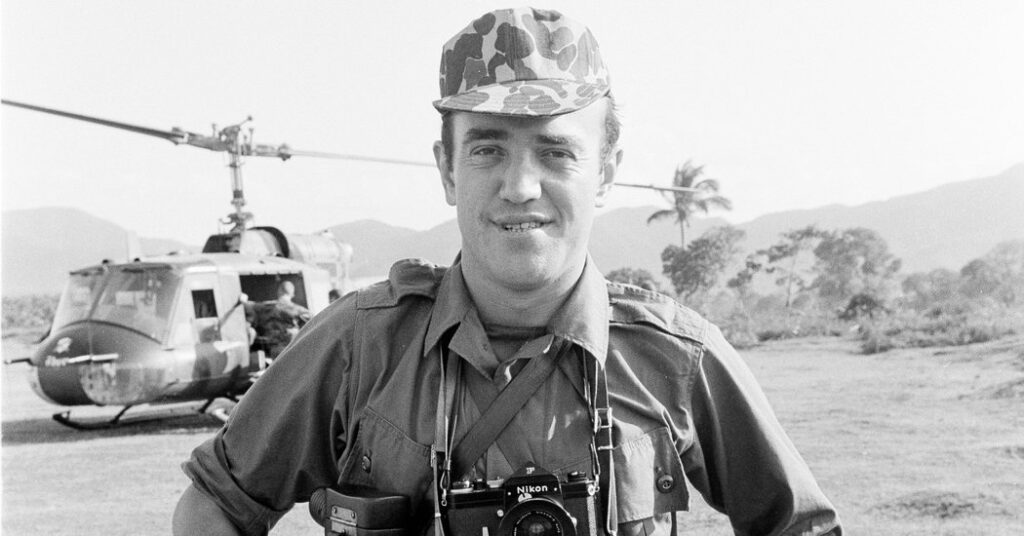
Peter Arnett, an intrepid Associated Press combat correspondent who won a Pulitzer Prize for coverage of the Vietnam War and became one of the world’s best-known television reporters on the scene of wars and insurrections for 18 years with CNN, died on Wednesday in Newport Beach, Calif. He was 91.
Mr. Arnett’s daughter, Elsa, confirmed his death and said the cause was prostate cancer.
From Vietnam’s jungles to war-torn Iraq, where he interviewed President Saddam Hussein and was twice among the last Western TV broadcasters in Baghdad — as the Persian Gulf War began in 1991 and as an American-led coalition invaded in 2003 — Mr. Arnett broke news and rules, infuriated national leaders and inspired generations of journalists.
Over 45 years, Mr. Arnett, by his own account, covered 17 wars in Asia, the Middle East, Europe and Latin America, first for The Associated Press and later for CNN and other television and print organizations. He made television documentaries, wrote two books, lectured widely and in 1997 interviewed Osama bin Laden, the leader of the Al Qaeda terrorist organization, somewhere in Afghanistan.
His first dispatch from a war zone was a scoop on a coup in Laos in 1960. When tanks blocked the telegraph office in the capital of Vientiane, he dived into the Mekong River and swam to Thailand to find an open wire to The A.P.
“The typed A.P. story, my passport and 20 $10 bills were clamped in my teeth,” he recalled in a memoir. “They thought me mad to swim the river, but at the time it made sense to me. I had to get the story out as fast as I could.”
Mr. Arnett was a renegade who defied authority, took calculated risks, distrusted officials and reached battlefields to see things for himself. He accepted foreign censorship to get stories, jettisoned objectivity when he felt it was called for, and was accused many times of reporting that sympathized with America’s enemies in Vietnam and Iraq.
Late in his career, Mr. Arnett ran into trouble for crossing journalistic lines of propriety. He left CNN in 1999 after reporting a Vietnam War atrocity that apparently never happened, and was fired by NBC in 2003 for claiming on Iraqi state television that the war plan of the American-led coalition against Iraq was failing.
A New Zealander, Mr. Arnett was a high school dropout who sought adventure in reporting and found his stride in Vietnam, where he worked for a decade and won the 1966 international-reporting Pulitzer for his coverage of the war, including a story about an American captain who watched helplessly as his troops were slain.
He was no Errol Flynn swashbuckler. “With a battle helmet drooping down over his ears, a battle jacket flapping about his thin and wiry body, and big combat boots encasing his short legs, he looked like a scarecrow thrust out in the middle of a wheat field,” John Hohenberg wrote in “The Pulitzer Prize Story II” (1980).
But he caught the essence of war. In bombed-out Ben Tre, once one of Vietnam’s loveliest cities, he quoted an American major in 1968, saying: “It became necessary to destroy the town to save it.” Although he never identified the source of the quotation and it was variously phrased later, the epigram about crushing an entrenched enemy regardless of civilian casualties became famous, symbolizing the contradictions of the war itself.
At a time when Washington was proclaiming victories and an ever-closer “light at the end of the tunnel,” Mr. Arnett reported time and again from the field that American and South Vietnamese troops had been overrun, challenging official accounts and presaging the failure of American policies.
President Lyndon B. Johnson and Gen. William Westmoreland, commander of the American forces in Vietnam, challenged Mr. Arnett’s reporting and tried unsuccessfully to have him removed.
Colleagues like David Halberstam and Neil Sheehan of The New York Times, and Malcolm W. Browne, The A.P. bureau chief in Saigon, defended Mr. Arnett as a dedicated reporter who wrote what he saw, with analysis, in eloquently simple language. Mr. Arnett’s account of the destruction of Bokinh and two other villages, published with his byline in The Times on June 1, 1969, was typical.
“For half a day, the fate of this hamlet and its two neighbors south of Saigon hung in the balance,” he wrote. “Would they live or die? The scales tipped when an American colonel, who was counseling restraint, was killed. The orders were sent, and fighter-bombers and artillery came in.”
The result: 19 civilians killed, 59 wounded and 385 homes destroyed. “Bokinh showed again,” Mr. Arnett said, “that while people are regarded as the key to victory in Vietnam, they become a secondary consideration when the choice is between saving them or securing a military objective.”
Mr. Arnett sometimes exceeded a journalist’s mandate. In 1972, he accompanied a group of American peace activists to Hanoi, North Vietnam’s capital, to bring home three prisoners of war. Defenders of American policy accused him of aiding the enemy cause.
As Saigon fell in 1975, the last Western civilians and reporters fled. But Mr. Arnett remained, filing stories on panic in the streets and chaos at the American Embassy as helicopters draped with refugees took off from the roof. After North Vietnam consolidated its victory, he continued to report on the transition to a reunified Vietnam.
In the late 1970s, Mr. Arnett, who became a naturalized American citizen, was a roving A.P. reporter in the United States, covering immigration, paramilitary groups and other issues.
In 1981, he joined CNN, then a start-up 24-hour-a-day news operation. Over the next decade, he covered wars in El Salvador, Lebanon, Afghanistan, Grenada and Angola. But it was the Persian Gulf War that forged a global reputation for CNN and Mr. Arnett.
He moved into the Al Rashid Hotel in Baghdad days before Operation Desert Storm began on Jan. 17, 1991. Most Western reporters had already left Baghdad on orders from employers. The rest — except for CNN’s crew — were expelled by Iraq. Then his CNN colleagues left voluntarily.
Mr. Arnett became the last Western reporter on the scene, the eyes and ears of millions around the world. He was unable to televise live pictures initially. But as air raid sirens wailed and bombs shook the city, his reports by telephone from his hotel room gripped audiences like the dramatic broadcasts of the CBS newsman Edward R. Murrow during the London Blitz of World War II.
For two weeks, until Western reporters and television crews were allowed to return to Iraq, Mr. Arnett’s exclusive reports, although censored, riveted worldwide audiences. Besides interviewing Mr. Hussein, he documented the hardships of Iraqis under the bombing, and the destruction of civilian shelters and other nonmilitary sites.
His coverage won many awards and the Overseas Press Club of America cited him for lifetime achievement. But critics, including dozens of congressmen, called him a mouthpiece for Mr. Hussein and an Iraqi sympathizer whose reports had endangered American lives. Mr. Arnett rejected the criticism, saying he had only reported the news.
Mr. Arnett’s filmed 90-minute interview with Osama bin Laden took place in a secret mountain redoubt in Afghanistan in March 1997, and was notable for bin Laden’s threats of jihad against the United States years before the terrorist attacks of Sept. 11, 2001. Asked about his plans, bin Laden replied: “You’ll see them and hear about them in the media, God willing.”
Mr. Arnett left CNN in 1999 after anchoring “Operation Tailwind,” a documentary that claimed the United States used poison sarin gas in a Laotian village in 1970 in an attempt to kill American defectors in the Vietnam War. After denials and protests by Washington, a CNN investigation found the allegations to be largely unsupported. CNN issued a retraction and fired nearly everyone involved in the program.
He was fired in 2003 for what he called “a stupid misjudgment.” As the American-led coalition invaded Iraq, Western news organizations ordered their staff out of Baghdad for safety. Mr. Arnett, with MSNBC’s National Geographic Explorer, and Richard Engel, freelancing for ABC News, chose to remain and were the last correspondents in Baghdad for the American networks.
Agreeing to be interviewed on Iraqi state television, Mr. Arnett compromised his reporter’s neutrality by hailing Iraqi morale and saying the allied war plan was failing “because of Iraqi resistance.” He apologized, but was quickly dismissed by NBC and National Geographic. His high-flying career went into a tailspin and, while he found jobs for several years, it never recovered.
Peter Gregg Arnett was born in Riverton, New Zealand, on Nov. 13, 1934, one of three sons of Eric and Jane (Gregg) Arnett. He dropped out of school at 17 to work for a daily paper in Invercargill, in the country’s south. After a hitch with the New Zealand Army, he joined The Wellington Standard, and 18 months later immigrated to Australia to work for The Sydney Sun.
In 1957, he boarded a Dutch tramp steamer for London, but disembarked in Thailand and for three years was an editor-reporter for the English-language Bangkok World. In 1961, he covered Laos and Indonesia as a part-time A.P. reporter, and in 1962 joined The A.P. in Saigon full-time.
In 1964, Mr. Arnett married a Vietnamese woman, Nina Nguyen. They had two children, Elsa and Andrew, then divorced after a long separation and were reconciled in 2006.
Mr. Arnett’s survivors include Nina Nguyen and their two children.
“Dateline Saigon,” a documentary by Thomas D. Herman, focused on five print journalists — the reporters Malcolm Browne, Peter Arnett, Neil Sheehan, David Halberstam and the photographer Horst Faas — as a band of brothers who questioned the American government’s official narrative of the Vietnam War.
Mr. Arnett, who lived in Fountain Valley, Calif., retired as a reporter in 2007. He later taught journalism at Shantou University in China. His memoirs were “Live from the Battlefield: From Vietnam to Baghdad, 35 years in the World’s War Zones” (1994), and “Saigon Has Fallen” (2015).
In a review of the first memoir, Jonathan Kirsch wrote in The Los Angeles Times: “Arnett’s book is, above all, a sharp reminder that the technology of journalism may change, but the qualities that make for good journalism do not. What really counts, Arnett shows in ‘Live from the Battlefield,’ are hustle, savvy, imagination, ingenuity and sheer physical courage, all of which Arnett possesses in abundance.”
Francesca Regalado contributed reporting.
Robert D. McFadden was a Times reporter for 63 years. In the last decade before his retirement in 2024 he wrote advance obituaries, which are prepared for notable people so they can be published quickly upon their deaths.
The post Peter Arnett, Pulitzer-Winning War Correspondent, Dies at 91 appeared first on New York Times.