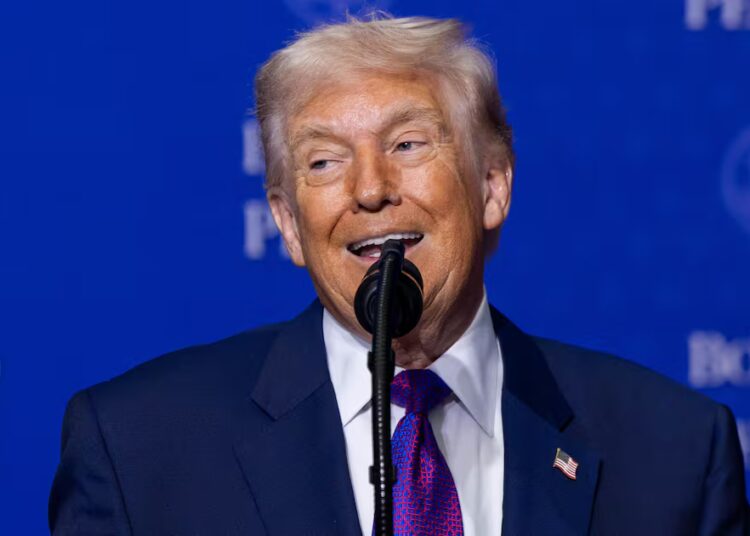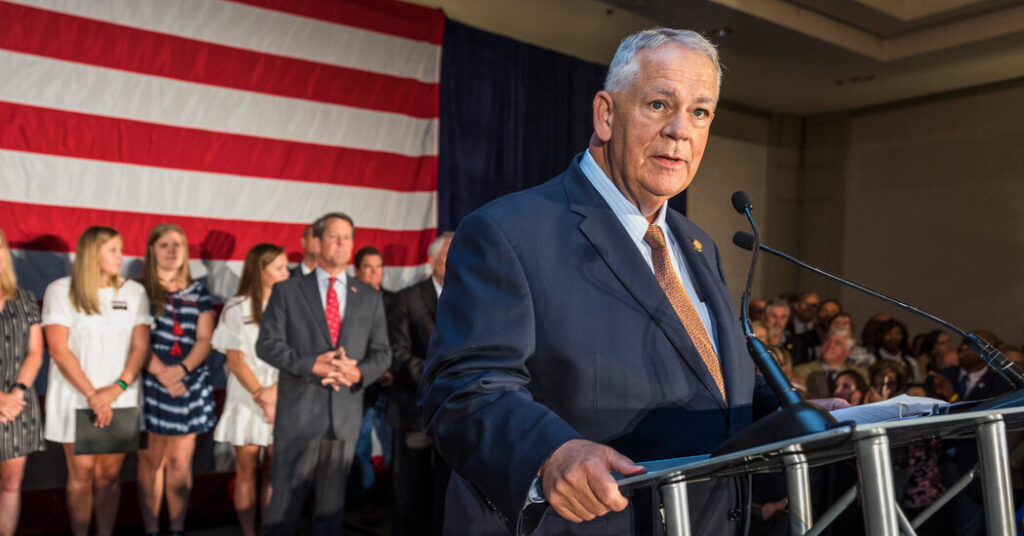
In a newly obtained recording of a phone call from late 2020, President Trump can be heard pressing the speaker of the Georgia House of Representatives to hold a special legislative session to overturn Mr. Trump’s election loss.
After citing false conspiracy theories of election fraud in Georgia, Mr. Trump told David Ralston, the speaker at the time, in the call on Dec. 7, 2020, that he could justify calling a special legislative session by saying it was “for transparency, and to uncover fraud.”
Mr. Trump added, “Who’s gonna stop you for that?”
Mr. Ralston, a Republican lawyer who died in 2022, responded with a chuckle, “A federal judge, possibly.”
The New York Times obtained a recording of the call on Wednesday. It is part of a trove of investigative documents generated in the recently dismissed criminal election interference case that was brought against Mr. Trump and 18 of his allies by Fani T. Willis, the district attorney in Fulton County, Ga.
A state judge last month dismissed the case, which focused on Mr. Trump’s efforts to stay in power after the 2020 election. Ms. Willis and her office had been removed from the case by the Georgia courts last year, following revelations that she had a romantic relationship with the lawyer she had hired to oversee it. The case met its final end on Nov. 26, when a replacement prosecutor determined that the charges should not have been brought.
During much of the 12.5-minute call with Mr. Ralston, Mr. Trump went through his claims that he had won Georgia, a state he lost by more than 11,000 votes that year. Some of his exaggerations baldly defied the reality on the ground.
“You know we won this thing by 400,000 or 500,000 votes,” he told Mr. Ralston. “Just like we did Alabama and every other state in the South. And, uh, we won, we won, we won your state massively. They took votes away.”
Mr. Trump referred to debunked conspiracy theories about voter fraud taking place at the State Farm Arena in Atlanta, where some claimed something nefarious was happening with ballots being stored in bins. He said in the call that votes were “coming out of suitcases, luggage, and it was a lot of votes. It was probably more than 100,000. You know they ran them through three or four times, you know, the same votes.”
It has long been known that Mr. Trump called Mr. Ralston, who held one of the most powerful positions in Georgia government, after the 2020 election to try to persuade him to convene a special session of the state legislature. The hope among Trump supporters was that lawmakers would be convinced of the fraud claims and vote to recognize a slate of pro-Trump electors, rather than electors for Joseph R. Biden Jr.
In 2023, the Atlanta Journal-Constitution reported that Mr. Ralston had recounted parts of the conversation to special grand jurors investigating the matter, including his recollection of the “federal judge” comment. And on the day after the Trump call, Mr. Ralston discussed it on an online show, saying the president’s idea of holding a special session was “very much an uphill battle.”
The call to Mr. Ralston was also mentioned in the indictment handed up by a grand jury in August 2023. It formed the basis for one of the numerous “overt acts” listed in the indictment as helping advance the alleged racketeering conspiracy to overturn the 2020 election.
And it was the basis for one of the original indictment’s other criminal charges against Mr. Trump: the crime of “solicitation of violation of oath by public officer.” (This charge was dismissed by the judge in the case in March 2024.)
But the precise language and tenor of the conversation were not known until now. The recording demonstrates the many ways in which Mr. Trump courted multiple Republican officials in Georgia as he sought to find a way to overcome his loss.
Trump Administration: Live Updates
Updated
- Trump unveils a presidential ‘Walk of Fame’ that takes jabs at Biden, Obama and Clinton.
- The Senate passes an air safety measure reversing a provision in the defense bill.
- ICE must allow lawmakers to inspect detention centers, a judge rules.
In a now-famous call with Brad Raffensperger, Georgia’s secretary of state, on Jan. 2, 2021, Mr. Trump said he wanted to “find” 11,780 votes — just enough to reverse the state results. He suggested that Mr. Raffensperger could be prosecuted criminally if he did not go along.
But in the call to Mr. Ralston, Mr. Trump mostly buddied up to a fellow Republican, trying to convince him that his political fortunes would rise if he did what Mr. Trump was suggesting.
“You’re popular now,” Mr. Trump said at one point in the recording, “but you’ll be more popular.”
Mr. Ralston appeared to entertain Mr. Trump’s pitch, though it’s not clear to what extent he had any intention of following through. He told the president that he had talked to Rudolph W. Giuliani, Mr. Trump’s personal lawyer at the time, and that his staff was studying the idea of a special session.
“We’re looking at it,” Mr. Ralston said on the call. “I mean Mr. President, I’ve, I have not signed up with the governor or the lieutenant governor on their public statements, which have blown off the idea of there being any kind of recourse, whether it’s special session or no.”
He was referring to Gov. Brian Kemp and Geoff Duncan, the lieutenant governor at the time, both of whom were resisting calls for a special session.
“I march to my own drummer,” Mr. Ralston continued, “and my own drummer says I want Donald Trump to remain the president. If there’s any way that we can possibly help in that regard, I’m on board.”
Ultimately, Mr. Ralston never publicly supported the idea of a special session.
Seventy-seven seconds of the call were redacted in the recording provided to The Times. It wasn’t immediately clear why, but a person with knowledge of the recording said they believed it happened around the time that Mr. Ralston’s office turned the recording over to Ms. Willis’s office.
The original indictment stated that Mr. Trump “importuned” Mr. Ralston to violate his oath of office by calling a special session of the state legislature “for the purpose of unlawfully appointing presidential electors from the State of Georgia.” Judge Scott McAfee of Fulton County Superior Court quashed the charge related to the call, arguing that prosecutors were not specific enough about what violations the defendants were pressuring public officials to commit.
But the call remained a part of the charge alleging that a racketeering conspiracy had been committed.
In the call, Mr. Trump appeared to direct Mr. Ralston on how a special session would play out: “If we had a special session, we will present, and you will say, ‘Here, it’s been massive fraud. We’re going to turn over the state.’”
Mr. Ralston, who hailed from the north Georgia mountains, often referred to himself as a “country lawyer.” But he was known as a sharp political operator keen on balancing the practical demands of the Georgia business community with the fervent conservatism of the Republican base.
In the recording, Mr. Ralston repeatedly voiced his support for Mr. Trump, but notably did not commit to a plan of action.
As it became clear that Mr. Trump was trailing in Georgia recounts in 2020, some of his allies in the State Senate called for a convening of a special session. In a joint statement issued on Dec. 7, 2020 — the date of Mr. Trump’s call to Mr. Ralston — Mr. Kemp and Mr. Duncan said that calling a special session “in order to select a separate slate of presidential electors is not an option that is allowed under state or federal law.”
That enraged Mr. Trump, who referred to Mr. Kemp as a “stone head” on the call with Mr. Ralston and said of Mr. Duncan, “what a jerk he is.” Despite Mr. Trump’s endorsement of an opponent, Mr. Kemp won re-election in 2022.
Five states pursued election-related inquiries after the 2020 election. They focused on efforts by Mr. Trump and his allies to deploy fake electors in seven states that he lost, and alternatively to see if state lawmakers might overturn the vote during special sessions.
While most of the inquiries have stalled or been dismissed, a Wisconsin judge ruled this week that felony charges against two Trump advisers should proceed to trial.
Richard Fausset, a Times reporter based in Atlanta, writes about the American South, focusing on politics, culture, race, poverty and criminal justice.
The post ‘Who’s Gonna Stop You?’ Listen to Trump Press Georgia Speaker Over 2020 Vote. appeared first on New York Times.