A quartet of politically vulnerable House Republicans rebelled on Wednesday against their own party’s refusal to address Affordable Care Act subsidies slated to expire at the end of the year, uniting with Democrats to grab control of the floor and tee up a bruising election-year battle over health care.
The revolt unfolded hours before the House passed a narrow G.O.P. health care bill that would allow the subsidies to expire, a result projected to send premiums soaring for millions of Americans. The bill would make a series of incremental changes not expected to have an immediate impact on costs.
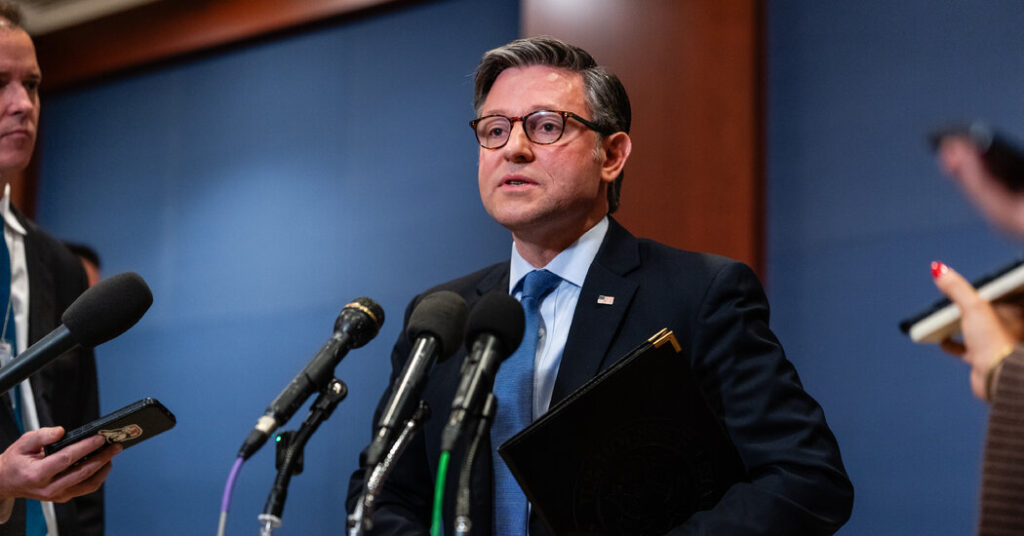
But the stunning maneuver by the splinter group of Republicans — moderates from competitive districts — effectively wrested control of the debate from Speaker Mike Johnson and the G.O.P., starting a clock that is expected to lead to an early January vote on reviving the subsidies.
That all but guaranteed to prolong Republican infighting over health care, an issue that has bedeviled the party for years, into a midterm election year in which the party is already facing considerable headwinds. And it will bolster Democrats, who spotlighted the expiring subsidies during the government shutdown fight and have repeatedly hammered the G.O.P. for failing to address soaring health care costs.
Several politically vulnerable Republicans had urged Speaker Mike Johnson to allow a vote to extend the subsidies, arguing they needed to show they were committed to avoiding premium hikes. Health care costs are set to spike for roughly 20 million Americans when the subsidies lapse.
Though Mr. Johnson initially appeared open to such a vote, he shut down that possibility on Tuesday amid conservative opposition. Frustrated with that outcome, Representatives Brian Fitzpatrick, Rob Bresnahan Jr. and Ryan Mackenzie, all of Pennsylvania, and Representative Mike Lawler of New York signed onto a Democratic effort to force a vote on a three-year extension of the subsidies.
Their signatures clinched a Democratic discharge petition pushed by the minority leader, Representative Hakeem Jeffries of New York, to go around Mr. Johnson and schedule action on the measure. It would not force a vote until after the subsidies have expired, and even if it were to succeed in the House, it would be all but certain to die in the Senate, where Republicans blocked a three-year extension last week.
But the Republicans’ maneuver meant that the House would have to weigh in within weeks on the issue, increasing the pressure on the G.O.P. to debate bolstering a key part of the Affordable Care Act, a law that most members of the party vehemently oppose.
“It’s inevitable that it comes to the floor for consideration,” Mr. Johnson said.
Though President Trump had vowed to come up with a health care policy, he has been virtually absent from the debate, leaving Republicans in Congress fighting among themselves while Democrats lay blame for rising health care costs at their feet.
Wednesday’s outcome appeared to vindicate a decision made by Mr. Jeffries to stick with Democrats’ maximalist demand — the full extension of the subsidies for three years — rather than endorse a bipartisan compromise that would have scaled them back.
In remarks on the House floor on Wednesday, Democrats savaged Republicans for allowing the subsidies to expire, and Mr. Jeffries urged Mr. Johnson to fast-track the vote to extend them rather than wait for it to be forced on him next year.
“Under no circumstances should we leave this Capitol this week before voting on an extension of the Affordable Care Act tax credit bill,” he said.
Republican backers of their party’s legislation, on the other hand, said that it would be wasteful to simply throw billions of dollars at propping up the Affordable Care Act, a system they charged was rife with fraud.
“It is a completely reckless and egregious thing to do as stewards of tax dollars,” Representative Jodey Arrington, the Texas Republican who chairs the Budget Committee, said of extending the subsidies.
The defection of the four Republicans on health care is the latest blow to Mr. Johnson’s grasp on the House floor as rank-and-file Republicans openly question his leadership and flout his wishes.
All four had been working on bipartisan measures that would extend the subsidies in some form. They had focused their efforts on shorter-term extensions than Democrats wanted, and their measures included eligibility restrictions that many Democrats had opposed.
Such efforts seemed destined to fail, given broad opposition to the subsidies from conservative Republicans. But the moderates hoped to get a vote that could give them political cover and show voters that they were working to avert the premium hikes.
“We have worked for months to craft a two-party solution to address these expiring health care credits,” Mr. Fitzpatrick said in a statement. “Our only request was a floor vote on this compromise, so that the American people’s voice could be heard on this issue. That request was rejected.”
Ultimately, Mr. Johnson refused to bring any of their measures to the floor, citing concerns over how to pay for extending the subsidies and over whether the measures should be subject to abortion restrictions sought by many conservatives.
That drove the Republicans seeking a vote into the arms of Democrats, whose discharge petition had been sitting at 214 signatures, short of the 218 needed to force action. In rapid succession on Wednesday morning, the four signed on, putting the effort over the top.
In a statement, Mr. Lawler made clear that his decision was meant as a signal to leaders that he wanted a vote on the issue, not that he supported Democrats’ proposal. “This procedural step is not an endorsement of the bill written,” he said.
The health care package that the House approved 216-211 on a nearly party-line vote, would still need to pass the Senate, where a bipartisan group has been working to find a compromise that could address the subsidies.
The bill included measures to let small businesses band together to buy insurance; new regulations on pharmacy benefit managers, the intermediary companies that help health plans administer prescription drug benefits; and the restoration of payments to health insurers that Mr. Trump canceled during his first term.
According to the Congressional Budget Office, a nonpartisan agency, the legislation could lead to 100,000 more Americans becoming uninsured by 2035.
Hours before voting on that bill, Mr. Johnson and his leadership team were still haggling with some defectors who were withholding their support to allow the legislation to even advance to the floor. At one point, as Representative Kevin Kiley of California was walking by, Mr. Johnson grabbed the sleeve of his suit to pull him into the discussion.
“I have been extremely critical of the House speaker for refusing to put any measure to extend these tax credits on the floor,” Mr. Kiley said later. He also accused Mr. Johnson of lying about negotiations.
But Mr. Kiley also criticized Mr. Jeffries for backing an “uncompromising measure” that had “no chance of becoming law” rather than supporting a bipartisan compromise. “This whole issue encapsulates what is wrong with this institution,” he said.
Though Republican leaders succeeded in bringing up their health care bill, one lawmaker who had been pressing for an extension of the subsidies, Representative Jen Kiggans of Virginia, voted against doing so, in yet another public display of discontent with Mr. Johnson’s leadership.
It was the latest evidence that the speaker’s grip on his fractious majority has slipped in recent weeks. The health care effort is the fourth discharge petition this year that has advanced after unhappy Republicans joined Democrats to circumvent the speaker.
Such actions were once rare in the House, with rank-and-file lawmakers afraid to publicly buck the speaker. The last time that four discharge petitions received 218 signatures in a single Congress was the 1937-38 session.
But Mr. Johnson insisted the defections were to be expected given Republicans’ slim majority.
“I have not lost control of the House,” he told reporters.
Carl Hulse contributed reporting.
Michael Gold covers Congress for The Times, with a focus on immigration policy and congressional oversight.
The post Republicans Clinch Democratic Bid to Force Vote on Health Subsidies appeared first on New York Times.