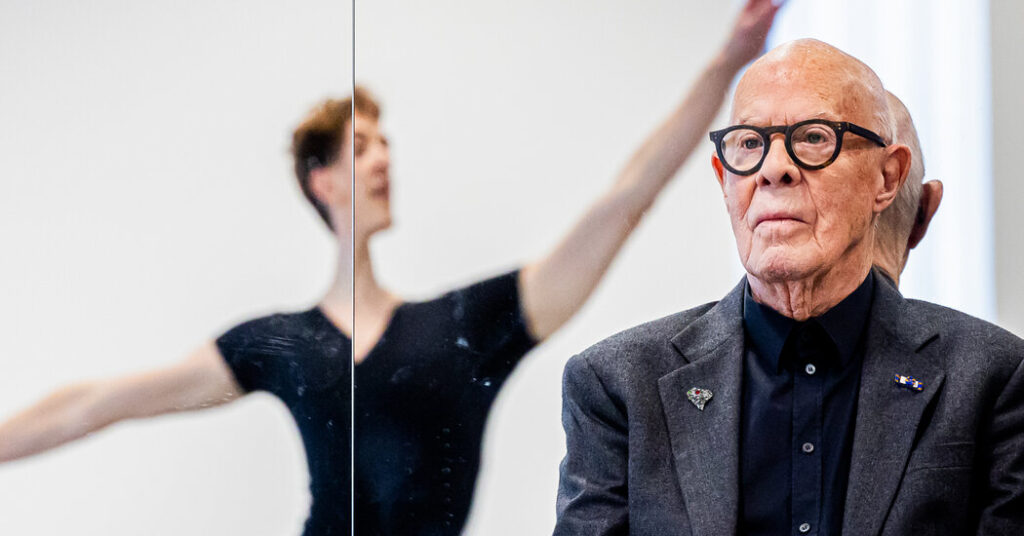
Hans van Manen, a former dancer who was chief choreographer of the Dutch National Ballet for more than 50 years, creating more than 150 avant-garde works for the company, died on Wednesday. He was 93.
His death was announced in a statement by Ted Brandsen, the director of Dutch National Ballet. It did not say where he died.
Mr. Van Manen fused classical ballet techniques and modern styles of movement in his choreography to create a spare, abstract style that earned him the nickname the Piet Mondrian of ballet. He was also labeled the Harold Pinter of dance — for his concise storytelling — as well as the Versace of dance, because his work was sometimes charged with homoeroticism.
None of the above quite applied, as Anna Kisselgoff, then the chief dance critic of The New York Times, observed in 1983. “He turns out, gratifyingly, to be his own man — the Hans van Manen of dance,” she wrote.
Throughout his career, Mr. van Manen had the distinction of serving as resident choreographer of the Netherlands’ two leading ballet companies: In addition to the Dutch National, in Amsterdam, he worked for Nederlands Dans Theater, in The Hague.
Outside the Netherlands, his dance pieces have been performed at a host of many major houses, including the English Royal Ballet, the San Francisco Ballet, the Stuttgart Ballet and the Alvin Ailey American Dance Theater in New York.
Mr. van Manen’s dance career, which began during the post-World War II avant-garde wave of the early 1950s, spanned eight decades. He continued to attend dance rehearsals and remained a visible presence in the Dutch cultural world into his 90s.
Hans Arthur Gerard van Manen was born on July 11, 1932, to Gustav and Marga (Lilienthal) van Manen in Nieuwer-Amstel, a suburb of Amsterdam known today as Amstelveen. His father had grown up in Germany, and his mother was a German citizen when they married in Germany in 1926. They had their first son, Guus, a year later, when they were both 19.
Facing financial hardships, the family moved to the Netherlands before Hans was born, and then at least a dozen more times before he was 5. His father earned what he could selling scrap metal and later found a job as a cosmetics salesman. When Hans was 5, his father died of tuberculosis, plunging the family into even greater poverty.
The older brother, Guus, a teenager by that time, left his family to live on his own, and Hans and his mother found an apartment in a building next door to the city theater, the Stadsschouwburg.
“The other two floors in that building were used by prostitutes, so it was actually a kind of brothel,” explained Sjeng Scheijen, author of a 2024 biography, “Gelukskind: Het leven van Hans van Manen” (“Lucky Child: The Life of Hans van Manen”). “From that point on, it becomes a Dickensian kind of story.”
Hans did odd jobs for “the ladies,” as he called them, to earn money for food and for wood to warm the house while his mother worked as a stenographer. During World War II, schools were often closed. “He was really a street kid,” Mr. Scheijen said. But he also found ways to bring himself joy.
“Ever since I was 7, all I wanted to do was dance,” Mr. van Manen said in an interview in 2018. “I would perform in the living room to live recordings from the Concertgebouw,” he said, referring to Amsterdam’s classical concert hall.
In the last year of World War II, a blockade of goods in the Netherlands led to famine, known as the Hunger Winter, and schools closed. Hans, at age 11, never went back, ending his formal education. But he would continue to broaden his cultural horizons through his work and personal connections for decades to come.
His mother arranged a job for him as an assistant to the hair and makeup artist who worked at the Stadsschouwburg. Hans enjoyed the work immensely, and at age 16 he won a national prize for hair and makeup.
Two years later, after seeing a rehearsal of the dance troupe Ballet Recital, led by the choreographer Sonia Gaskell, he asked if he could join them. Ms. Gaskell agreed to train him once a week, but they argued.
“She kicked him out after a few months,” Mr. Brandsen said in an interview for this obituary in 2024, “and she said, ‘You’ll never amount to anything.’”
Hans promptly went to study with another pioneer of Dutch modern ballet, Francoise Adret, director of the ballet of the Dutch National Opera.
Ms. Gaskell later invited Hans back, giving him his first opportunity to perform as a professional dancer in 1951. Four years later, he choreographed his debut ballet, “Olé, Olé, la Margarita,” for a revue mounted by the Dutch singer and actor Ramses Shaffy, in Amsterdam. The following year, he created his second work, “Swing,” for the Scapino Ballet of Rotterdam. His third piece, in 1957, for the Dutch National Ballet’s performance of the opera “Feestgericht” won the State Award for Choreography.
As a young artist, Mr. Van Manen was deeply influenced by a number of cultural figures who became his friends, among them the Dutch designer and artist Benno Premsela and the American photographer Robert Mapplethorpe.
Mr. Premsela gained notice for speaking openly about his homosexuality on national television in 1964, and Mr. van Manen, who had come out to his mother when he was a teenager, became active in the gay rights movement in the Netherlands.
In the 1970s, he met Henk van Dijk, a photographer and cameraman. They married in 1999, the year that gay marriage was legalized in the Netherlands. Mr. van Dijk survives him.
Throughout the years, Mr. van Manen maintained a circle of friends and collaborators that included the designer Keso Dekker, the photographer Erwin Olaf and the ballet dancer Rob van Woerkom.
After living briefly in Paris, where he worked with Roland Petit’s dance company, Mr. van Manen moved to The Hague in 1960 to join Nederlands Dans Theater, a new company that had been formed by two of Ms. Gaskell’s acolytes, the famed Dutch ballet couple Alexandra Radius and Han Ebbelaar. Mr. van Manen became its resident choreographer as well as a joint artistic director for the next decade.
Among his best-known ballets from that period was his 1963 ballet, “Symphony in Three Movements.” The ballet, the first of eight set to music by Stravinsky, is often described as his choreographic breakthrough. He then produced one ballet after another — a total of about 35 by 1971.
Mr. van Manen often cited George Balanchine as his greatest influence, but he also incorporated the contraction and release technique of Martha Graham, as well as more casual forms of popular dance, like the tap dances of Fred Astaire and Gene Kelly.
Mr. van Manen joined the Dutch National Ballet in 1973, taking up the post of resident choreographer and working alongside the artistic director Rudi van Dantzig. Ms. Radius and Mr. Ebbelaar were also principle dancers there at the time. Mr. van Manen’s successful ballets included “Adagio Hammerklavier,” from 1973, and “5 Tangos” (1977), both of which have been performed frequently since.
He returned to the Nederlands Dans Theater as its resident choreographer in 1987, staying until 2003, when he once again became resident choreographer of the National Ballet & Opera.
Over the years, Mr. van Manen won multiple awards for his choreography, including a lifetime achievement award, the Erasmus Prize, one of Europe’s most prestigious; the Grand Prix à la Carrière in France; and a Dutch royal decoration, Officer of the Order of Orange, bestowed in 2018 by King Willem-Alexander.
In 2023, the National Opera & Ballet hosted a dance festival to celebrate Mr. van Manen’s 90th birthday.
Even late in life, he remained a highly sociable participant in the dance world. Mr. Brandsen recalled a National Ballet international tour several years ago in which Mr. van Manen stayed up all night celebrating after a performance.
“Hans is a huge hero in Russia; they treat him like a god,” Mr. Brandsen said in 2024. “There was a reception afterwards, and when the bar closed at 2 a.m., he said, ‘Let’s go to my room.’ He was 87 or 88 years old at that time. I was like, I’m going to bed. They all went to his room, and they had a party till 4:30 in the morning. He’s amazing. He’s such a force of life.”
The post Hans van Manen, Celebrated Dutch Choreographer, Is Dead at 93 appeared first on New York Times.