The House on Wednesday rejected a pair of resolutions that would have forced President Trump to go to Congress for approval before attacking Venezuela and to continue his campaign of striking vessels in the Caribbean Sea and Pacific Ocean.
The mostly party-line votes came as lawmakers in both parties have expressed grave concern about the nature and legality of the boat strikes, as well as the administration’s lack of consultation with Congress about the offensive, and worries that Mr. Trump’s moves in the region could lead to a wider conflict.
It unfolded one day after the president ordered what he called a “complete blockade” on sanctioned oil tankers arriving and departing from Venezuela, an escalation of his administration’s pressure campaign against President Nicolás Maduro of Venezuela.
The votes were a victory for Mr. Trump and Speaker Mike Johnson, Republican of Louisiana, who have struggled to contain dissent within their conference and have taken extraordinary measures to avoid votes that directly challenge the president’s authority.
In forcing the House to weigh in on the matter, Representatives Jim McGovern of Massachusetts and Gregory W. Meeks of New York, both Democrats, invoked a provision of the 1973 War Powers Act, which requires that resolutions to terminate hostilities be considered under expedited procedures.
The resolution by Mr. Meeks, the top Democrat on the Foreign Affairs Committee, aimed to end the strikes against vessels in the Caribbean or Pacific “unless authorized by a declaration of war or a specific congressional authorization for use of military force.”
The United States has carried out at least 25 strikes on vessels accused of ferrying narcotics to U.S. shores since the campaign began in September, killing at least 95 people in the Caribbean and Pacific.
The measure offered by Mr. McGovern, a leading antiwar voice in Congress, sought to force the Trump administration to ask Congress for authorization to use military force before engaging in hostilities “within or against Venezuela.”
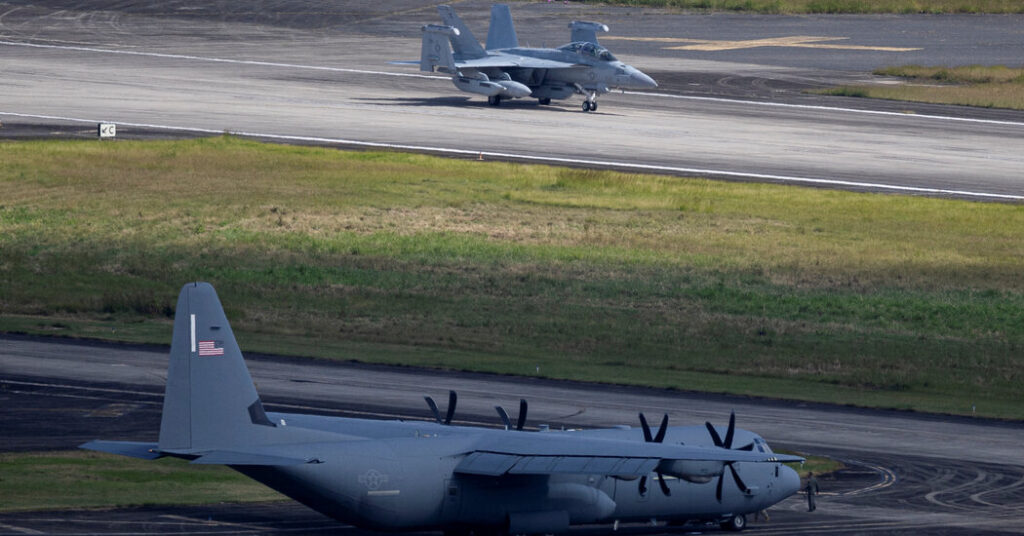
For months, the U.S. military has been building up a large naval force in the Caribbean as Mr. Trump continues to threaten to strike inside Venezuela. Tuesday’s announcement of a blockade appeared aimed at targeting a crucial economic lifeline to inflict more pain on the Maduro government.
“I do not want any war in Venezuela” Mr. McGovern said ahead of the vote. “I am deeply troubled by the idea of endless wars of America spending more of its treasure on wars that are not clearly defined,” he added, “at a time when we cannot even provide health care in this country”
Just two Republicans, Representatives Thomas Massie of Kentucky and Don Bacon of Nebraska, joined nearly all Democrats in backing the proposal to end the boat strikes, which was defeated on a 216-to-210 vote. Representatives Henry Cuellar and Vicente Gonzalez, both from Texas, were the only Democrats to vote against Mr. Meeks’s resolution. Mr. Bacon and Mr. Massie were joined by Representative Marjorie Taylor Greene of Georgia as the three Republicans backing the measure to bar an attack on Venezuela, which was rejected 213 to 211. Mr. Cuellar was the sole Democrat to reject it.
Armed with charts, graphic photos and stories of affected families, Republicans opposing the resolutions accused Democrats of ignoring the drug epidemic that kills thousands across the country.
“Democrats don’t want the president to be able to defend America,” Representative Brian Mast of Florida, the chairman of the House Foreign Affairs Committee, said ahead of the vote. “Even more tragic is the fact that nearly 80,000 Americans overdosed last year on fentanyl, cocaine, and other cartel-trafficked drugs. The Democrats don’t want to protect you from that, either.”
Democrats countered that they were trying to preserve Congress’s prerogative to maintain oversight authority over matters of war.
“There’s not a Democrat who doesn’t believe that 100,000 overdoses is an appalling outcome,” Representative Jim Himes of Connecticut, a Democrat, said from the House floor. “There’s not a Democrat here who doesn’t experience the crushing, disgusting horror of those losses. We couldn’t agree with the majority more that this is a huge problem. But what this is about is whether the representatives of the people should be involved in a discussion about how we solve this problem.”
Congressional oversight authority is what attracted at least some Republicans to support the measures. Mr. Massie, known for regularly breaking with his party, noted that Wednesday’s vote was not about whether the United States should be engaged in military operations in the region but about “reasserting the plain and simple language in the Constitution that Congress must decide questions of war.”
Mr. Bacon said that he supported the campaign and expressed confidence in the Pentagon officials carrying out the strikes, but said he believed that “continued hostilities does require congressional approval.”
“They’re doing appropriate work, they are stopping drugs from coming into our country, but I do think it needs congressional approval,” he said.
The outcome mirrored that of similar votes held earlier this fall in the Senate, reflecting reluctance among Republicans to challenge Mr. Trump and assert Congress’s authority over matters of war. Republicans maintained that this was not the moment to do so.
Representative Keith Self, Republican of Texas, called the measures “a dangerous limitation on the president’s constitutional authority to defend the United States.”
“Our world is changing, and changing fast,” he said. “The president must have the flexibility to change with the threats.”
Robert Jimison covers Congress for The Times, with a focus on defense issues and foreign policy.
The post House Rejects Measure to Bar Strikes Inside Venezuela appeared first on New York Times.