We’re nearly a year into President Trump’s second term and his unprecedented, wide-ranging and unpredictable campaign of retribution against his political opponents.
Our reporters have spent much of the year capturing the daily developments, the different tentacles and how Trump has wielded power unlike any modern president.
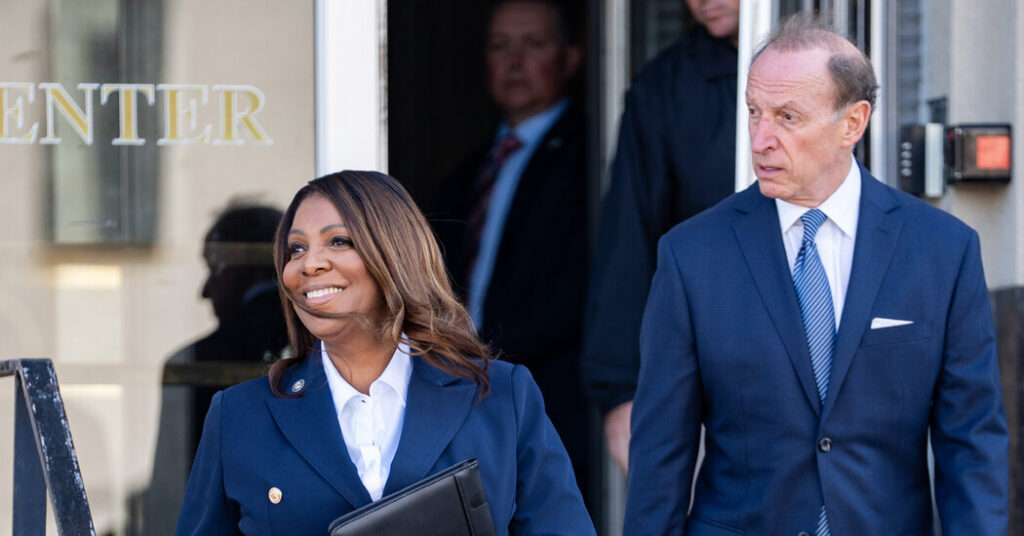
The brazenness of his effort was underscored on Tuesday when Vanity Fair published a series of interviews with the White House chief of staff, Susie Wiles, in which she acknowledged that Trump had engaged in “score settling” and that the prosecution of the New York attorney general, Letitia James, might amount to “retribution.”
But we’ve spent less time evaluating the overall success of Trump’s campaign and whether he is truly achieving his goal.
In some ways, Trump’s broader flexing of power has achieved what he set out to do. He has forced major institutions like universities and law firms that he sees as opposing him politically to fall into line, and he has made life more difficult for some of his real or perceived political opponents.
But his attempts to push prosecutions of rivals have been far less successful — and more complicated.
We’ve been covering this retribution campaign in Washington and New York all year, including in this newsletter. And tonight we’ll chat about where the effort stands.
Michael Schmidt: Trump has wanted to jail his rivals since his first term, but he couldn’t find anyone to do it. He promised to do it when he was running for his second term. And when he returned to power, he made it seem as if his aides and political appointees would follow through on whatever he wanted.
Jonah Bromwich: Yes, the fact that he’s pushed the Justice Department to pursue his adversaries is not surprising. But we did not really know how it would unfold. We’d never seen a president openly declare that he would seek retribution, so we had nothing to compare it to.
His first few weeks back in the White House were pure shock and awe. The administration looked as if it had endless momentum, and would be able to barrel through and achieve what it wanted — even putting the president’s rivals behind bars.
The Justice Department was being led by his former lawyers, who looked comfortable following his orders. And they set about firing prosecutors they were suspicious of or who had some involvement in the investigations that Trump didn’t like.
So it seemed initially that he would be able to exert influence to a remarkable extent.
Michael: It all looked as if it was falling into place so easily for him. When the law firms — led by Paul Weiss — bent the knee, he looked unstoppable. He put out executive orders targeting rivals, groups or institutions he saw as enemies. And he took away the security details for some former officials who had worked for him. That not only made his critics more vulnerable in terms of their security, but also sent a message to anyone considering crossing him that they could face extraordinary consequences.
But looking back, with the clarity of hindsight, we can see that there were signs of how it wasn’t all going to be so easy.
Jonah: Yeah. One of the first things Trump’s political appointees at the Justice Department tried to do was abandon a case against Eric Adams, the New York City mayor who had indicated that he was willing to help Trump crack down on illegal immigration. Trump’s political appointees succeeded in abandoning the case, but only after eight prosecutors resigned, creating a distracting furor.
Michael: Trump’s appointees at the Justice Department and the F.B.I. may have been directing investigations into his enemies, but time and time again, career prosecutors and even some of the president’s political appointees thwarted the inquiries and were unable to build criminal cases against his rivals.
Jonah: Trump’s appointees actually told Trump that they were going to be unable to deliver the indictments he wanted, and he didn’t like that, to put it lightly. In September, a clearly frustrated Trump publicly erupted, demanding that the U.S. attorney general prosecute three of his political opponents: James, Senator Adam Schiff of California, and the former F.B.I. director James Comey.
And Trump pushed out the U.S. attorney in Eastern District of Virginia, who had expressed skepticism of cases into Comey and James. The Justice Department quickly replaced him with a former Trump aide, Lindsey Halligan.
Michael: Sure, he hit that roadblock. But he quickly overcame it because by autumn, his Justice Department had indicted both Comey and James, delivering Trump a huge victory.
Jonah: Right, and that’s when the courts came in — and they did so more swiftly and decisively than we might have expected. Comey and James’s defense lawyers brought all kinds of challenges to the prosecutions. One of the things they said was that Halligan’s appointment was illegal. And a judge agreed with them and so, as quickly as the cases were brought, they were dismissed, and the Justice Department had to try to do it all over again.
So, there we saw that the haste that had Trump looking very powerful early in his term actually undid the cases.
Michael: Other parts of the criminal justice system also kicked into gear against Trump. After the case against James was tossed by the judge, the Justice Department twice brought indictments of her before a grand jury, and twice the grand jurors declined to indict. I can’t emphasize enough how unusual and extraordinary that it is.
All of us law enforcement reporters are taught that prosecutors can indict a ham sandwich. But we’re seeing that these checks — which were not thought to be particularly strong, and are not particularly strong — can still come into play when there are allegations that someone is seeking to abuse the system.
Jonah: The other really important takeaway, to me, is that it’s just not easy to invent a criminal case out of thin air. Even the folks leading the Justice Department, who have indicated they have few qualms about pursuing Trump’s opponents on his behalf, have had a hard time pushing cases without substance, because the process makes it difficult to do so.
Michael: If it turns out to be true over time that Trump cannot easily jail his rivals, it will have profound consequences for how we think about his power. It might also persuade the White House to push even harder in new and different ways against the rules as they currently stand.
But to bring it full circle: Wasn’t one reason for the retribution campaign that Trump wanted to put his enemies through what he believed was the injustice done to him?
Jonah: At the end of the day, the idea for Trump is revenge — to do unto others what had been done to him. And of course, he had always said he was targeted unfairly by his political opponents, specifically Joe Biden’s White House.
But the difficulties Trump has run into this year illuminate how hard it is to coordinate a prosecutorial campaign in that way.
Michael S. Schmidt is an investigative reporter for The Times covering Washington. His work focuses on tracking and explaining high-profile federal investigations.
The post Trump Finds That Retribution Isn’t Always So Easy appeared first on New York Times.