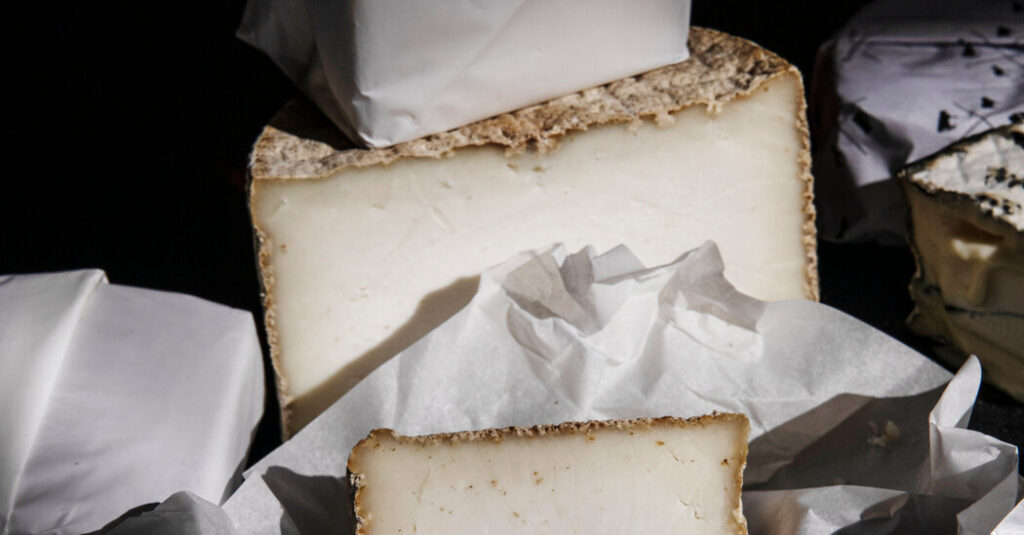
In a large new study published today, researchers found that eating high-fat cheese or cream was associated with a lower risk of developing dementia.
Cheese lovers may cheer. But be careful about celebrating with an entire block of your favorite Cheddar.
Cheese and cream are high in saturated fats, and nutrition guidelines have long recommended that people limit their consumption of such fats based on substantial evidence that they raise LDL, or “bad,” cholesterol and the risk of heart attack or stroke.
Recently, however, federal health officials have questioned this recommendation. Robert F. Kennedy Jr., the health secretary, has said that the next edition of the federal dietary guidelines, expected in early 2026, will overturn the longstanding advice to limit the fats and “stress the need to eat” them. Many experts are concerned that such a change could lead to an uptick in cardiovascular disease.
That said, there is some debate among scientists about whether full-fat dairy products increase health risks. The latest study adds to certain evidence that the foods may be neutral or even beneficial for health, including for dementia or cardiovascular disease. Such findings do not mean that saturated fats are healthy, but rather that other aspects of some dairy products may offset the potential harms of the fats, said Emily Sonestedt, a nutritional epidemiologist at Lund University in Sweden, who lead the new study.
But the new research was limited, experts said, and showed only associations between high-fat dairy and dementia, not cause and effect. We asked experts to help us unpack the findings.
What did the new research find?
The research, published in the journal Neurology, was one of the largest and longest studies to look at links between the consumption of dairy products and the risk of developing dementia, said Dr. Patricia Chocano-Bedoya, a physician and a nutritional epidemiologist at the University of Bern in Switzerland, who was not involved in the study.
In the 1990s, researchers recruited about 28,000 adults, age 45 to 73, in Sweden and collected information about their diets. Participants wrote down everything that they ate and drank for seven days, and completed a written questionnaire and an in-person interview.
Then, in 2014 and in 2020, the researchers looked at how many of the participants had developed dementia, based on medical information collected in a national registry in Sweden. And they looked at whether the participants’ consumption of different dairy products at the start of the study was related to their likelihood of developing dementia years later. In their analyses, the researchers controlled for other aspects of people’s health, such as whether they smoked or consumed alcohol or had high blood pressure or a family history of cardiovascular disease.
By 2020, about 10 percent of people who reported consuming at least 50 grams daily of high-fat cheese, like Cheddar, Brie or Gouda, had developed dementia, compared with 13 percent of people who consumed less than 15 grams daily. Fifty grams of cheese is about 1.8 ounces — a little more than the recommended U.S. serving size of 1.5 ounces, an amount in two sandwich-size slices of Cheddar cheese. (U.S. guidelines recommend that adults consume about three servings of dairy per day, with most choices being fat-free or low-fat.)
People who consumed at least 20 grams of high-fat cream (equivalent to about 1.3 tablespoons of heavy cream) daily were also less likely to develop dementia compared with people who did not consume cream at all, according to the study.
The researchers found no link between how much butter, milk, fermented milk, low-fat cheese or low-fat cream participants consumed and their likelihood of developing dementia.
The study had several limitations and should be “interpreted with caution,” said Dr. Tian-Shin Yeh, a physician and nutritional epidemiologist at Taipei Medical University in Taiwan, who wrote an editorial published alongside the new study. For one thing, the researchers assessed the participants’ diets just once, at the start of the study. People may have changed how they ate in the decades that followed.
The researchers conducted a “substitution analysis” to understand how swapping in more of one food (high-fat cheese, for example) in place of another affected participants’ risk for dementia. The results of this analysis showed that eating cheese instead of high-fat red meat or processed meat was associated with a lower risk of disease, Dr. Yeh said. That suggests that cheese may be a better option than those less healthy foods, but the study can’t show that it is “inherently neuroprotective,” she said.
The study did not examine the effects of substituting cheese for foods rich in healthy unsaturated fats, like fish, olive oil, nuts or seeds, Dr. Yeh said.
Is there something special about cheese?
Dr. Sonestedt acknowledged the limitations of the study, and she emphasized that the findings may not apply to a country like the United States, where much of the cheese consumed is processed, and a majority of it comes with foods like pizza, sandwiches and tacos.
But, she said, it’s possible that certain healthful components of cheese, like vitamins K or B12, or minerals like calcium, may confer benefits.
The findings shouldn’t be interpreted as giving saturated fats a pass, said Dierdre K. Tobias, an epidemiologist at Brigham and Women’s Hospital in Boston. Research consistently suggests that saturated fats are associated with long-term health risks, including for dementia, whereas unsaturated fats, such as those found in olive oil, canola oil, fish, nuts and seeds, are associated with a reduced risk.
And many of the studies that show full-fat dairy products are beneficial or neutral for health, including this latest one, fail to fully account for other aspects of participants’ diets, Dr. Tobias said.
Relative to many other foods in people’s diets — like those high in refined carbohydrates, for example — full-fat dairy products may appear to be better, or at least not worse, for health, she said. But when researchers have compared full-fat dairy products to foods like whole grains, olive oil, legumes or nuts, those foods are consistently associated with better health, she said.
What’s the bottom line?
People shouldn’t necessarily eat more cheese because of the results of this study, Dr. Sonestedt said. But it does suggest that, in moderation, cheese can be a part of a healthy diet.
Still, there are better foods for brain health, said Dr. Yeh. Research consistently suggests that following a plant-rich diet, like the Mediterranean or MIND diets, can reduce your risk of cognitive decline. That means consuming lots of fruits, vegetables, legumes, whole grains, nuts and seeds, and healthy fats like those found in olive oil and fish, she said.
Alice Callahan is a Times reporter covering nutrition and health. She has a Ph.D. in nutrition from the University of California, Davis.
The post A Study Linked Cheese to Lower Dementia Risk. Is That Too Good to Be True? appeared first on New York Times.