The Las Vegas Museum of Art has revealed new key details of Pritzker Prize-winning architect Diébédo Francis Kéré’s design for the city’s first freestanding museum, which is expected to break ground in 2027.
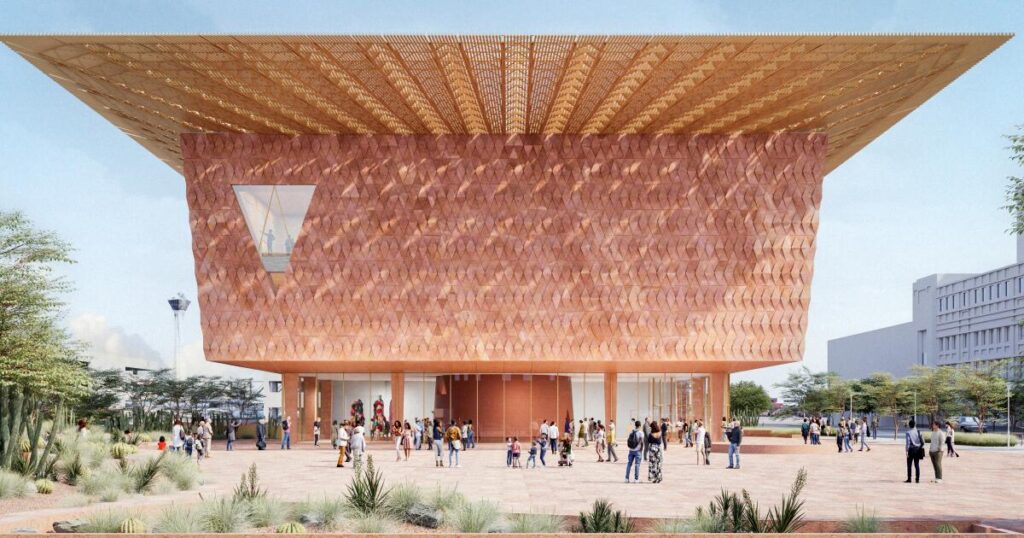
The earthy red structure will feature a facade of locally sourced stone, and was inspired by the canyons and red rock landscape that stretches beyond the brash, man-made playground of Sin City, Kéré said in an interview alongside the museum’s executive director, Heather Harmon.
“How can I use what is surrounding Las Vegas to create something open and welcoming?” he said. “We started to think about the subtle beauty of the nature, and to bring it into the core of the museum.”
Renderings of the structure, which is situated in Symphony Park, show a cubed modernist building with a large awning that stretches over a bustling entry plaza to provide shade. A curved grand entrance staircase spirals through the center of the museum and is visible from the building’s floor-to-ceiling windows. Cloistered second-floor galleries are meant to provide a peaceful sanctuary for taking in the art.
Architect Paul R. Williams’ Guardian Angel Cathedral, which opened in the city in 1963, is cited as a design influence, as are the singular stocky trunk baobab trees of the African savanna. Kéré was born in the village of Gando in the West African country of Burkina Faso, and noted that although the natural environment of his home country is quite different from that of Las Vegas, he was able to find many design parallels for inspiration.
Kéré, who is also a professor at Yale in New Haven, Conn., has made many trips to Las Vegas over the last few years, and received personalized tours of the city and its natural surroundings from Harmon and Elaine Wynn, a museum board member and philanthropist who died in April.
They went to the Valley of Fire State Park, which features fantastical sandstone formations the same color as the museum’s renderings. They also saw various quarries as well as the Hoover Dam. In the city, they visited the west side, which is rooted in the city’s rich African American history, as well as Ward 3 on the east side, which is home to a large Latino population.
“We looked at community spaces, we looked at people in community spaces,” said Harmon. “And we really wanted to have that feeling of understanding as we approached the project — just knowing firsthand who we were building the museum for.”
The 60,000-square-foot building is expected to welcome more than 2.4 million year-round Las Vegas residents, as well as millions of global tourists. The museum is expected to cost about $200 million, including its endowment. The target opening date is in 2029.
Last year, the Los Angeles County Museum of Art announced it would share its collection with the Vegas museum, which does not have plans to become a collecting institution. LACMA director and LVMA founding trustee Michael Govan told The Times that the sharing arrangement is part of a paradigm shift for LACMA, allowing it to expand access to its collection without increasing the physical footprint of its home base. (Critics, including former Times art critic Christopher Knight, disagreed with the move.)
“I think that’s a very 20th century idea — to keep adding wings until you’re a million square feet on Fifth Avenue,” Govan said in an interview at the time.
The post Architect Francis Kéré’s design for the Las Vegas Museum of Art takes shape appeared first on Los Angeles Times.