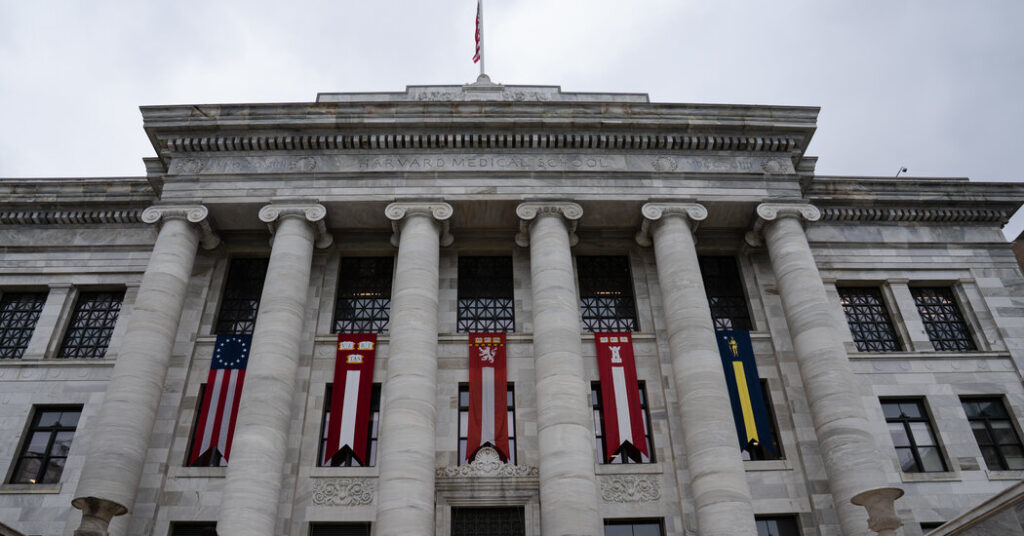
A former manager of the morgue at Harvard Medical School who stole body parts that had been donated for research and sold them for thousands of dollars was sentenced on Tuesday to eight years in prison.
The former Harvard employee, Cedric Lodge, 58, and his wife, Denise Lodge, 65, stole and sold human remains to several people, who ultimately resold the body parts for a profit, including to at least one woman who described herself as a collector of oddities, prosecutors said.
Chief Judge Matthew W. Brann of the Middle District of Pennsylvania on Tuesday sentenced Mr. Lodge and Ms. Lodge, of Goffstown, N.H., on charges of interstate transport of stolen human remains, which included dissected heads, organs and brains. Ms. Lodge received 12 months and one day in prison.
Lawyers for the couple did not immediately respond to requests for comment. Both pleaded guilty earlier this year.
From 2018 to at least March 2020, the Lodges made thousands of dollars from the sale of parts that Mr. Lodge took from donated cadavers that had been intended for research and teaching purposes.
The remains were supposed to be disposed of in keeping with Harvard’s Anatomical Gift Program agreement with donors, who typically elected to either have their remains returned to a designated person, cremated and given to a designee, or cremated and buried in a Harvard memorial plot, according to court documents. Instead, Mr. Lodge brought the remains to his home in New Hampshire.
The Lodges would then ship the parts to buyers they found on websites, including Facebook, according to the government’s sentencing memorandum for Mr. Lodge. Some buyers would collect the parts in person.
In May 2018, Ms. Lodge shipped 24 hands, two feet, nine spines, a partial skull and two skull caps to one buyer, who paid $3,050, according to the sentencing memorandum. In February and March 2019, she shipped two heads, for $1,725, and five faces to the same buyer for $2,300.
The couple made between $40,000 and $95,000 from the sales, according to court documents.
The daughter of a person whose body was donated said in the sentencing document that “this corruption transcends the bodily level and extends into the realm of memory.”
“It will likely be a long time, if ever,” she said, until she could look at a photo of her father “and not have thoughts like, did he still have his head? Did they sell his herculean right hand? Were the skin of his tattoos made into cushions?”
She added: “Whether the answer is yes or no is not the issue so much as the families have had to go to that space with the real anxiety and pain such gruesome questions inflict.”
Harvard sent letters in June and July 2023 to the next of kin of about 400 donors who may have been subject to Mr. Lodge’s conduct, according to the sentencing memorandum. Mr. Lodge worked at Harvard from 1995 until he was fired in 2023.
Ms. Lodge had Stage 4 breast cancer, according to court documents, and the couple looked after her daughter, who had delayed intellectual functioning. They have been married for nearly 25 years.
Seven other people identified in court documents have entered guilty pleas in related cases. Some have been sentenced to prison, and others are awaiting sentencing.
Earlier this month, Katrina Maclean, the owner of a store called Kat’s Creepy Creations in Peabody, Mass., pleaded guilty to trafficking stolen human remains. Mr. Lodge sold body parts to Ms. Maclean, including skin that she planned to have tanned into leather and bound into a book, according to the sentencing memorandum.
In March, Ms. Maclean’s lawyer filed a motion seeking to have the charges against her dismissed, saying that she was part of a “legal, nationwide oddities community that collects body parts.”
During the investigation, prosecutors also learned of an apprentice mortician in Arkansas, Candace Chapman Scott, who stole human remains from the mortuary where she worked and sold them. In January, she was sentenced to 15 years in prison.
Mr. Lodge acted without the knowledge or permission of Harvard Medical School or the donors’ loved ones, the school and the prosecutors said. In a statement on Wednesday, Harvard Medical School said that Mr. Lodge’s actions had been “abhorrent and inconsistent with the standards and values that Harvard, our anatomical donors, and their loved ones expect and deserve.”
“While Lodge’s sentencing concludes the criminal case against him, the process of healing from the pain he caused continues,” the statement said. “Our Anatomical Gift Program relies on the deep, selfless commitment of individual donors and their families to provide essential educational opportunities to medical students, surgeons, pharmacists and many allied health professionals. We reaffirm our deep sorrow for the families of donors who may have been impacted.”
The Federal Bureau of Investigation, the United States Postal Inspection Service and the East Pennsboro Township Police Department investigated the case.
“The trafficking of stolen human remains through the U.S. mail is a disturbing act that victimizes already grieving families while also creating a potentially hazardous situation for postal employees and customers,” Christopher Nielsen, the inspector in charge of the Philadelphia division of the Postal Inspection Service, said in a statement.
Amanda Holpuch covers breaking news and other topics.
The post Ex-Harvard Medical Morgue Manager Who Sold Body Parts Gets 8-Year Sentence appeared first on New York Times.