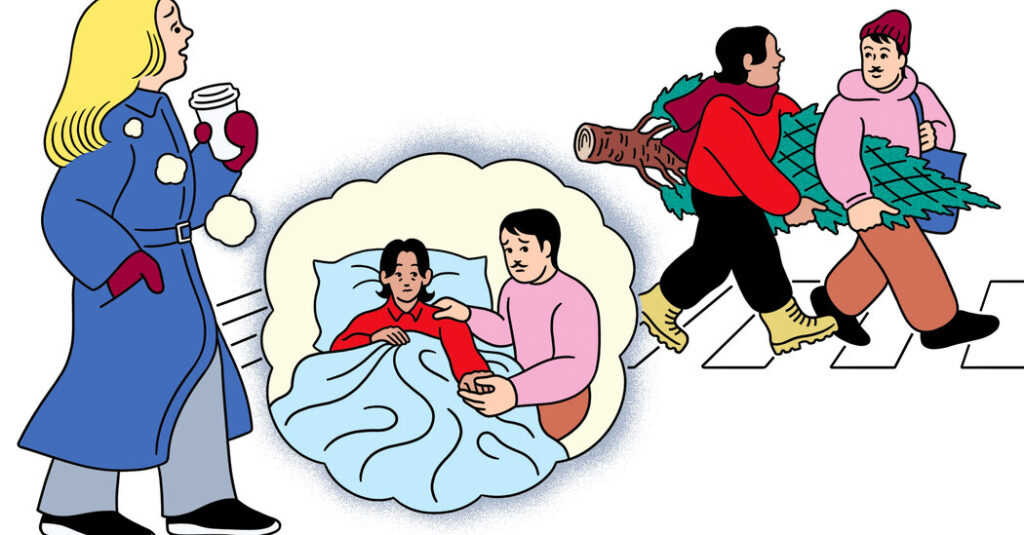
Last summer, I was dating a man in our weekender community outside New York City who seemed like a wonderful guy. A month after we became intimate, he told me that he was married but that he had been separated from his wife for a year. He explained that the reason he has not gotten a divorce is that she has cancer and is on his health insurance. He said she had just had surgery and was recovering. Naturally I felt compassion and said I wouldn’t push him. Eventually, I ended the relationship, because I started feeling I wasn’t getting the full story. When I mentioned our relationship to a friend who also knows him, I learned that my instincts were correct. Apparently, he is very much still with his wife, and she is healthy. I am so shocked by this. Should I contact his wife and let her know this is what he is doing and saying? Given that they are both journalists, I would think veracity would be a priority. — Name Withheld
From the Ethicist:
This man wronged you, not least by making you an unwitting accomplice to his betrayal of his wife. Your anger is justified. But justified anger isn’t necessarily a good guide to justified action. If you want to tell his wife in order to wound him, you’re being driven by revenge, a sentiment that rarely improves the moral situation. Nor should you be spurred by guilt. He was the deceiver, not you.
Let’s be clear: He forfeited any claim to your discretion when he lied to you so extensively. And if this is a pattern with him, sharing your experience among your mutual acquaintances could spare others the same pain. We can agree, too, that his wife is entitled to know the truth about her husband. But that doesn’t mean you are the one who should deliver it. You might ask yourself what you hope to accomplish. If she’s unaware of the episode, your disclosure could upend her life; if she already knows, this couple may have reached a truce.
As for your reference to journalism: People’s adherence to professional ethics doesn’t necessarily align with virtue in their personal dealings. (Character traits don’t work in that “global” way, social psychologists tend to think.) The issue is irrelevant to your situation. The question for you is whether you want to remain entangled with this man by intervening directly in his marriage. You can’t make him honest, but you don’t have to let his dishonesty define your life.
A Bonus Question
My lovely, generous neighbors gave me a ticket to a local theater production, which I happily accepted. The show was terrible, but I was still happy for the evening out. Of course I thanked them for the gift, but must I also lie and say the show was great, or even good? — Name Withheld
From the Ethicist:
Certainly not. You can be gracious without actually deceiving your kind neighbors. One true thing you can say is that you were happy for the evening out. And given that you were, you can probably say that you enjoyed yourself. If you’re glad that there are people producing plays in your community, you can say that too. I realize that small lies ease social life, and at times they can’t be avoided without cruelty. Still, they carry a cost. The more of these lies we tell, the harder it becomes to trust the nice things we say when we truly mean them.
Readers Respond
The previous question was from a reader who wanted to stop giving financial support to his adult son unless he had a vasectomy. He wrote:
My wife and I have a 24-year-old son, our only child. He was different from the start. … By high school he was doing respectably and taking medication for his attention issues. This changed during his senior year, when remote learning and his decision to stop taking his medication resulted in a decline in academics and self-discipline. … We looked into a program for neurodiverse students that seemed promising, but he did not want to be associated with people who were “different.” He instead enrolled in a state university, where he failed every class because he did no work. … At home, his oppositional defiant disorder and dishonesty became intolerable, so we rented him an apartment. … Eighteen months later, he has no job and probably can’t hold one. He lives on food stamps and Medicaid, rarely bathes, hasn’t brushed his teeth in more than 18 months and refuses basic self-care. … At this point we believe he may never be able to care for himself. … My view is that if we’re providing housing and financial help, he should have a vasectomy. … I’ve told him that when his lease expires, I won’t continue supporting him unless he agrees. … I think it’s ethical, or at least far less unethical than the idea of him fathering a child. — Name Withheld
In his response, the Ethicist noted:
You’ve obviously done an extraordinary amount over the years to try to provide your son with the resources to manage his life. But you’re holding two incompatible pictures of him, and they pull in opposite directions. One treats him as someone who, despite unusual preferences, can still respond to incentives. That’s the rationale behind conditioning your offer of housing on his agreeing to ordinary hygiene and medical care. The fact that this hasn’t worked cues the other picture, in which he has serious mental impairments and, at least without forms of treatment he refuses, can’t manage basic tasks. … If this second picture is closer to the truth, he can’t really be expected to respond to bargaining, and it’s inappropriate to treat him as if he could. … You’d do better to accept the limits of what you can control — and figure out what form of long-term shelter you can afford — than to try to force outcomes he’s not equipped to sustain.
(Reread the full question and answer here.)
⬥
What if the letter writer’s son is actually able at some point to regain control of his treatment and resume a reasonably functioning life? What if after that he meets someone he can have a stable relationship and even a family with? Throwing out as a bargaining chip something that would take away this choice is disturbing to say the least. I thought we had long ago established that forced or coerced sterilization is a human rights violation. — Susanne
⬥
My first thought, as difficult as it may seem, is to let him go. I think you may be trying to deal with something beyond you: a young man with a damaged brain that cannot be fixed. It hurts. It’s embarrassing. But physically, he’s an adult, and what he does is not your fault. As disturbing as it is, he is still his own person — and no longer your responsibility. — Judy
⬥
Reading this letter, I felt like I was reading about my wife’s and my relationship with the son we adopted when he was 21 months old. The Ethicist questions how likely it is that the son will find sexual partners, but our son has no difficulty finding willing partners, some of whom have similar (lack of) hygiene habits. When my wife and I initially discussed the idea of our son getting a vasectomy, we struggled with the ethical concerns related to eugenics. When we broached the subject with him, he agreed to do it if we paid him $500. In both our case and the letter writer’s case, the sons had or have a choice. Until one has experienced the insanity of living with and supporting a mentally ill person, it is difficult to understand how heartbreaking yet responsible it is to financially incentivize birth control. A vasectomy is an effective method of mitigating some of the chaos that the son otherwise would inevitably wreak on his parents and society. — Michael
⬥
As a parent of a neurodivergent adult child myself, my heart aches for these parents. The biggest concern is always what happens after we are gone. I hope the letter writer and his wife have established a special-needs trust with provisions for someone else to manage and distribute the assets, rather than leaving any money directly to their son. In addition, while it is difficult to establish disability (to receive government benefits) and even more difficult to establish a conservatorship, if the son is truly unable to engage in basic self care, these might be options. An attorney who specializes in these areas might be of help. — Lynn
⬥
I totally agree with the Ethicist, but I would add that the parents need more help. I recommend the National Alliance on Mental Illness. Its members are families who have extensive experience managing their mentally ill children, including adults. It sounds as if the letter writer’s son has been diagnosed, but the letter doesn’t mention a relationship with mental-health providers. The parents need professional advice, including how to respond to their son’s failure to stay on his medication and what other interventions, if any, are available. Looking ahead, they need help planning for their son’s future if he is unable to care for himself. — Jennifer
The post My Ex-Lover Lied About His Marriage Being Over. Should I Tell His Wife? appeared first on New York Times.