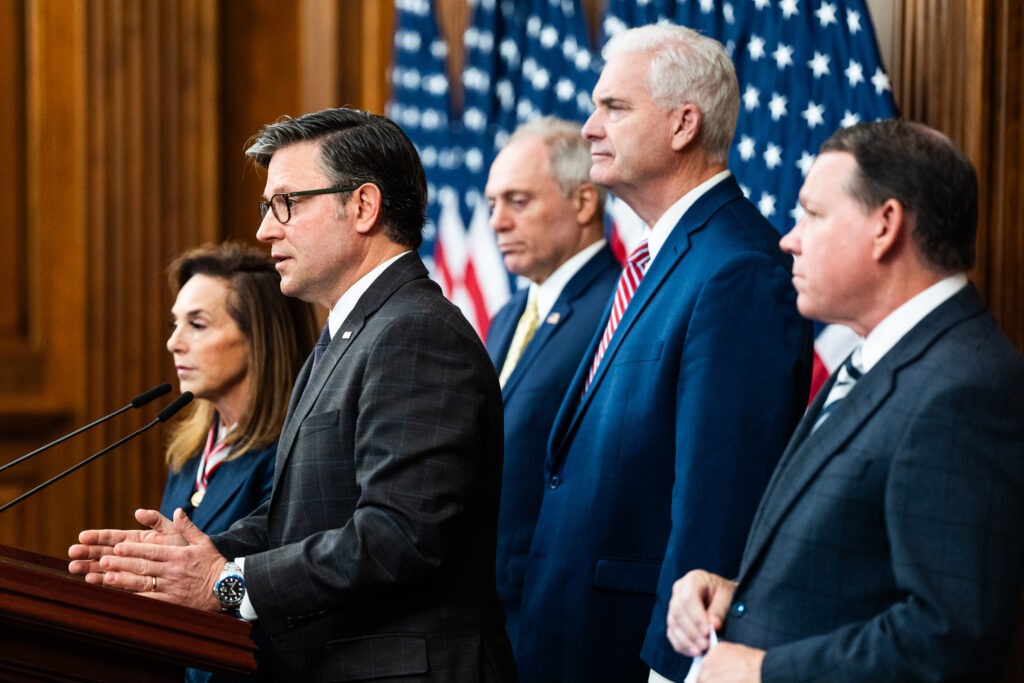
A small group of moderate House Republicans are joining Democrats to force a vote on a proposal to extend pandemic-era enhanced Affordable Care Act subsidies that are set to expire at the end of the year, seizing control of the floor from GOP leaders yet again in a sign of the sharpest tensions yet within the party.
The subsidies are still virtually certain to expire because the Senate has already rejected the plan.
House GOP leaders are still planning to hold a vote Wednesday on a modest health care reform bill that Speaker Mike Johnson (R-Louisiana) unveiled last week. But with most Republicans opposed to the subsidies, Johnson refused to allow a vote on extending the policy, fomenting the strongest rebellion among Republicans from swing districts to date. Many of those lawmakers, who fear political backlash in next year’s midterms due to rising prices, tried unsuccessfully to persuade Johnson to include the extension for weeks.
Separately, Democrats — who had made an extension their chief demand during the government shutdown this fall — have been circulating what’s known as a discharge petition, which can force legislation to the floor over leaders’ objections if a majority of the House signs on. On Wednesday morning, four House Republicans, enough to put the petition over the top, joined that effort. The measure, sponsored by House Minority Leader Hakeem Jeffries (D-New York), would extend the subsidies for three years.
“To me, the clean three-year extension is not ideal,” said Rep. Michael Lawler (R-New York). “But doing nothing is not an answer.”
The expiration of the enhanced premium tax credits is expected to push up costs for most of the 24 million Americans who buy health insurance on the ACA marketplace. In late October, ACA insurers had already raised prices by 26 percent for 2026 plans.
Republicans have been fighting bitterly among themselves over health care changes since before the shutdown, echoing long-standing debates that date back to the ACA’s enactment 15 years ago.
A handful of House Republicans representing competitive districts have been pushing to extend the subsidies for months, concerned about rising health care costs affecting their reelection prospects. But most conservatives, including many in the ultraconservative House Freedom Caucus, contend that the subsidies are no longer necessary, that they’re vulnerable to fraud, and that they serve a relatively small number of Americans — around 7 percent.
Including any provisions to a health care bill that extends premium subsidies risked a revolt from the far-right flank of the conference, where members want to see the subsidies expire or include provisions limiting access to abortion in exchange for their vote.
Unable to find a solution, Johnson sided with conservatives and introduced a plan that does not extend subsidies and would allow small businesses to pool health coverage and fund premium reductions for low-income people in the individual health insurance market. That proposal would reduce the deficit by $35.6 billion over the next decade, reduce premiums by around 11 percent and push around 100,000 people off of health insurance per year, according to the nonpartisan Congressional Budget Office.
“Many of them did want a vote on this Obamacare covid-era subsidy the Democrats created,” Johnson said of the moderates Tuesday. “We looked for a way to try to allow for that pressure release valve, and it just was not to be.”
But upsetting moderates is risky for Johnson, potentially alienating — and endangering — a key bloc of lawmakers who are on the frontline defending the House majority in the midterm elections. And the group did not go down without a fight.
One GOP proposal was hashed out after Johnson negotiated with moderates through the afternoon Tuesday. Rep. Nick LaLota (R-New York) introduced a plan that would not extend the subsidies — which are paid to insurance companies — but would replace them with equivalent tax credits directly to people buying health insurance on the ACA marketplace for the next two years.
Fitzpatrick also introduced his own proposal — which is also filed as a discharge petition — that would extend the subsidies by two years and implement a series of reforms, including new income eligibility caps and a minimum monthly premium payment. A second proposal drafted by Rep. Jen Kiggans (R-Virginia), also a discharge petition, would extend the subsidies by one year with narrower eligibility changes.
All the proposed amendments were struck down by the GOP-controlled House Rules Committee Tuesday night. The move prompted a group of moderate Republicans — Reps. Fitzpatrick, Lawler, Rob Breshnahan (Pennsylvania) and Ryan Mackenzie (Pennsylvania) — signed onto the Democratic petition Wednesday morning. Rep. David G. Valadao (R-California), another vulnerable incumbent, told The Washington Post he also wanted to sign the petition.
Republicans also blamed their leadership for failing to recognize the political consequence of missing the deadline, saying the attempt to pass a slim health care bill was pointless. Rep. Chip Roy (R-Texas), who voted against extending the subsidies, said Tuesday night that Johnson’s health care bill was “milquetoast garbage.”
“I think people need to get back home more and spend time with their constituents and hear them out,” Fitzpatrick said about his colleagues not wanting to pass premiums. “Things are very expensive right now. Health care is very expensive. Anything we can do to lower the cost, we ought to do.”
Hill Democrats have been pushing to extend the subsidies they approved during the covid-19 pandemic for months, refusing to fund the government without an extension. The subsidies have more than doubled enrollment in health care plans through the ACA marketplace.
Divisions over the policy in the Senate led to the longest shutdown in U.S. history, which concluded when a group of Senate Democrats agreed to reopen the government in exchange for a vote on a three-year extension of the enhanced tax credits. After the Senate blocked that legislation last week, it also rejected a GOP plan to redirect subsidies to individual accounts that can be used to pay for out-of-pocket health care costs.
Over the weekend, Johnson sought to get the moderates to abandon their petitions in exchange for a vote on the bipartisan bill Fitzpatrick proposed to amend the GOP plan. Moderates agreed to that initial deal but then walked away from it after GOP leadership made new demands, including finding a way to offset the cost of an extension. That could take around $64 billion for a three-year extension, according to the CBO. Fiscal conservatives say that’s too expensive.
The post Moderate House Republicans join Democrats to force vote on ACA subsidies appeared first on Washington Post.