LONDON — As European leaders make a last-ditch effort this week to unlock some 210 billion euros ($246 billion) in frozen Russian assets to help Ukraine, for at least one of the bloc’s members, the decision weighs heavily.
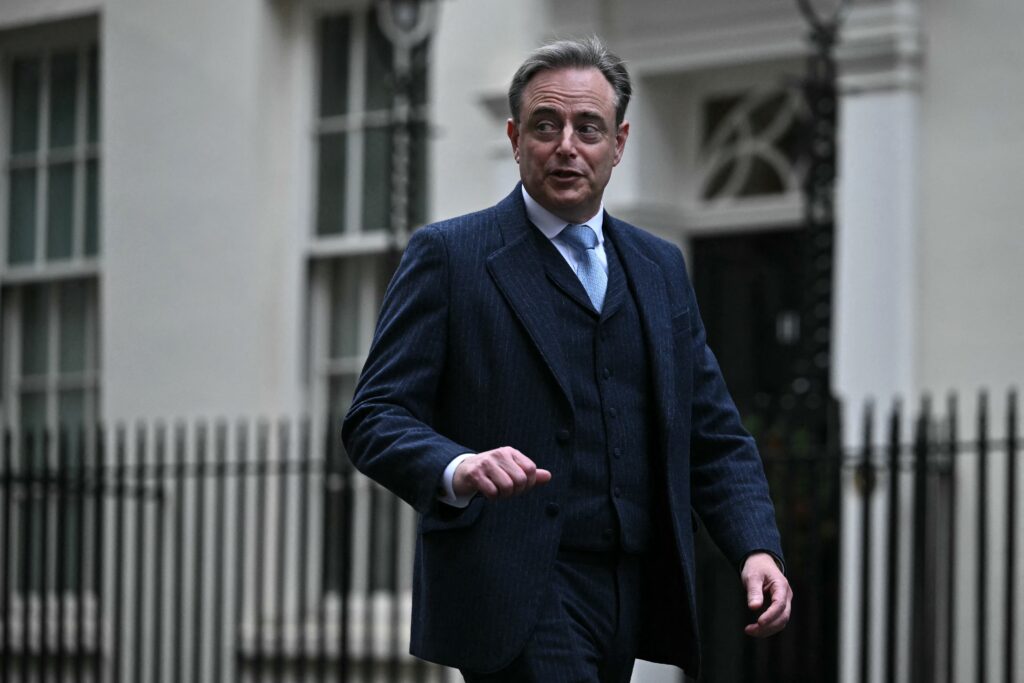
Amid a spate of drone incursions over his country, one lawsuit with threats of more to come and verbal attacks, Belgian Prime Minister Bart De Wever, whose country holds most of the frozen funds, said that the Kremlin has threatened him personally.
“Who believes that Putin will calmly accept the confiscation of Russian assets? Moscow made it clear that if confiscation happens, Belgium and I personally will feel the consequences for eternity. That seems like a rather long time,” De Wever told a Belgian newspaper.
A little-known Flemish nationalist until his surprise ascent to power in February, De Wever is now on the front line of a Russian campaign to intimidate the European Union out of using the funds to support Ukraine. European officials cast the decision, due at a summit of the E.U.’s 27 leaders on Thursday, as critical not just for sustaining Ukraine’s ability to fight back, but also for ensuring Europe’s own voice in global decision-making.
“Let us not deceive ourselves. If we do not succeed in this, the European Union’s ability to act will be severely damaged for years, if not for a longer period,” German Chancellor Friedrich Merz said this week. “And we will show the world that, at such a crucial moment in our history, we are incapable of standing together and acting to defend our own political order on this European continent.”
Others put it even more starkly. If the effort fails, “it means that we would not have the money to sustain Ukraine economically and militarily into 2026 and on,” said Nathalie Tocci, head of Italy’s Institute for International Affairs. It “basically means that Ukraine would capitulate and that we would be opening the front door for war to spill out to other European countries.”
The E.U. has shied away from deploying the Russian central bank reserves it froze as part of sanctions for Russia’s 2022 invasion of Ukraine over concerns about the legal and financial risks of setting a precedent by seizing sovereign assets. But now that President Donald Trump’s administration has stopped providing more funds for Ukraine and economic woes weigh ever more heavily on European taxpayers, the plan — which proposes using the funds as collateral for loans to Kyiv — has emerged out of urgency.
As Moscow counts on European support for Ukraine otherwise drying up, Russia appears to have resorted to a multipronged campaign, threatening “decades” of lawsuits if its assets are seized and an unspecified “response” if Brussels proceeds with such “a hostile act.”
In a social media spat over Moscow’s conduct, former Russian president Dmitry Medvedev threatened that Belgium could “disappear” if Russia tested its nuclear-capable Poseidon underwater drone. And, in recent weeks, mysterious drone incursions have led to airport closures across Europe, part of a destabilization campaign European security officials say is orchestrated by Moscow. Russia denies any involvement in drone incursions or sabotage attacks.
“Russia is testing us in the gray zone with tactics that are just below the threshold of war,” Britain’s newly appointed MI6 chief, Blaise Metreweli, said in a speech this week. “It’s important to understand their attempts to bully, fearmonger and manipulate.”
Belgium has been a particular target. In the first 10 days of November alone, it reported more than a dozen drone incursions at airports, military bases and a nuclear power plant. The head of defense of the Belgian armed forces, Gen. Frederik Vansina, warned the country is “the focus of growing hybrid threat.”
The fate of the frozen Russian assets has also featured in the 28-point peace plan initially put forward by U.S. special envoy Steve Witkoff following discussions with Russian representatives. The proposal called for $100 billion of the Russian assets to be used in U.S.-led efforts to rebuild and invest in Ukraine, with the remainder to be put into a joint U.S.-Russian investment vehicle. Since then, De Wever — and other European leaders — have faced pressure from U.S. officials, European officials said.
“Russia has not only been trying to intimidate but also trying to get the White House to think maybe we can get our hands on it,” said one former senior Western banker operating in Moscow who, like others, spoke on the condition of anonymity to discuss sensitive matters. “They think we’ll get the White House to help us take it away from the Europeans by letting them have a piece of it.”
Two officials familiar with the matter said the Europeans had received clear signals that the U.S. administration wants to use the assets in a settlement, raising the specter of a clash with Europe’s leaders.
There used to be “a lot of debate about whether it was a good idea to seize the assets or not, but the question is now, if the E.U. doesn’t seize the assets, the U.S. will do it,” said Agathe Demarais, a fellow at the European Council on Foreign Relations and a former adviser to the French treasury in Russia. “So it’s not a question of whether the assets will be seized anymore, but a question of by whom, which I think is completely changing the debate.”
Russia’s tactics are leveraging long-standing fault lines across the E.U., focusing on leaders who, like De Wever, are squeamish about the idea or take a more populist tack. In recent days, Italy’s Prime Minister Giorgia Meloni, an ally of Trump, as well as Bulgaria, the Czech Republic and Malta, have expressed hesitation about the assets plan. Moscow’s allies of Hungary and Slovakia, meanwhile, have outright rejected it.
De Wever is so far digging his heels in and opposing the plan. In the same interview with Belgian newspaper La Libre, he said suggestions that Russia could lose in Ukraine were “a fairy tale” and “a total illusion.” He added that it would be undesirable for them to lose “so that instability does not grip a country that possesses nuclear weapons.”
He also called any move to use the Russian assets theft — echoing Kremlin language. “Stealing frozen assets of another country, its sovereign wealth funds, has never been done before,” he said.
A few days later, in a speech to the Belgian Parliament, his insistence that he was no less pro-European or pro-Ukrainian for expressing worries about the E.U. plan was greeted by thunderous applause. “Let there please be no doubt: Our country stands right with Ukraine and wants to do what is necessary to make it stronger and further supported,” De Wever told lawmakers. He voiced “regret that all sorts of insinuations and fake news” are being deployed “to pressure us by claiming the opposite.”
De Wever’s office has not replied to a request for comment.
Belgium has sought concrete assurances that its E.U. neighbors will fully share the risks if a bill comes due and that others will commit to using Russian assets held in their countries too. De Wever has said the E.U. is taking steps toward meeting Belgium’s conditions, seemingly leaving room for negotiation. He has staunchly pushed back on claims he is playing into Russia’s narrative and appears to have support from Belgians for his reluctance, with polling showing a majority oppose using the assets.
As a populist politician, De Wever previously supported separatist causes in Europe. The New Flemish Alliance party he has led since 2004 has called for the transformation of Belgium into a confederal state as well as campaigning for Flemish secession.
For some in Europe, he is still an unknown quantity. “He was always a regional politician. This is the first time he is facing off against Russians and Americans as a decision-maker,” said one former European official who previously worked in Belgium.
It remains unclear if a charm offensive launched by European leaders to secure his support is going to resonate. The European Commission is seeking to reassure De Wever that his country would not have to face down any lawsuits or retaliation by Moscow alone.
Belgian officials had been irritated with the commission’s initial approach, which they felt took its approval for granted and didn’t do enough to allay the smaller member state’s concerns, two E.U. diplomats said.
“We have the frustrating feeling of not being heard, our concerns are being downplayed,” Belgian Foreign Minister Maxime Prévot told reporters as tensions spiked in recent weeks. “We are simply seeking to avoid potentially disastrous consequences for a member state that is being asked to show solidarity without being offered the same solidarity in return.”
But despite its opposition, Belgium was among the 25 E.U. members states that agreed last week to a key step in the plan: indefinitely freezing the assets and eliminating the need for a unanimous vote every sixth months, bypassing a veto from Moscow-friendly Hungary.
E.U. foreign policy chief Kaja Kallas, however, sounded a note of caution this week, saying it was “increasingly difficult” to forge consensus. Although officials have said the decision could be pushed through with a weighted majority vote, overriding opposition from Belgium, Kallas said it was important to make sure they had its backing. Without Belgium, “it wouldn’t be very easy because they have the majority of the assets and it’s important that they are on board whatever we do,” she said.
Whatever the outcome of Thursday’s vote, European security officials said they are bracing for further Russian threats including on the banking system and Belgium’s Euroclear, where most of the assets are held. “We are expecting an increase of the hybrid warfare starting this weekend,” one senior European security official said. “We are not unprepared, but we don’t know what the scale would be of the attacks.”
Francis reported from Brussels, Mekhennet from Washington. Beatriz Rios in Brussels contributed to this report.
The post As Europe eyes Russia’s frozen assets, Belgium fears Moscow’s revenge appeared first on Washington Post.