There’s a lot of luck involved in traveling to the Big Island of Hawaii to see a volcanic eruption. When Kilauea blew in early October, with lava spewing up to 1,300 feet in Hawaii Volcanoes National Park, viewing it at night, from a campsite some 30 miles away, was the second-best thing about taking an off-the-grid approach to touring the Big Island.
The first: overnighting as close to nature as possible on an island renowned for its climatic diversity — from black-sand beaches to rainforests and snow-capped Mauna Kea volcano — without packing a tent.
Though frequent campers, my nature-loving family appreciates prearranged shelter and bedding, especially in a destination like Hawaii that requires flying. So we turned to Hipcamp, an online booking service for campsite and shelter reservations on public and private lands, to find cabins and yurts for a close-to-nature experience at bargain rates, roughly $90 to $180 a night, when many resorts were charging $600 or more.
The tech entrepreneur and outdoor enthusiast Alyssa Ravasio founded Hipcamp in 2013 to expand camping locations beyond public parks to privately owned land, including farms and ranches. More than one million people booked on Hipcamp this summer, its busiest season to date.
The platform, which operates in Australia, Britain and Canada in addition to the United States, is intended “to support people who want to spend more time in nature, and these are often not people who want to sleep on the ground,” Ms. Ravasio said, explaining that structures like cabins, yurts, treehouses and tiny homes were the fastest-growing types of accommodations booked at Hipcamp.
To test the Hipcamp experience, I designed a five-day road trip on the Big Island that would expose my husband, son and me to its geographic variety from campsites that made it easy to reach beaches and inland attractions by car.
Turtles and Volcanic Eruptions
The first rule of Big Island camping: Rent a high-clearance vehicle. Reaching remote lodgings required driving many steep and potholed roads.
From the island’s main airport, near the town of Kailua-Kona, we headed toward our first Hipcamp location on the south coast, about a two-hour drive to Naalehu and then up a narrow mountain road another 15 minutes, dodging mongooses and stray cows.
The purple Butterfly Pea Coastal Cabana (from $89) is one of two solar-powered cabins on an eight-acre farm. We had the compound to ourselves, including a portable toilet and an open-air shed that housed a shower stall with a natural rock floor and a sink with running water that drained into the ground.
Screened windows wrapped around the single-room cabin, which had a queen bed, a day bed, a small table and twin lamps plugged into a solar-charged battery.
By night, coqui tree frogs sang loudly under a star-filled sky. By day, saffron finches foraged on the lawn and lavender plants scented the property, which offered expansive views of the ocean.
In addition to offering a good base from which to explore Hawaii Volcanoes National Park, the location was close to Punaluu Beach, known to attract green sea turtles. We spied several on the black sand and in the surf.
Our Hipcamp accommodations introduced us to lesser-visited towns we grew to love, starting with Naalehu, where Hana Hou Restaurant — which bills itself as the southernmost restaurant in the United States — was serving seared ahi tuna ($25) caught by a local fisherman named Anthony Vierra. Stands and food trucks at the town’s Wednesday-morning farmers’ market offered local brew from Aikane Plantation Coffee Company and $3 Spam musubi, a popular snack of grilled Spam on rice wrapped in seaweed.
Waterfalls and a Swimming Hole
From the south coast, we drove past the national park about 30 miles northeast to Hilo, the largest town on the Big Island and the gateway to the Hamakua Coast, known for its rainforests and waterfalls, which still appeared lush despite drought conditions.
About a 15-minute drive from downtown, our next Hipcamp cabin, at the Kikala Waterfall Lodge (from $105), on the slopes of Mauna Kea, included access to one of Hamakua’s waterfalls, a gentle shower on the Kikala River that fed a swimming hole we immediately jumped into on a hot day.
Our wood-clad, one-room cabin named Hale Io on the 14-acre garden and farm offered a double bed and an additional sleeping loft with use of a kitchen and shared bathrooms in the nearby main lodge.
From the cabin, we explored pocket beaches north along the wave-pounded coast. At Akaka Falls State Park, we hiked through a flower-filled forest to views of the 442-foot waterfall framed in greenery.
Staying close to lively Hilo, we lingered at the Hilo Farmers Market on a “big market day” (Wednesdays and Saturdays) when the open-air complex is at its busiest with fruit, vegetable and coffee vendors, and artists and craftspeople selling jewelry, art, sarongs and more.
We returned at night for a splurge: creative seafood at Moon & Turtle restaurant (entrees from $32), then a set by a blues guitarist in the basement speakeasy the Hidden Nene before driving back to camp to fall asleep to the chirping of tree frogs.
Snorkeling and Song
From Hilo, we followed the Saddle Road over the center of the island for stunning views of Mauna Kea and a chance to hike the Puu Oo Trail, a 7.4-mile round trip through lava fields. Marked by cairns through the stark lava flows, the trail links oases of old-growth forests of native koa and flowering ohia trees known as “kipuka,” which attract colorful endemic birds, including the bright red iiwi and yellow amakihi.
We continued driving north through cattle pastures to the ranching town of Waimea for a burger at Village Burger (from about $12) before turning west toward the resort-filled Kohala Coast to go snorkeling at Waialea beach.
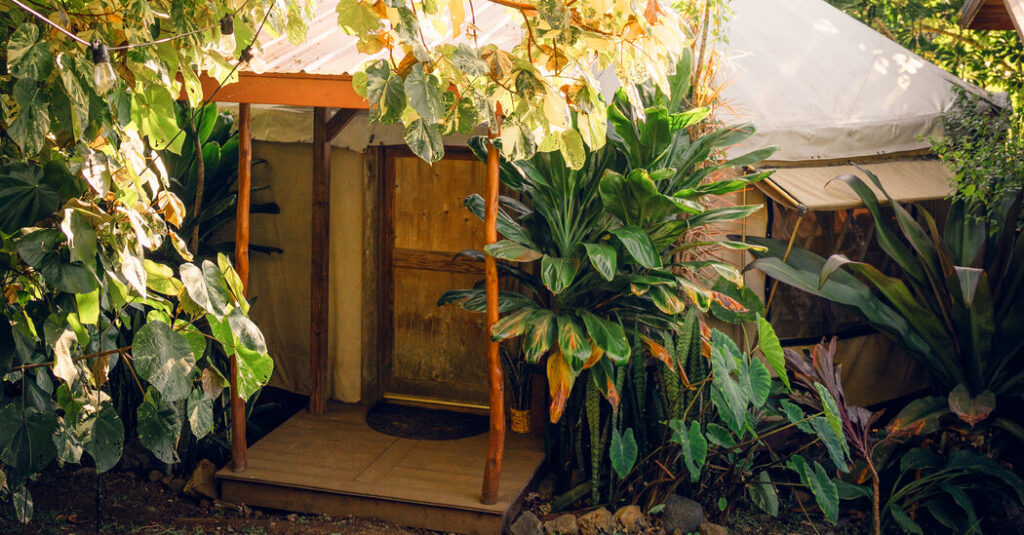
We spent our last two nights at a more upscale campsite, the Enchanted Yurt on Organic Farm (from $180), in Kealakekua in the Kona District, about 10 miles south of Kailua-Kona.
The canvas-sided, open-plan yurt included a bed, a couch and a fully stocked kitchen with a French coffee press, fitting given its location on a coffee and vegetable farm. A small exterior walkway led to an addition with a lounge, a bathroom with a walk-in shower and a free-standing tub, and a back porch that opened onto a coffee grove where we enjoyed daily visits from the farm’s friendly cats.
The host thoughtfully stocked snorkeling gear and beach towels, which we took one sunrise to Honaunau Bay, a snorkeling spot nicknamed Two Step for the entry steps carved into the shore-side lava rock. Sunny yellow tang, sinuous trumpetfish and striped butterflyfish stood out in the clear turquoise water. A starfish the size of a dinner plate draped over the coral, and in the quiet morning hours we managed to spend some time with a curious octopus, from a respectful distance.
The bay adjoins Puuhonua o Honaunau, a place of refuge for those who violated sacred laws in ancient Hawaiian history. Now a national historical park, the sanctuary remains a solemn site with a traditional temple and wood carvings of gods, somewhat at odds with the tourist traffic that grew throughout the morning.
The stretch of highway between the refuge and Kailua-Kona became our favorite for thrift and antique store browsing and bargain food finds led by Kaaloa’s Super J’s, serving lunches of pork and chicken laulau (slow cooked in taro leaves) with rice and macaroni-potato salad (from $12).
On a tip from the radio station KAPA, we caught the celebrated slack-key guitarist Led Kaapana in a free show at Don’s Mai Tai Bar & Restaurant at the Royal Kona Resort in Kailua-Kona, part of its Thursday-evening Legends of Hawaiian Music concert series (happy hour draft beer, $8).
Many in the crowd, filled with regulars, sang along and a woman danced the hula to several numbers, a reminder that minding a budget while traveling isn’t a limitation; it’s a local introduction.
Follow New York Times Travel on Instagram and sign up for our Travel Dispatch newsletter to get expert tips on traveling smarter and inspiration for your next vacation. Dreaming up a future getaway or just armchair traveling? Check out our 52 Places to Go in 2025.
Elaine Glusac is The Times’s Frugal Traveler columnist, focusing on budget-friendly tips and journeys.
The post Saving Money and Getting Close to Nature on Hawaii’s Big Island appeared first on New York Times.