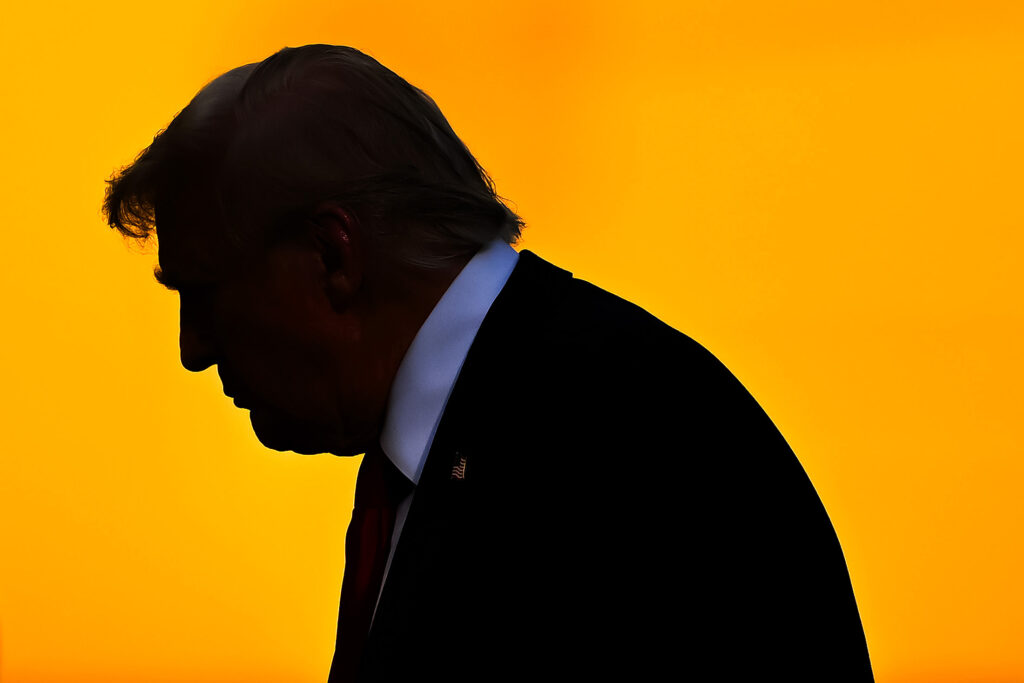
Donald Trump had been waiting four years to get back in the Oval Office, and he arrived with a long to-do list.
“They came out of the gate like Man o’ War,” says Joseph Grogan, who served as director of Trump’s domestic policy council during the first term. “They set a blistering pace of administrative actions across all major agencies.”
[time-brightcove not-tgx=”true”]
On his first day alone, he pulled the U.S. out of the Paris climate-change agreement, froze all foreign aid, suspended refugee admissions, and granted clemency to more than 1,500 people charged in the Jan. 6, 2021, Capitol riot that tried to overturn his 2020 election loss. And he was just getting started. Within a month, he’d fired 17 inspectors general, allowed immigration agents to arrest people inside courthouses, taunted Denmark about handing over Greenland, announced steep tariffs on Canada and Mexico, and said the U.S. should “own” the Gaza Strip.
Within two, he had deported Venezuelan men to a notorious prison in El Salvador, declared English the country’s official language, and bawled out Ukraine’s President in the Oval Office as cameras rolled.
It was hard to keep up. Presidents typically sprint to get things done during their first year in office, while they can ride the momentum from a winning campaign. But Trump’s pace as he returned to the White House was head-spinning. “It is obvious the team knows they are in a hurry,” Grogan says. Many of those working with Trump were frustrated with how often courts blocked major initiatives in his first term and how investigations and Trump’s impeachment distracted from their work, Grogan says, and they are trying to make up for that.
While Trump continued to court controversy, his team kept up its relentless pace to enact his domestic agenda. They stripped away energy regulations in an effort to increase U.S. oil and gas production and gutted subsidies for wind and solar projects. They pushed out more than 300,000 civil servants, stripped away COVID vaccine requirements, and froze research funding to major universities to pressure them to end diversity programs and hire more conservatives as faculty.
During Trump’s first term, he burned through a lot of time trying to get Congress to repeal the Affordable Care Act. This time, Trump shifted his strategy. He prioritized tax cuts for corporations and the wealthy, and eventually insisted they be wrapped with a laundry list of his other agenda items—including ending green-energy subsidies and massively expanding funding for border and immigration enforcement. Some Republicans balked at the strategy, but it worked. In July, Trump signed the One Big Beautiful Bill Act into law.
The new funding for Trump’s immigration agenda—a whopping $170 billion—was just one part of Trump’s stark overhaul of the country’s approach to immigration. He shut down a Biden-era program that allowed migrants to make an appointment at the border to request asylum and revoked temporary protective status for more than 675,000 people residing in the U.S. He then mobilized the Border Patrol and ICE agents to make visible and often indiscriminate arrests in communities and ramped up deportations. Trump deployed the National Guard in Los Angeles to confront protests against his immigration actions—and sent Guard troops to Washington, D.C., and Memphis, saying it was to address crime. Daily life for migrants in communities across the country was upended. Border crossings between points of entry plummeted.
Whereas Trump’s immigration regime has been brutally consistent, his erratic use of tariffs roiled world and industry leaders. Stock markets endured a roller-coaster spring as Trump dramatically announced -historically high tariffs on dozens of trading partners, and then postponed or rolled back many of them, -frustrating both large and small business owners, who have struggled with the uncertainty around what imports will cost.
While Trump presented the tariffs as part of a plan to revive domestic manufacturing, he also used the threat of tariffs as a tool of international diplomacy. When India and Pakistan exchanged fire earlier this year, Trump claimed it was his threat of new tariffs that persuaded the two longtime adversaries to stand down. “If I didn’t have the power of tariffs, you would have at least four of the seven wars raging,” Trump said in the Oval Office on Oct. 6. “Not only did we make hundreds of billions of dollars, but we’re a peacekeeper because of tariffs.”
On the world stage, Trump also pressured European countries to invest more in their own militaries and to pay more for weapons shipments used for Ukraine’s defense. He killed dozens in military strikes on alleged drug-smuggling boats on the Caribbean and Pacific that many decried as illegal and callous. He hit Iranian nuclear facilities, then declared an end to an aerial war between Israel and Iran. He persuaded Middle East states to back his cease-fire plan for Gaza, which required Hamas to return the remaining 20 living hostages kidnapped during the deadly Oct. 7, 2023, attacks on Israel.
On the campaign trail in 2024, Trump wasn’t shy about saying he would use a second term to get revenge on his enemies. He followed through, siccing his Justice Department on longtime adversaries like former FBI Director James Comey and New York State attorney general Letitia James, and targeting law firms that had previously conducted work or hired lawyers he didn’t like. The retribution campaign, along with a wide range of profitable business endeavors by Trump and his family, drew charges of an Administration beset by corruption.
At every turn, Trump used his knack for dominating news cycles to make himself the focus of attention all year. But identifying which efforts will be worthy of space in history books requires some sifting through the noise, says Whit Ayres, a longtime Republican strategist. “He has taken more actions and made more news than any other President in my lifetime in one year, but that news and those actions have not necessarily led to lasting accomplishments,” says Ayres.
Trump’s approval rating started the year at 47%, according to Gallup polling, but has hovered near 40% since the summer. Ramping up deportations of immigrants who have lived in the U.S. for years is broadly unpopular. But voters give Trump credit for reducing the flow of illegal border crossings, says Ayres. “It’s quite an accomplishment that he has effectively shut down the southern border without spending a lot of money,” Ayres says.
Other Trump policies that have been popular with Americans, according to Ayres, are getting Europe to increase defense spending, negotiating the cease-fire in Gaza, and addressing concerns about transgender athletes competing in youth sports.
But voters were less positive on Trump’s first year overall. Millions turned out in cities across the country for anti-Trump “No Kings” protests in June and October. The off-cycle elections in New Jersey and Virginia were a disaster for Republicans, as many voters who pulled the lever for Trump in 2024 backed Democrats who promised to do more to address high prices and push back on Trump’s chaotic leadership. With the midterm elections coming in 2026, Trump and Republicans will make reversing public sentiment a priority. How Trump addresses the issues topping most polls—the economy and the increasing cost of living—could define his second year in office.
The post All Gas, No Guardrails: Trump’s Whirlwind First Year Back in Office appeared first on TIME.