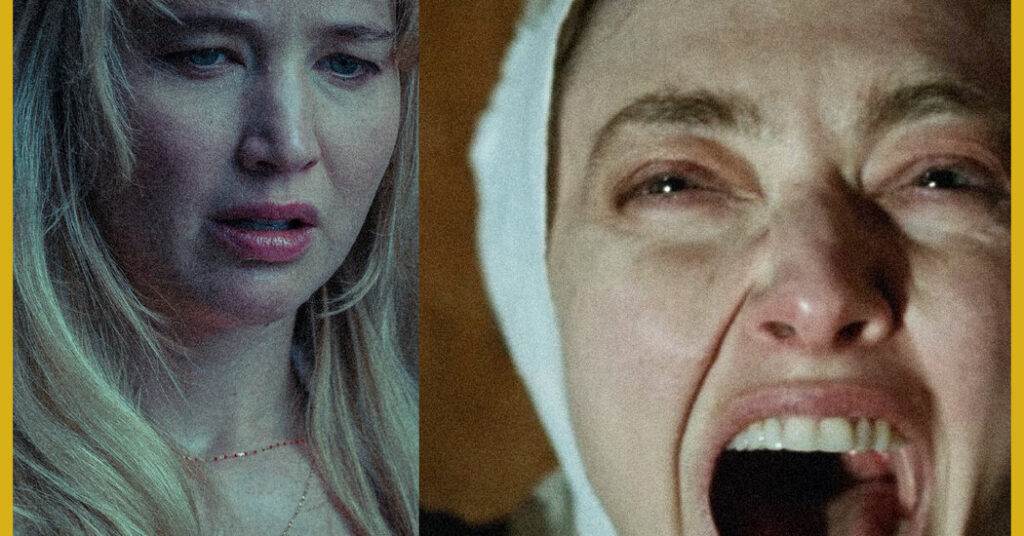
In “If I Had Legs I’d Kick You,” Rose Byrne plays Linda, a frazzled therapist under constant siege: Her clients won’t listen, her daughter won’t eat, her husband is out to sea and her apartment is caving in. As her situation grows worse, Linda begins to lash out, though her entirely justified anger only serves to make things worse.
It’s been years since Byrne had a big-screen role this bold, and her nerve-jangling performance has already earned top honors from the New York Film Critics Circle and Los Angeles Film Critics Association. With those bona fides, she ought to be a lock for an Oscar nomination.
So why do I fear Byrne may be overlooked entirely? Perhaps it’s because recent history suggests that Oscar voters have a tough time with tetchy women.
Just last year, Marianne Jean-Baptiste earned awards from those same critics’ groups for “Hard Truths,” in which she played a woman who seemed congenitally prone to tearing into everyone around her, from unlucky strangers to long-suffering family members. Jean-Baptiste was a force of nature in the role, but many male voters told me they simply didn’t like her character. On the morning of the Oscar nominations, she was unfairly snubbed.
I noted at the time that when a woman suffers nobly, it’s considered Oscar bait, but when she makes others suffer, voters are far less sympathetic. With that in mind, I’m keeping an eye not only on Byrne but also on Jennifer Lawrence and Amanda Seyfried, who delivered some of their strongest ever work this year playing difficult women, yet remain on the bubble in most best-actress predictions.
In May, when the rising distributor Mubi spent $24 million to acquire “Die My Love” at the Cannes Film Festival, a robust awards run for Lawrence seemed certain. The Oscar winner plays Grace, a new mother whose relationship with Jackson (Robert Pattinson) has grown strained since the arrival of their baby. Feeling unseen and unloved, Grace begins to act out in disturbing ways, like stripping her clothes off in the middle of a crowded children’s party or attacking on the uncomprehending Jackson.
With this material, Lawrence is taking risks that feel bracing and new, but even at Cannes, I wondered whether voters would have issues with her character. Many of the men I spoke to after the premiere were still recoiling: One male movie critic dismissed the film with a curt “Not for me,” while a prominent indie-film executive was even more blunt. “I hated that woman,” he said.
Months later, when “The Testament of Ann Lee” premiered at the Venice Film Festival, that debate began anew. The film stars Seyfried as Ann Lee, an impoverished but charismatic Manchester woman who became the founder of the Shaker religious movement in the mid-18th century. Forced into marriage with a sexually sadistic cad (Christopher Abbott), Lee comes to see herself as a prophetess, eventually persuading her fellow Quakers to renounce marriage, embrace celibacy and follow her to America to establish a new religious community.
Seyfried is a marvel in the role, yet as I left that first screening in Venice, a French journalist appeared totally stymied by the character: “She was antisex and a religious zealot. Was I supposed to like her?”
To me, that reaction misses the point. Even if Lee’s message of abstinence may not map neatly onto contemporary mores, her rejection of sex may have been the only way this 18th-century woman could rise from nothing to become the leader of a remarkably equitable sect. Though I may not be inclined to describe Ann Lee as a rootable girlboss, that’s because I don’t watch movies with such a concussed point of view.
Anyway, isn’t it enough to find a character fascinating rather than likable? Too often during awards season, I find that likability is a metric applied against female leads far more often than to men, who manage to get away with just about anything. Rabble-rousing women who score with Oscar voters tend to soften by the end of their movies — think Frances McDormand in “Three Billboards Outside Ebbing, Missouri,” whose rage is modulated just so — but if the characters played by Byrne, Lawrence and Seyfried ever yield, it’s only to exhaustion.
It’s interesting, then, to compare those three performances with the one expected to dominate the best-actress race. In “Hamnet,” Jessie Buckley plays Agnes, the wife of William Shakespeare. Like Linda, Grace and Ann Lee, she is enduring a traumatic passage of motherhood while her husband is largely absent, though unlike those women, she’s the one who encouraged him to realize his ambitions by moving to the city to pursue playwriting. Resentments pile up anyway as she remains in the countryside to raise their family. But at least when tragedy strikes, the healing power of her husband’s art can help them both cope.
Buckley isn’t just the front-runner, she’s also one of the few contenders who hails from a surefire best-picture nominee, in part because her film culminates in a cathartic outpouring of grief set to soaring strings. To say the other leading ladies don’t get that would be to understate things considerably: Their outcomes are complicated, with any moments that border on cathartic either imagined or posthumous.
I don’t mean to devalue how good Buckley is in this wrenching role: If she steamrolls all season, it will be well-deserved. Still, I wonder whether this performance has found more purchase than the others because her character grieves in ways that are not just palpable but palatable. Even when Agnes confronts her husband, I wanted her to let him have it a little more. Oscar voters may applaud her restraint, but if Agnes ever truly needs to let loose, at least there are three defiant women around she could learn something from.
Kyle Buchanan is a pop culture reporter and also serves as The Projectionist, the awards season columnist for The Times.
The post Will the Oscars Make Room for ‘Difficult’ Women? appeared first on New York Times.