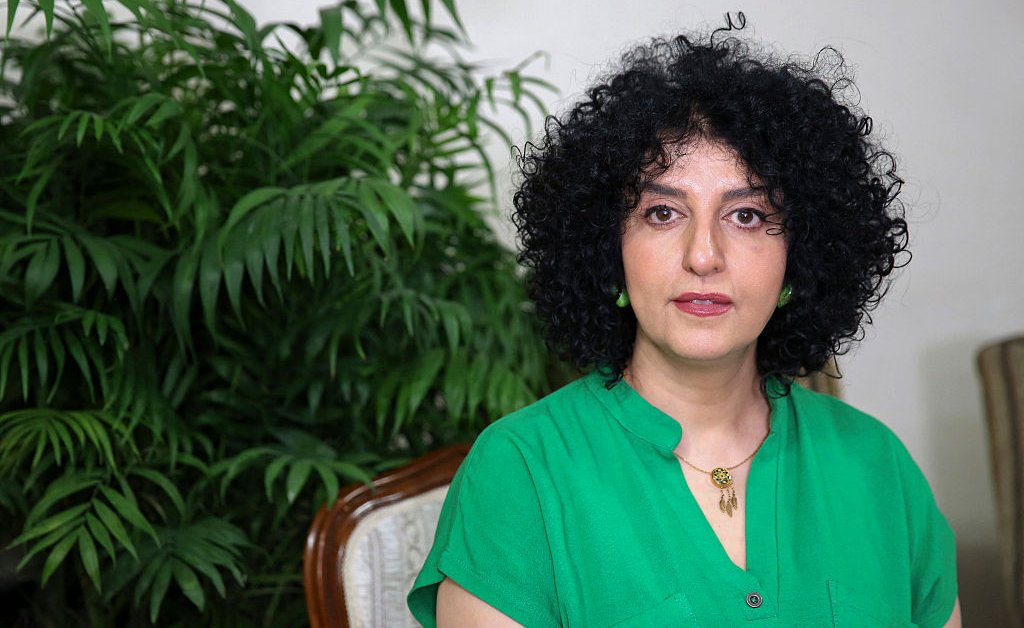
On Friday, Iranian security forces dragged Nobel Peace Prize laureate Narges Mohammadi by her hair into a waiting vehicle. Her crime? Attending a memorial service for a human rights lawyer who was recently found dead in murky circumstances in Mashhad, a city in northeast Iran. Witnesses described a scene of chaos and violence: tear gas, batons, mourners beaten as they fled.
[time-brightcove not-tgx=”true”]
Mohammadi, who has spent much of the past two decades in and out of Tehran’s notorious Evin prison, was hauled away along with at least nine other activists. She has been on medical furlough from prison for the past year, and was consistently advocating for greater freedoms for Iranian people and a peaceful transition to democracy. “Violence, whether imposed from outside or from within, is not the answer,” Mohammadi wrote in a recent essay for Time.
She wasn’t the only target. In early December, a court in Tehran sentenced Jafar Panahi, the acclaimed Iranian filmmaker, to one year in prison and a two-year travel ban in absentia, and banned him from membership of political and social groups for “propaganda activities” against the regime. Hours after news came of his sentencing, Panahi, who won the Palme d’Or at Cannes Film Festival in May, won the best director, best original screenplay, and best international feature at Gotham Awards for his film, “It was Just an Accident.” Panahi, who was has been arrested twice and faced bans on making films, plans to return to Iran after his campaign for the Academy Awards in the United States for the his most recent film.
The arrest of Mohammadi and the sentencing of Panahi are not random acts of authoritarian spite but symptoms of a theocracy in existential crisis, the desperate flailing of a regime that is aware it is losing its grip. The Islamic Republic has always been brutal toward its critics but the current wave of repression in Iran has the unmistakable scent of panic.
Panic in Tehran
Since the 12-day war with Israel in June, Iranian authorities arrested thousands of people they suspected to be spies—including numerous activists, journalists, and ordinary citizens. Tehran has executed more than a 1,000 people, according to the estimates by the United Nations experts. Internet blackouts have become routine.
The Iranian security apparatus is working overtime, not because the regime is strong but because it is terrified. The war with Israel was supposed to demonstrate the might of Iran’s vaunted “axis of resistance.” Instead, Israeli precision strikes killed senior Revolutionary Guards commanders, damaged nuclear facilities, and revealed that Tehran’s much-hyped air defenses were little more than expensive theater. The regime’s regional proxies, from Hezbollah to Hamas, have been battered into irrelevance. The architecture of deterrence that Iran spent decades constructing lies in ruins.
The state of the Iranian economy, polity, and environment is equally bleak. After years of severe inflation, in December, the Iranian rial collapsed to 1.3 million to the dollar. In October, Iranian government got parliamentary approval for a monetary overhaul to lop off four zeros from the currency to simplify transactions and spare Iranians the indignity of carrying bricks of cash to buy bread. Inflation hovers around 40 percent. Meat has become a luxury. The price of basic staples has surged by more than 50 percent in a single year.
And then there is the water crisis. Iran is experiencing its worst drought in at least half a century. Reservoirs around Tehran, the capital, are at less than 10 percent capacity. President Masoud Pezeshkian warned recently that Tehran may need to be evacuated if the rains don’t come. Tehran has experienced some rain in the past week, but nowhere near enough.
A grim history of repression
Looming over all of this is the question of succession. Supreme Leader Ayatollah Ali Khamenei, who has ruled Iran since 1989, is 86-years-old. His health has been the subject of speculation for years—he was treated for prostate cancer in 2014—and after the war with Israel, during which he was reportedly a target, he has largely retreated from public view. Behind the scenes, a clerical committee is accelerating its search for a successor, with Khamenei’s son Mojtaba and Hassan Khomeini, the grandson of Ayatollah Ruhollah Khomeini, the founder of the Islamic Republic, among the names in circulation.
The regime desperately needs to restore order before that transition comes—and it could come at any time. A smooth handover of power requires a quiescent population, not one seething with grievances. The theocracy has only managed one succession in its 46-year history, and that was under far less fraught circumstances. The men around Khamenei know that the interregnum will be a moment of maximum vulnerability. They cannot afford to face it with the streets in ferment and the economy in freefall.
The Islamic Republic has a long history of targeting prominent intellectuals, artists, and activists precisely when the theocracy feels most threatened. In the chaotic years after the 1979 revolution, the regime executed thousands of political prisoners, including members of leftist groups who had initially supported the uprising against the Shah.
After the July 1988 ceasefire in the Iran-Iraq war, Mojahedin-e-Khalq (MEK), an armed opposition group, operating from Iraq, made a failed attempt to topple the Islamic Republic. Soon after the MEK incursion, thousands of political prisoners were executed in the aftermath and buried in secret mass graves.
The regime, again, resorted to widespread repression to crush the 2009 Green Movement protests. When millions took to the streets to challenge a stolen election, the regime responded with batons, bullets and silencing dissent and its most articulate voices. Filmmakers, writers, and academics were arrested, interrogated, and in some cases murdered.
The crackdown intensified again after the “Woman, Life, Freedom” protests of 2022, sparked by the death of Mahsa Amini, a young Kurdish woman, in the custody of the morality police. Protesters were shot in the streets. Prominent activists were handed lengthy sentences. And the regime made a point of going after cultural figures: the rapper Toomaj Salehi was sentenced to death (later commuted), filmmakers were banned from working, and actresses were arrested for appearing in public without the hijab.
We are witnessing the latest iteration of this grim tradition, but with an intensity that suggests the regime perceives the current threat as existential. The arrest of Mohammadi and the sentencing of Panahi, who are internationally recognized figures, carries a diplomatic cost. But the regime is sending a message: no one is untouchable. Tehran is willing to absorb international condemnation because it fears its own people more than it fears foreign censure.
The coming crisis
Iranians face economic ruin and ecological catastrophe and more protests are entirely possible. And when they come, the regime will almost certainly ratchet up the repression. Senior Iranian officials, speaking anonymously to Reuters, have admitted as much. “The establishment knows protests are inevitable,” one said. “It is only a matter of time.” Their strategy is to delay that reckoning through fear, executing people at a rate of four a day, deploying checkpoints across major cities, monitoring citizens’ phones, and making examples of anyone with a platform.
The irony is that this very repression may hasten the regime’s demise. Each execution, each arrest of a beloved artist or activist, each internet blackout, erodes whatever residual legitimacy the Islamic Republic retains. The theocrats have always relied on a compact with the Iranian people: accept our rule, and we will provide stability and a modest prosperity. That compact is shattered. The regime can no longer provide electricity reliably, let alone economic security. It cannot protect its citizens from foreign attack. It cannot even guarantee water.
What it can do is kill. And so it kills.
The question is how long this can continue. Regimes built on fear can endure for a surprisingly long time—just ask the North Koreans. But Iran is not North Korea. Its population is educated, urbanized, and connected to the outside world despite the regime’s best efforts. Its young people have made clear, through repeated uprisings, that they reject theocratic rule. The 2022 protests may have been suppressed, but the sentiment that fueled them has not dissipated.
The arrests of Mohammadi and Panahi, the mass executions, the checkpoints and blackouts—these are spasms of a system in terminal decline. The men who rule Iran know this. That is why they are so afraid. The regime may not be deterred by foreign censure, but consequences should follow anyway. Not because they will necessarily stay the executioner’s hand, but to ensure that when the moment comes, the architects of repression cannot escape accountability.
The international community should also put Tehran on notice now: a repeat of previous brute behavior will not be tolerated. There must be consequences for regime figures who order or carry out atrocities: targeted sanctions, legal action at the International Criminal Court, travel bans, asset freezes. The world must also prepare for an exodus of Iranians fleeing repression. And if the Iranian people, exhausted and brutalized, find the strength to seize that moment, the international community must be prepared to help.
The post Why Iran Is Going After Its Best appeared first on TIME.