When China’s rulers ordered tens of thousands of soldiers to crush pro-democracy demonstrations in Beijing in 1989, Gen. Xu Qinxian was the commander who famously said no.
He refused to lead his troops into the capital to help clear the protesters in Tiananmen Square by armed force. For decades, the story of his defiance remained murky.
Now, a leaked video of his secret court-martial has shed a rare light on General Xu, and on the tensions inside the military as Deng Xiaoping, China’s paramount leader at the time, prepared to send the soldiers into Beijing. That deployment culminated in the killing of hundreds — by some estimates, thousands — of unarmed people on June 3 and 4 as soldiers fired on protesters and bystanders.
In the trial footage, General Xu explains that he refused the order as a matter of individual conscience and professional judgment. He tells judges that sending armed troops against civilians would lead to chaos and bloodshed, saying that a commander who carried out martial law poorly would go down as “a sinner in history.”
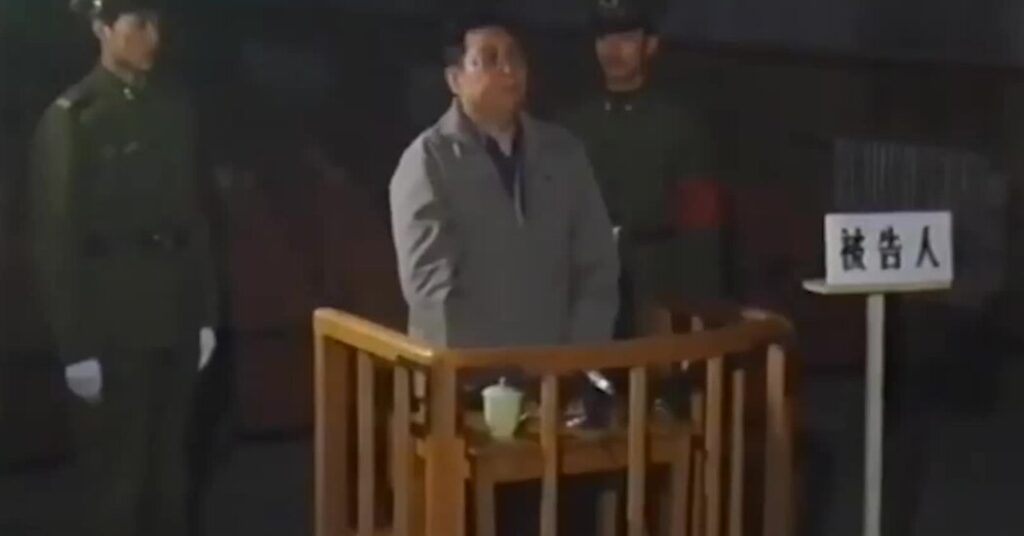
General Xu had risen from a family of small-time vendors to command the 38th Group Army, one of the military’s most prestigious units. But by the time of his court-martial in 1990, captured in the video, he had been stripped of his command, charged with disobeying martial law orders, and brought before the judges to defend the decision that abruptly ended his career.
The six-hour video of the trial shows General Xu, in drab civilian clothes, entering a courtroom, guarded by three soldiers. Three judges gaze down from a podium. The courtroom is devoid of spectators.
General Xu does not beg for mercy. Instead, he tersely lays out why he refused to comply.
“I said that whoever carries this out well could be a hero,” he tells the judges, “and I said that whoever carries this out poorly would become a sinner in history.”
It is almost unheard of for such footage, describing internal decision-making and dissent within the Chinese military, to become public, and discussion of the 1989 crackdown is still heavily censored in China. The video, which has been shared on YouTube, a platform blocked in China, has drawn intense interest, with more than a million views on one channel alone.
“It is one thing to read about General Xu taking a stand and following his conscience. It is another to see him sitting in such a vulnerable position in court,” said Jeremy Brown, a professor at Simon Fraser University in Canada who wrote a history of the Tiananmen protests and crackdown. “To see Xu explain how he decided to refuse to follow a bad order from his well-informed military perspective forces the observer to think: ‘What would I do in this situation?’”
General Xu tells the judges that he was speaking only for himself, not for the 38th Army, in refusing the order.
His account, along with the testimony of other generals cited by the judges and prosecutor at his trial, provides new insights into how Chinese leaders secretively developed and conveyed the plans for martial law and tried to stifle misgivings in the People’s Liberation Army.
General Xu, perhaps like other generals, was summoned individually to hear the orders. It may have been an effort to prevent them from sharing any concerns, said Wu Renhua, an independent historian from China who now lives in Taiwan. Mr. Wu, who has written several studies of the 1989 pro-democracy uprising and crackdown, also noted that General Xu’s trial showed how the martial law orders were delivered orally, leaving no paper trail.
“This counts as the most important material I have come across in over 30 years of collecting material on June 4,” Mr. Wu said of the trial video.
“General Xu Qinxian’s insubordination was a pivotal event in the June Fourth events, but many details remained unclear before this footage emerged,” said Mr. Wu, who as a young scholar in Beijing went to Tiananmen Square in 1989 to join the protests.
Mr. Wu was among the people who posted the video online, but said he did so only after seeing that others had. He said he had been given the video by a trustworthy source, whose identity he declined to reveal, and that he checked details carefully to confirm that the footage was authentic. Professor Brown and another historian of the Tiananmen protests, Timothy Brook, a professor emeritus at the University of British Columbia, also said they saw no reason to doubt the authenticity of the video.
The trial centers on a tense meeting between General Xu and his commanders on May 18, 1989. For weeks, students had occupied Tiananmen Square, demanding political liberalization. China’s top leader, Deng, wanted a decisive end to the tumult.
General Xu was in a hospital, recovering from a kidney stone, when he was summoned to the Beijing Military Region headquarters. China’s leaders had decided to impose martial law, and General Xu was being ordered to send about 15,000 armed troops from the 38th Army — an elite force based about 90 miles from Beijing — to be part of an initial force of 50,000.
“I said that I had disagreements about this,” General Xu told the court, referring to the martial law order. The protests should be resolved mainly through political means, not by force, he said. If the central government ordered troops in, they should be deployed only to Beijing’s outskirts.
General Xu acknowledged that the 38th Army would have to comply. But he did not want to be part of the operation, he told the commanders.
“I said to them that my superiors can appoint me, and they can also dismiss me,” he recounted in court, seeming to indicate that he was willing to lose his job over his decision.
One of the generals at the meeting, Dai Jingsheng, told investigators that he and his colleagues went silent for about a minute while they absorbed General Xu’s defiance. “Nobody expected words like this from Xu,” said General Dai, according to the testimony.
Under questioning, General Xu acknowledged that the military answered to China’s Communist Party leaders. But he suggested that it should also be subject to a broader authority.
He told the commanders that an order so momentous should first be discussed more widely among senior party and government officials and — crucially, perhaps — by the National People’s Congress, the legislature that some moderates in the party also hoped would step in to halt the slide toward carnage.
To support his case, General Xu said the People’s Liberation Army had been “incorporated into the state system” and so answered not only to party leaders, but to the government and lawmakers. (Communist Party leaders, especially Xi Jinping, have since condemned the idea of a “national” military as a threat to the party’s control of the armed forces.)
General Xu “seemed to believe that there was a possibility that his expression of concern would go up the food chain to higher levels that would essentially pump the brakes on martial law,” said Joseph Torigian, a historian of the Chinese Communist Party at American University in Washington who has examined the trial video.
“The trial reveals, I think, that there was a sense even within the military that conversation, dialogue, to try to win over the students — that option had not been exhausted,” Mr. Torigian said.
General Xu seemed to wrestle with how far to take his dissent.
Pressured by his commanders during the Beijing meeting, he relayed the martial law orders to a 38th Army colleague in a phone call, but also told him that he did not want to participate. He later called one of the commanders who had passed on the orders, repeating that he did not want to be involved. The next day, after a 38th Army officer beseeched General Xu to stay with the army if it went into Beijing, he said he would. But by then, it was too late to change course.
“This is intolerable,” one vice chairman of the Chinese military said of General Xu’s actions, according to the trial testimony. Senior leaders cut off his contact with 38th Army officers, and he was later detained.
Under a new commander, the 38th Army became notorious for its bloody advance into Beijing, shooting bystanders as well as people who resisted.
General Xu was sentenced to five years in prison, and he died in 2021 at 85. Parts of his story surfaced in books and news reports. In 2011, he told a Hong Kong newspaper that he had no regrets about his decision.
Chris Buckley, the chief China correspondent for The Times, reports on China and Taiwan from Taipei, focused on politics, social change and security and military issues.
The post The Secret Trial of the General Who Refused to Attack Tiananmen Square appeared first on New York Times.