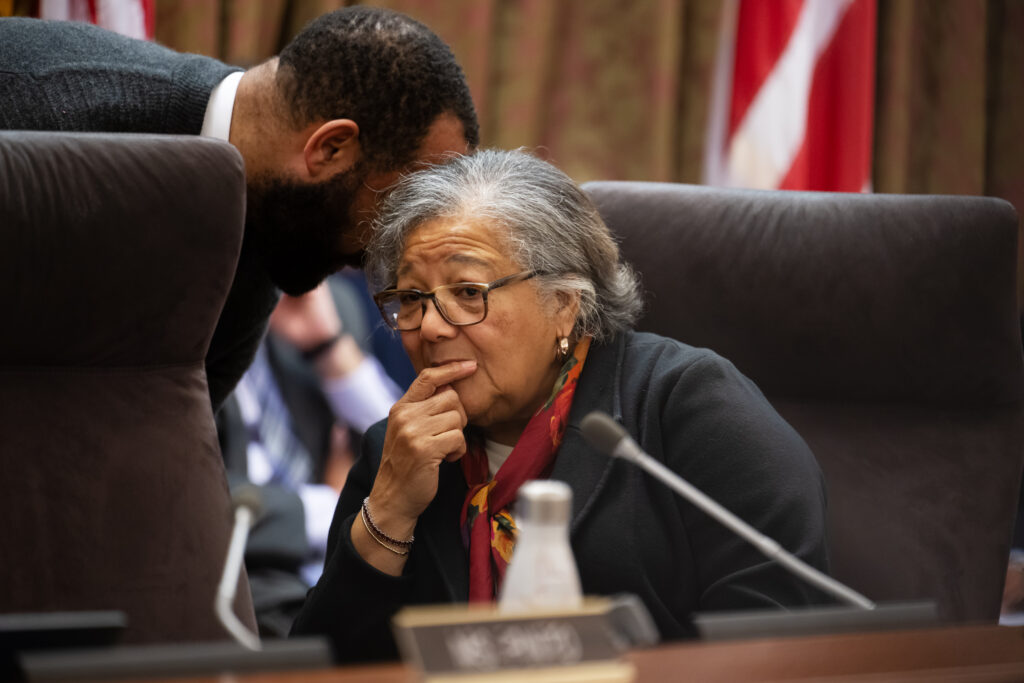
D.C. is moving forward with ranked-choice voting in next year’s June primary election, after an attempt by a group of D.C. lawmakers to delay the new voting method failed on Tuesday.
D.C. Council members Anita Bonds (D-At Large) and Wendell Felder (D-Ward 7) pushed an emergency measure that sought to delay ranked-choice voting until 2027, expressing concerns that the D.C. Board of Elections did not have enough time or a firm enough plan to successfully implement the new voting method by June.
“It is clear that January to June 2026 is an unacceptable calendar. It simply is not enough time to execute a new large-scale process that will have an impact on thousands of our residents,” Bonds said during the debate.
But the measure failed by a vote of 8-5, as a majority of lawmakers saw the attempt as delaying the will of voters who passed a ballot initiative last year and, with an election cycle already underway, inappropriately halting a voting method that candidates and voters were expecting to use.
Council member Charles Allen (D-Ward 6) said lawmakers needed to stop the “confusing messaging we keep sending out of, ‘will we, won’t we’” and implement ranked-choice voting because it is already the law and it is moving forward.
“It is unfair to the candidates and to the campaigns to have their rules changed on them midstream,” he said. “I do believe this is going to be probably one of the most consequential elections that we have in recent memory, with more open seats and competitive races than we’ve probably seen in quite a while. To me, that is all the more reason ranked-choice voting has to be on our ballot this election, because it will better capture the voters’ choices.”
Gary Thompson, chairman of the D.C. Board of Elections, said in an interview that the board is on track to hold a successful election with ranked-choice voting in June, while pledging that their plan includes a robust education and outreach campaign for voters who may not be familiar with the method.
“The train has left the station,” Thompson said. “We’re on schedule to implement ranked-choice voting by June 16, and it’s going very well.”
The method will mark a transformation in how local elections are held. Voters will be able to rank candidates in their order of preference; if no one gets a majority in the first round of counting, lower-performing candidates are eliminated and votes for them are redistributed until someone surpasses 50 percent.
D.C. is joining multiple jurisdictions nationwide, including New York City and Alaska, in adopting the method. Advocates say it allows voters to vote their conscience since they do not have to select a single person but can rank their top choices, and incentivizes candidates to reach more people.
“Making a transition to ranked-choice voting is difficult and it is in many ways a sea change for a jurisdiction depending on how the systems had been set up prior,” said Michael Thorning, director of structural democracy at the Bipartisan Policy Center, who recently co-wrote a paper examining ranked-choice voting nationwide.
Voter education has tended to be crucial to success in places that have switched to ranked-choice voting, the report found.
Some D.C. lawmakers on Tuesday — most of whom have opposed ranked-choice voting — raised concerns that the D.C. Board of Elections would not be able to transform the elections process and conduct a strong enough voter outreach campaign in time for the 2026 primary.
Bonds, Felder, Trayon White Sr. (D-Ward 8), Kenyan R. McDuffie (I-At Large) and Chairman Phil Mendelson (D) voted in favor of the delay.
Lawmakers’ concerns grew out of a hearing last month in Bonds’s committee in which they spent hours asking Monica Evans, executive director of the Board of Elections, about how preparations for ranked-choice voting were coming along. Evans said the board could stand up ranked-choice voting by June. But she also suggested it was a big lift, and that the Board of Elections has repeatedly been asked in recent years to do herculean work on tight timelines to make major changes to elections systems.
“We’re not typically asked what it would take for an implementation team — we’re essentially told ‘make it happen,’ and that’s the posture we generally approach new legislation with,” Evans said.
When council member Zachary Parker (D-Ward 5) asked directly whether the board had enough resources and time to implement ranked-choice voting, Evans said it was “kind of a tricky question” and she could not give a yes or no answer.
“The reason I say that is because more time, more money, means more touchpoints. So we will absolutely be able to engage in a voter-education outreach campaign, but as far as how robust that campaign will be, that will depend on dollars,” Evans responded.
Mayor Muriel E. Bowser (D), who is not seeking reelection, wrote in a letter to lawmakers that the testimony raised concerns for her about whether the Board of Elections could put on a “glitch-free” election in June, and urged the council to conduct a thorough review of the board’s plans. “It is important we ensure this new voting system is rolled out in an organized and efficient way that maintains the integrity of our elections,” she wrote.
A spokeswoman for the Board of Elections declined to comment this week, and didn’t answer questions about how the board’s preparations are going.
But Thompson, the chairman, said the board is very much on track. He said Evans’s prior comments shouldn’t be interpreted as the board being unable to implement a robust education campaign, but simply that more resources are always welcome. “If we had more time or more money, that would help — but if you’re asking me whether we can proceed with ranked-choice voting on June 16, the answer is absolutely,” Thompson said.
He said preparations are divided into two categories: technical changes the board has to make to equipment and elections administration, and voter outreach.
The prep for the technical changes is “pretty straightforward,” he said, requiring new software and digital design of the ballot, work that will be done by hired vendors with experience developing those tools, he said.
The outreach work will entail educating voters, such as through mock elections using ranked-choice voting. He also said they have targeted education campaigns for groups including elderly voters, first-time or young voters, voters in areas with very low turnout, disabled voters and those with limited English proficiency.
Council member Christina Henderson (I-At Large) said the emergency bill from Bonds and Felder would simply “kick the can down the road” on voter education.
And council member Robert C. White Jr. (D-At Large) pointed out that D.C. could be in the exact same position, if not worse, if ranked-choice voting were delayed by one year. The board in that case probably couldn’t do robust voter education until after the November 2026 election to avoid confusion — but special elections could be held in 2027, meaning the board would have the same or less time for voter education, White feared.
In Ward 1, five candidates seeking to fill the seat being vacated by council member Brianne K. Nadeau (D) issued a rare joint statement urging the council to reject Bonds’s emergency bill, noting they all backed ranked-choice voting and already were planning around it.
“We have built our campaigns around ranked-choice voting from the outset. It is pushing us to reach out to every voter, rather than just a small share. It is allowing us to campaign positively, rather than attack each other,” said the statement from Brian Footer, Terry Lynch, Rashida E. Brown, Miguel Trindade Deramo and Aparna Raj.
A sixth candidate, Jackie Reyes Yanes, who recently led efforts in Bowser’s administration on community affairs, separately saidshe supported ranked-choice voting but wanted the council to ensure preparations were adequate.
Thompson said he hoped elected leaders could move forward and — like the Ward 1 candidates — join them in spreading the word about how to successfully use the new method.
“I’m hoping our political leaders cheer us on a bit. If they vote this thing down today, hopefully we can just move forward and say, ‘We’re doing this, and we’re doing it together,’” Thompson said.
The post Ready for ranked-choice voting, D.C.? It’s moving forward. appeared first on Washington Post.