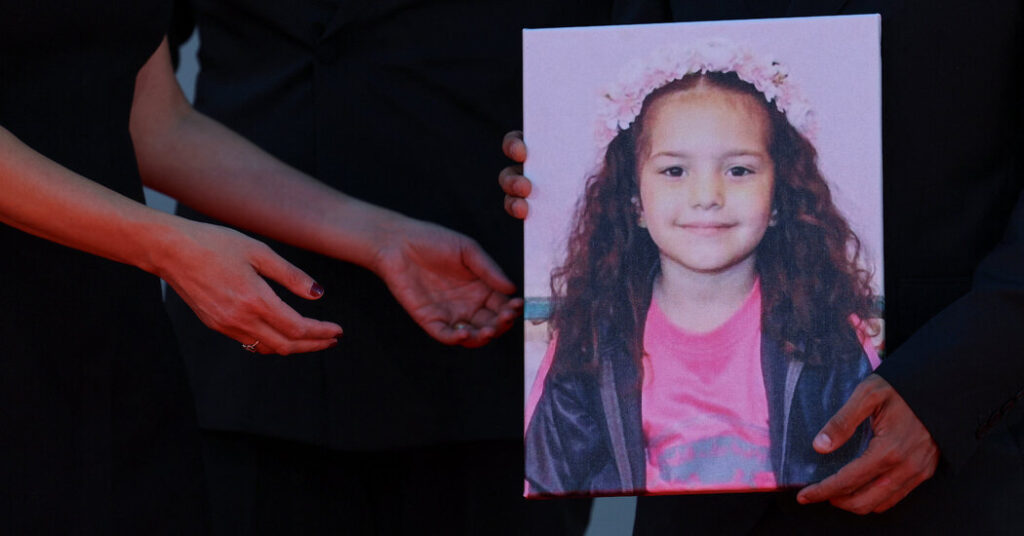
I was afraid to see “The Voice of Hind Rajab.” I knew that the movie is based on the recordings of a 5-year-old Gazan girl, trapped in a car with the bodies of her family members, speaking with rescue workers. I knew that the girl — Hind Rajab — was eventually killed, too. And I knew that the film was made by Kaouther Ben Hania, the Tunisian director who has invented ways to mix documentary and fiction filmmaking that make it impossible to look away.
The movie isn’t suspenseful, in the sense that you know how the story ends. And it is eerily kind to the viewer, who never has to see the little girl stuck in the car, the little girl terrified of being killed, the little girl dying. All you see are the rescue-center workers at their office in Ramallah (the film was actually shot on a set in Tunisia) — computers, glass partitions, a soaring but sterile view of the sky. Their task is to coordinate: to get clearance for an ambulance in Gaza to pick up the child. It’s an eight-minute drive for the ambulance, but the car can’t set off until its mission and route are approved — we never know exactly by whom. Eventually, as I knew going in, the ambulance would be shelled by Israeli forces and everyone would die.
What I didn’t realize when I resisted seeing the movie was that these deaths were not its subject. The subject of the movie is the moral injury inflicted on people who became implicated in these deaths, even as they tried to prevent them. Had I known, I might have been even more scared of seeing “The Voice of Hind Rajab,” because this focus hits even closer to home.
The most important word in this film is “coordination.” This word is whispered and yelled, mouthed with desperate need, shouted with disdain, and called forth as though it were a magic spell.
Coordination is the process by which rescue workers arrange for a safe route for an ambulance. At one point, Mahdi, one of the four central characters in the film, explains the process: He calls the Red Cross in Jerusalem; the Red Cross calls a unit of the Israeli Defense Ministry called COGAT, which stands for Coordination of Government Activities in the Territories; COGAT and troops on the ground agree on a route, which is communicated to the Red Cross, which sends it to Mahdi — who said, “But receiving the route doesn’t mean we have the green light. The green light to deploy the ambulance is another step from A to Z. I have to follow this procedure to the letter, because if we don’t, they could shoot at our ambulance and say it’s our fault.”
It’s a long process, and like any bureaucratic process, it consists primarily of waiting. Omar, another rescue worker, who has been speaking to Hind directly, finds the waiting intolerable. He wants to bypass coordination and dispatch the ambulance directly. But Mahdi can’t risk the lives of the rescue workers on the ground.
The word “coordination” jumped out at me because this word — Gleichschaltung in German — had a special meaning in 1930s Germany. It was used to describe the process of people and institutions falling in line: universities adopting Nazi policies, prominent entrepreneurs and academics swearing allegiance to Hitler or wearing Nazi symbols. Some people “coordinated” because they believed in the Nazi project, others coordinated because they felt it would advance their careers or bring profits to their businesses, and still others coordinated because they felt they had no choice.
(Ben Hania, the director, told me by email that she was not aware of that resonance. “In the film, the term ‘coordination’ is the direct translation” of the Arabic word “tanseeq,” she wrote. “Any resemblance to other historical uses of the term is purely coincidental and was not part of my intention or reference while making the film.”)
The people in this film have no choice but to coordinate, but their relationships to coordination are different. Mahdi seems to see it as his duty to follow the rules, because that will keep the maximum number of people alive. Omar sees himself and his colleagues as becoming complicit in inflicting fear, injury and ultimately death on the little girl. Mahdi points to photographs of Gazan rescue workers who have died: He is struggling to protect those who remain. Omar yells at him. “How can you coordinate with the army who killed them and all those people?” he asks. Eventually, they come to blows. Omar curses about green lights and coordination, and shouts, “It’s because of people like you that we’re occupied.”
A couple of years ago, I spent several months reporting on an underground network of Russian volunteers who were doing similar work, getting people out of occupied or besieged parts of Ukraine. The people I interviewed were opposed to the war, but their work involved a seemingly endless series of compromises, big and small. The hardest cases — very sick or elderly people who needed to be evacuated by ambulance, for example — required the volunteers to work with the Russian military, the same military that was reducing Ukrainian towns to rubble, the rubble from underneath which people had to be rescued. I was told that sometimes, after people were rescued, Russian propaganda outlets would use them to illustrate the supposed cruelty of Ukrainians and the humanity of the Russian state. The volunteers continued their work, at great personal risk, because they had decided that they cared about saving lives more than they cared about being used by the propaganda machine.
At one point in “The Voice of Hind Rajab,” Omar proposes that the Palestinian Ministry of Health call the Israeli military to pitch the idea that they rescue Hind and use her for propaganda purposes. The people in the room seem stunned at the suggestion. It may sound brilliant, but it would not work. An unspoken understanding hangs in the air — Palestinians have been so thoroughly dehumanized by the Israeli media that it’s unimaginable that even a 5-year-old girl could be seen as anything but the enemy.
Eventually, there is an approved route, but still no “green light.” The little girl, of course, cannot understand how it is that adults are failing to help her. One of the women rescue workers, Rana, tries to explain that the rescue workers are like a big family, and that “my brothers and sisters at the Red Crescent are coordinating,” adding, “I swear, we are doing what we can.”
She repeats: “We need to coordinate to get there.” It has been more than two hours.
One of the last times we hear the word, it’s Hind’s mother who is speaking. She has been patched in so she can speak with her child. She wants to know whether the team has coordinated. The rescue workers assure her they have.
They were about 200 feet from Hind when the ambulance was shelled. She lived for at least an hour after that.
“The Voice of Hind Rajab” had its premiere at the Venice Film Festival in September and took the Grand Jury Prize, the second-highest honor. A few days later, it was screened to great acclaim at the Toronto International Film Festival. High-profile U.S. distribution companies came calling. But then, the producers Odessa Rae and Elizabeth Woodward told me, one by one the companies peeled off. In the end, Woodward, who has a small distribution company, put together something akin to self-distribution. The movie opens in New York and Los Angeles on Wednesday. Elsewhere in the world this film, shortlisted for the Oscar for best foreign movie, has major distributors — but not in the United States or Israel. That’s a kind of coordination, too.
M. Gessen is an Opinion columnist for The Times. They won a George Polk award for opinion writing in 2024. They are the author of 11 books, including “The Future Is History: How Totalitarianism Reclaimed Russia,” which won the National Book Award in 2017.
The Times is committed to publishing a diversity of letters to the editor. We’d like to hear what you think about this or any of our articles. Here are some tips. And here’s our email: [email protected].
Follow the New York Times Opinion section on Facebook, Instagram, TikTok, Bluesky, WhatsApp and Threads.
The post The Movie I Was Afraid to See appeared first on New York Times.