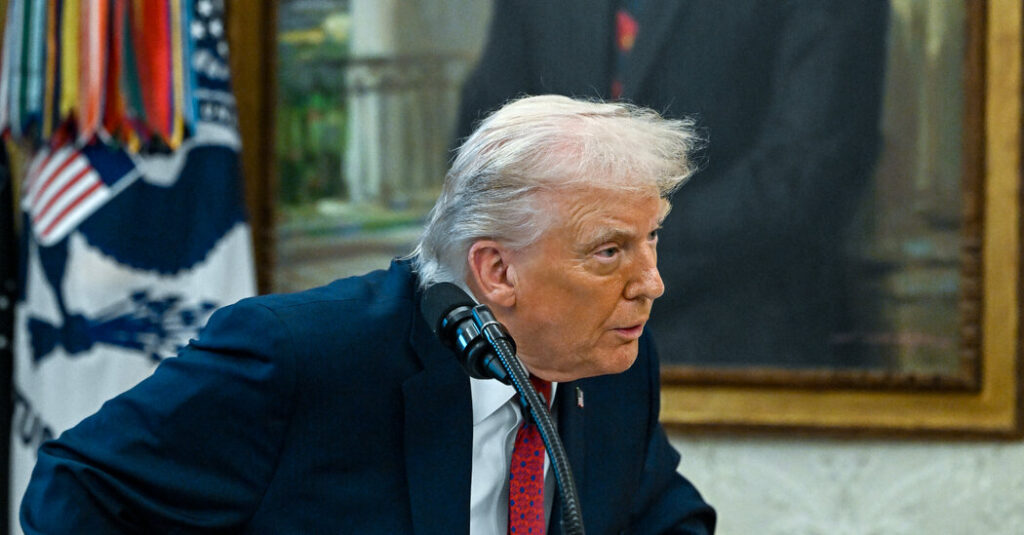
There is a presidency at work in Washington, but it is not clear that there is a president at work in the Oval Office.
Ask Donald Trump about the goings on of his administration, and there is a good chance he’ll defer to a deputy rather than answer the question. “I don’t know her,” said the president, when asked about his nominee for surgeon general, Casey Means, earlier this year. “I listened to the recommendation of Bobby,” he said, pointing to Robert F. Kennedy Jr., the secretary of health and human services.
Ask Trump for insight into why his administration made a choice, or to explain a particular decision, and he’ll be at a loss for words. Ask him to comment on a scandal? He’ll plead ignorance. “I know nothing about it,” Trump said last week, when asked about the latest tranche of photographs released from the estate of Jeffrey Epstein.
None of this on its own means the president isn’t working or paying attention to the duties of his office. But consider the rest of the evidence. He is by most accounts isolated from the outside world. He does not travel the country and rarely meets with ordinary Americans outside the White House. He is shuttled from one Trump resort to another to play golf and hold court with donors, supporters and hangers-on.
Ronald Reagan took regular meetings with congressional leaders to discuss his legislative agenda; George H.W. Bush spearheaded negotiations with the nation’s allies and led the United States to war in Iraq; and George W. Bush was, for better or worse, “the decider” who performed leadership for the cameras as much as he tried to exercise it from the Oval Office. Trump is a ubiquitous cultural presence, but there is no outward sign that he is an active participant in running the national government. He was mostly absent during discussions of his signature legislation — the Big Beautiful Bill Act — and practically AWOL during the monthlong government shutdown.
It is difficult for any president to get a clear read on the state of the nation; it takes work and discipline to clear the distance between the office and the people. But Trump, in his second term, does not seem to care about the disconnect. Abraham Lincoln once remarked that it would “never do for a president to have guards with drawn sabers at his door, as if he fancied he were, or were trying to be, or were assuming to be, an emperor.” A president has to be engaged — attentive to both the government and the public he was elected to serve.
Trump is neither. He is uninterested in anyone except his most devoted fans, and would rather collect gifts from foreign businessmen than take the reins of his administration. “The president doesn’t know and never will,” Susie Wiles, the White House chief of staff, said in an interview with Vanity Fair, commenting on the work of Elon Musk in the first months of the year. “He doesn’t know the details of these smallish agencies.”
Instead, the work of the White House has been delegated to a handful of high-level advisers. Russell Vought, the director of the Office of Management and Budget, is the de facto shadow president for domestic affairs. As one senior government official told ProPublica, “It feels like we work for Russ Vought. He has centralized decision-making power to an extent that he is the commander in chief.” It was Vought who orchestrated the administration’s assault on the federal bureaucracy, including the wholesale destruction of U.S.A.I.D. It was Vought who either froze or canceled hundreds of billions of dollars in funding for anti-poverty programs, H.I.V.-reduction initiatives and research into science, medicine and technology. And it is Vought who has been pushing the boundaries of executive power as he attempts to turn the federal government into little more than an extension of the personal will of the president — as channeled through himself, of course.
If Vought is the nation’s shadow president for domestic policy, then Stephen Miller is its shadow president for internal security. Miller, Trump’s top domestic policy adviser, is using the president’s authority to try to transform the ethnic mix of the country — to make America white again, or at least whiter than it is now. He is the primary force behind the expansion of Immigration and Customs Enforcement and Customs and Border Protection into a roving deportation force. He has pushed both agencies to step up their enforcement operations, targeting schools, restaurants, farms and other work sites and detaining anyone agents can get their hands on, regardless of citizenship or legal status. It is Miller who is behind the militarization of ICE, the use of the National Guard to occupy Democrat-led cities and assist deportation efforts, and the plan to blanket the United States with a network of detention camps for unauthorized immigrants and anyone else caught in his dragnet.
Traditionally, presidents have had a mostly free hand in the conduct of American foreign policy. But here as well, Trump has handed the power of the presidency over to a set of figures — inside and outside of government — who are not so much acting on his behalf as they are acting in his stead. Marco Rubio, the secretary of state, and Pete Hegseth, the secretary of defense, are orchestrating a war — and possibly regime change — in Venezuela, while Steve Witkoff, a real estate developer, and Jared Kushner, the president’s son-in-law, are busy pushing a so-called peace deal that would give large parts of Ukraine to Russia, rewarding Vladimir Putin for his decision to wage a war of conquest.
In his foreword to Theodore Sorensen’s 1963 book, “Decision-Making in the White House,” President John F. Kennedy wrote that the “heart of the presidency is therefore informed, prudent, and resolute choice” and that the “secret of the presidential enterprise is to be found in an examination of the way presidential choices are made.”
.op-aside { display: none; border-top: 1px solid var(–color-stroke-tertiary,#C7C7C7); border-bottom: 1px solid var(–color-stroke-tertiary,#C7C7C7); font-family: nyt-franklin, helvetica, sans-serif; flex-direction: row; justify-content: space-between; padding-top: 1.25rem; padding-bottom: 1.25rem; position: relative; max-width: 600px; margin: 2rem 20px; }
.op-aside p { margin: 0; font-family: nyt-franklin, helvetica, sans-serif; font-size: 1rem; line-height: 1.3rem; margin-top: 0.4rem; margin-right: 2rem; font-weight: 600; flex-grow: 1; }
.SHA_opinionPrompt_0325_1_Prompt .op-aside { display: flex; }
@media (min-width: 640px) { .op-aside { margin: 2rem auto; } }
.op-buttonWrap { visibility: hidden; display: flex; right: 42px; position: absolute; background: var(–color-background-inverseSecondary, hsla(0,0%,21.18%,1)); border-radius: 3px; height: 25px; padding: 0 10px; align-items: center; justify-content: center; top: calc((100% – 25px) / 2); }
.op-copiedText { font-size: 0.75rem; line-height: 0.75rem; color: var(–color-content-inversePrimary, #fff); white-space: pre; margin-top: 1px; }
.op-button { display: flex; border: 1px solid var(–color-stroke-tertiary, #C7C7C7); height: 2rem; width: 2rem; background: transparent; border-radius: 50%; cursor: pointer; margin: auto; padding-inline: 6px; flex-direction: column; justify-content: center; flex-shrink: 0; }
.op-button:hover { background-color: var(–color-background-tertiary, #EBEBEB); }
.op-button path { fill: var(–color-content-primary,#121212); }
Know someone who would want to read this? Share the column.
What do we make of a president who chooses not to make these choices?
For Chief Justice John Roberts and the conservative majority on the Supreme Court, the answer is to deliver that president an expansive grant of executive power. In a series of decisions on the court’s so-called shadow docket, Roberts and his allies have backed Trump’s repeated claims to virtually uncontested authority over the entire executive branch. The court has allowed the president to fire officials otherwise shielded by for-cause protections created by Congress, and has signaled quite clearly that it intends to overturn a New Deal-era decision that affirmed the power of Congress to create agencies that are independent of the president’s direct control.
The theoretical basis for the court’s expansion of executive power is the “unitary executive theory.” Devised by lawyers in the Reagan administration, themselves frustrated by the many legislative obstacles to presidential ambition, the theory holds that the Constitution’s executive vesting clause — “the executive power shall be vested in a president of the United States of America” — is a broad grant of inherent authority. This inherent authority — drawn as well from Article II’s command that the president “take care that the laws are faithfully executed” — includes the power to dismiss executive branch officials at will.
This sounds reasonable until you realize that legislative limits on removal are one of the key ways that Congress holds the president accountable. A nonpartisan official tasked with carrying out the public good or investigating executive branch malfeasance cannot do her job if the president can dismiss her at will for any reason under the sun — or for no reason at all. Imagine a member of a regulatory body, fired because she might threaten the interests of a favored donor, or an inspector general pushed out because he uncovered wrongdoing.
Proponents of the unitary executive theory call it necessary for presidential accountability. This is backward. The theory works, instead, to shield the president from legislative scrutiny — to render him unaccountable accept for a single, quadrennial election. This runs against the structure of the Constitution, which imagines not separation of powers but separated institutions sharing powers. The idea that Congress cannot insulate officials from direct presidential control would shock those members of Congress, among them delegates to the constitutional convention, who voted to do exactly that in the 1790s, when the ink had barely dried on the Constitution. Or perhaps they were mistaken and it is Roberts — and the conservative legal community — which understands the true scope of presidential power.
Whether or not the unitary executive theory is historically or intellectually grounded, it is undoubtedly true that in the hands of a president such as Trump, greater executive power is less a means to make the government more accountable than it is a license for presidential dictatorship. It puts something like sovereign power in the hands of one man to use as he sees fit, with few opportunities for real accountability until the next election. Think Bonapartism with an American twist.
But there is something ironic at work in this effort to concentrate executive power in the name of constitutional fidelity. It is being done on behalf of a president who is mostly missing from the business of government. The unitary executive lacks an executive. And the president we have isn’t unitary. He has given his newfound power away to a small set of virtually unaccountable advisers, insulated from public outcry and indifferent to public opinion.
There is a strong argument that far from a grant of presidential power, the executive vesting clause was a simple statement of structure: There shall be one magistrate and not a council of magistrates. This was the subject of real debate during the Philadelphia Convention and the vesting clause exists to make this clear. Alexander Hamilton’s disquisition on “energy” in the executive branch — found in Federalist No. 70 — is a response to critics who thought republican government needed a plural executive, not a brief for unlimited presidential authority.
The modern presidency is very different than the one the framers envisioned. But one important aspect of the overlapping systems of accountability and control that emerged over the course of two centuries — in response to real and difficult problems of governance — is that they affirmed and reaffirmed the principle of presidential responsibility that drove the decision to create a single executive. A government with independent and nonpartisan officials is a government that can make clear, to the people’s representatives in Congress, if the president is honoring the public’s trust.
The purpose of the presidency is to carry out the aims of Congress and help govern the nation on behalf of its people — not, as this Supreme Court would have it, to carry out the political will of the president. It makes sense that, from time to time, Congress would put some institutional distance between its goals and the president’s agenda. This doesn’t diminish accountability — it enhances it. Put another way, independence can provide voters a clear view while direct political control can be used to obscure, occlude and obstruct.
In fact, we can see quite clearly that the concentration of presidential power in this administration has done more to make the government unaccountable than it has opened it up to public input or made it more responsive to public discontent.
The embrace of the unitary executive theory by both the president and the court has given us the worst of all worlds: An ultrapowerful presidency without an actual president at the helm. A figurehead whose viziers exercise unitary authority on his behalf, running roughshod over both the law and common decency in pursuit of their own narrow agendas.
The White House is a lost cause, but one might hope that the Supreme Court would be attentive enough to the conditions of the real world to think twice about continued pursuit of its ideological project. But these are principled conservatives. They believe in their theories. And they intend to see them through, no matter the cost to the Constitution or the damage done to American democracy.
The Times is committed to publishing a diversity of letters to the editor. We’d like to hear what you think about this or any of our articles. Here are some tips. And here’s our email: [email protected].
Follow the New York Times Opinion section on Facebook, Instagram, TikTok, Bluesky, WhatsApp and Threads.
The post The Man Who Rules the Country Presides Over Nothing appeared first on New York Times.