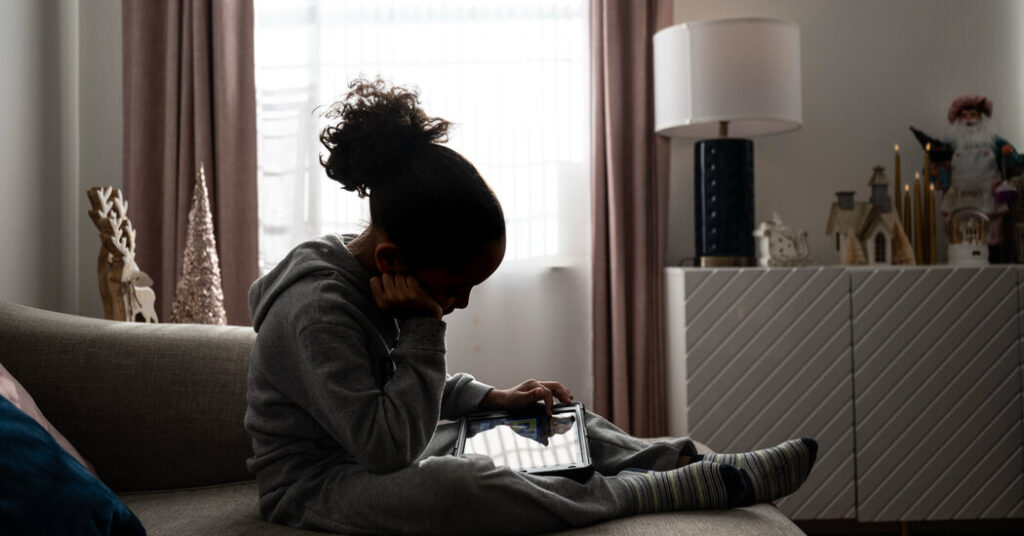
Ara Calcano knew the public education system in New York City was failing her young son when he constantly confused letters and sounds while his classmates were becoming proficient readers.
His teachers wondered whether he might have dyslexia. But each year, he was moved ahead anyway. He was barely able to read above kindergarten level by the time he entered third grade, a crucial year because students who can’t read well by then face a far greater risk of never graduating high school.
It took Ms. Calcano more than two years, dozens of hours of meetings and calls, and pleas to a lawyer to get help for her son, who was growing increasingly demoralized.
“I felt alone,” Ms. Calcano said. “It was like, ‘You’re the parent. You deal with it.’”
It wasn’t supposed to be like this. After generations of students with dyslexia languished in New York City schools, Eric Adams, the outgoing mayor, pledged to change course.
The issue was personal: Mr. Adams’s own dyslexia went undiagnosed until college and he feared being asked to read aloud in his public school classes. On the campaign trail and in office, he frequently portrayed his struggles with reading as a foundational part of his biography.
Mr. Adams spoke in lofty terms about transforming the biggest public education system in the United States into a national model for how to find and serve children like him.
Today, though, New York is still falling short of its promise — and its mandate under federal law — to provide an equal education for every child with dyslexia, according to interviews with more than a dozen parents, advocates for students with disabilities and special education lawyers.
Sarah Part, a senior policy analyst at Advocates for Children of New York, said that the mayor’s record was decidedly mixed.
On one hand, he achieved several meaningful wins, bringing more attention to dyslexia and joining a broader national movement to overhaul reading instruction and embrace practices rooted in brain science and how children learn.
But too often, Ms. Part said, students remain unable to access the support they need. Her organization still regularly receives calls from distressed parents whose dyslexic children are struggling. And middle and high school students remain especially underserved.
“No one should be declaring victory,” Ms. Part said. “There’s still a long way to go and a lot of work left to do.”
The challenges reflect a familiar struggle for families in districts across the country, where children with dyslexia — the most common learning disability, affecting as many as 5 to 20 percent of students — are often never identified and regularly denied help.
The stakes are hard to overstate. With targeted support, students with dyslexia can become adept readers. But without it, they can join the ranks of the one in five U.S. adults who are functionally illiterate. They may spend their lives struggling to read medical prescriptions, fill out job applications or understand unwieldy transit schedules.
“It’s just completely screwed up because you’re failing kids that need the extra help,” Ms. Calcano said, who asked to withhold the name of her son, who is now 8, to protect his privacy. “This public school system needs to do more for our children.”
Nicole Brownstein, a spokeswoman for the city’s Education Department, said the city had worked to “create a sea change.” Through “universal screeners” for reading challenges, she said, the school system had assessed students’ risk for dyslexia and other learning disabilities, and taken “a data-driven approach to providing interventions.”
She also pointed to the city’s broader overhaul of how reading is taught, saying it had “revolutionized literacy instruction by going back to basics” and would expand help for disadvantaged children this school year.
Still, in New York City, the struggle to educate every student with a disability not only leaves some children behind, but also takes a financial toll. When public schools fail to serve students, families may sue in an attempt to win a private school placement and tuition reimbursement. Those cases cost the city more than $1.1. billion in recent years.
The spending has risen significantly at a time when the incoming mayor, Zohran Mamdani, will be searching for funding for his ambitious agenda. (For the sake of comparison, his proposal to make city buses fast and free would cost up to $800 million each year, according to his campaign’s projections.)
Four years ago, it seemed dyslexia reform might emerge as a legacy-defining achievement for Mr. Adams, like the creation of a free, universal preschool program was for his predecessor, Bill de Blasio.
Today, though, the story of how New York was left with a patchier record on the issue may serve as a lesson — or cautionary tale — for the next administration, education experts said.
Under Mr. Adams, the city began several small pilot programs that often significantly benefited the disadvantaged children they served. But in a sprawling system with more than 1,500 schools — where more than one in five students have disabilities — the efforts failed to address the scale of need.
Jessica Selecky, who oversees the Special Education Unit at the New York Legal Assistance Group, recalled the expectation that all children would be screened for dyslexia and that the city would make “a real push” to better serve those who had it. “Ultimately, we just didn’t see that,” she said.
“It became a piecemeal approach,” Ms. Selecky added.
After a yearslong advocacy campaign by mothers, the city opened two so-called literacy academies, serving several dozen students so far, during Mr. Adams’s term. The city also created a handful of specialized programs for dyslexia and added staff members to help struggling readers.
Many advocates point out that Mr. Adams helped eliminate the stigma around dyslexia, a notable shift in a city that has long been reluctant to tackle the issue head-on.
“I do have to give credit,” said Naomi Peña, a mother of four public school children with dyslexia. “The fact that we’re finally saying the word ‘dyslexia’ is massive.”
Ms. Peña, who helped push the city to open the two literacy academies, said families enrolled in them often saw their children rapidly become more confident. “They’re walking taller, they feel smarter, they’re not using words like ‘I’m dumb,’” she said.
In the second half of his tenure, though, Mr. Adams made few policy announcements centered on dyslexia. His schools chancellors did not mention the disability in the two most recent State of Our Schools speeches, the annual addresses meant to promote the city’s education accomplishments and priorities.
New York City was never expected to fix decades-old problems overnight. But even some political allies who were vocal champions of the Adams administration’s work on the issue have grown increasingly disillusioned.
Robert C. Carroll, a Brooklyn assemblyman with dyslexia who has been at the forefront of legislative efforts on the issue, joined the mayor onstage at a Harlem school in 2022 to celebrate his dyslexia plan.
Three years later, though, Mr. Carroll became sharply critical of the city’s commitments. He argued that Mr. Adams’s legal and ethical troubles — he was the first mayor in the city’s modern history to face criminal charges — became a distraction that hampered any push for change.
“Eric — because of his many issues — not only did not have the follow through, but basically did nothing for kids with dyslexia,” Mr. Carroll said in an interview. “They were a punchline to a press release.”
“This task is incomplete right now — and incomplete in a long way,” he added.
Mr. Adams said in a statement that he was proud his administration had “prioritized finding a new approach to dyslexia,” adding that the “results speak for themselves.” The city’s overall reading scores jumped by seven points on the most recent state tests. (English scores also rose by seven points statewide.)
“I’d like to think my 7-year-old self would be proud of me,” he said.
Still, several special education lawyers said that the next administration had to devote more time and money to students with dyslexia to truly make a difference.
Nelson Mar, a senior staff attorney at Bronx Legal Services, which provides free help to low-income residents, said he had recently worked with several clients whose children clearly have dyslexia, but attend schools that still seem unsure how to offer them the support they need.
Mr. Mar said that while “clearly there has been progress,” it ultimately remained “a very small drop in the bucket.”
He recalled the story of one of his clients, Leticia Johnson, who faced a yearslong struggle to help her son, Kashawn, much of which coincided with Mr. Adams’s time in office. Kashawn could barely read a simple sentence after third grade, his mother said.
She added that she believed his Bronx elementary school ignored his problems for years, and that it seemed as though some of his teachers simply wanted to “hurry up and get him out of there because they didn’t want to deal with him.”
Mr. Mar stepped in, and her son, now in seventh grade, is receiving more support. But the help came long after it became evident he likely had dyslexia, and after Kashawn and his mother had endured many painful school years.
“He really slipped through the cracks,” Ms. Johnson said, her voice breaking. “You all did not give him the help he needed. I shouldn’t have to go and get an attorney. I shouldn’t have to sit there and cry, beg and plead for somebody to listen to me.”
“They failed him.”
Troy Closson is a Times education reporter focusing on K-12 schools.
The post Eric Adams Pledged to Help Dyslexic Students. Many Say He Fell Short. appeared first on New York Times.