In 2006, when the US National Oceanic and Atmospheric Administration (NOAA) released the first-ever Arctic Report Card, scientists already knew the top of the world was in trouble.
It’s now much worse, according to the 20th edition of the report, which tracks the health of the polar region across multiple indicators.
The last 10 years have been the Arctic’s hottest 10 on record. Warm Atlantic waters have pushed into the central Arctic Ocean, hastening the loss of sea ice. With less ice to reflect sunlight back into space, and faster-melting snow, the region is primed to warm further. And as Arctic permafrost thaws, it releases more heat-trapping carbon dioxide into the atmosphere.
Compiled by some 100 scientists from around the world, the 2025 report chronicles changes that are profound, not only for those living in northern latitudes but for all of Earth, since the Arctic acts as the world’s air conditioner. (“To observe the Arctic is to take the pulse of the planet,” as the authors wrote.)
The effects of some of these shifts aren’t yet well understood by experts — such as “rusting” rivers, the northward movement of certain plants and animal species and rising plankton populations.
“There’s no question that today we’re at a starkly different point than we were 20 years ago,” said Twila Moon, deputy lead scientist of the National Snow and Ice Data Center at the University of Colorado at Boulder and one of the editors of the report card.
Here’s a summary of key findings over the Arctic’s air, water and land.
Air
- From October 2024 to September 2025, Arctic-wide surface air temperatures were the warmest in at least 125 years. (Hydrologists typically measure the year from Oct. 1 to Sept. 30 to better align with seasonal rainfall and snowmelt cycles.)
- Precipitation over the same period was the highest since 1950. Overall, the atmosphere over the Arctic is becoming more moisture-laden, causing more extreme precipitation events, including atmospheric rivers that can cover large expanses with rain or snow.
Water
- Summer sea surface temperatures were among the hottest on record in much of the region. In August, some areas were as much as 7C (12F) above the average from 1991 to 2020.
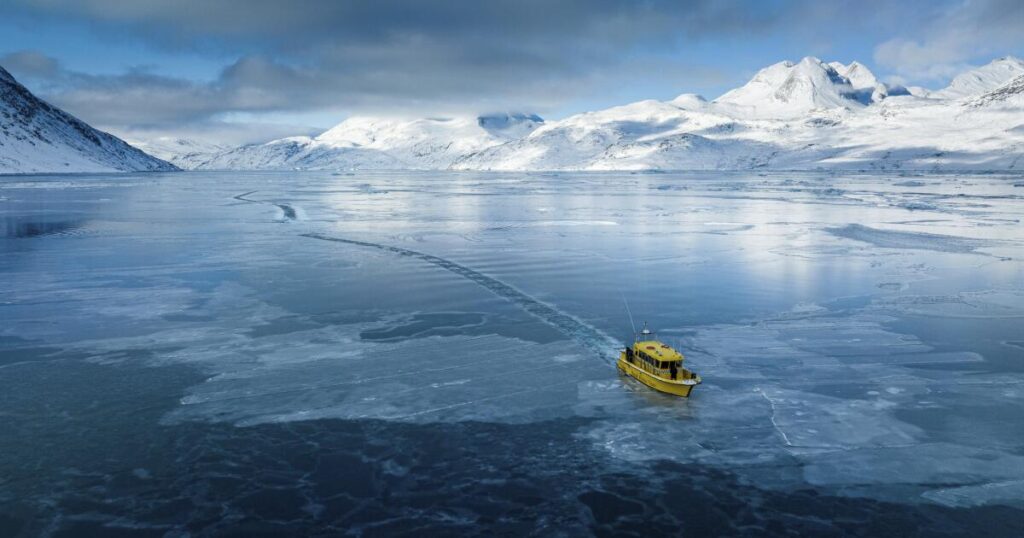
- The yearly peak coverage of sea ice in March was the smallest observed in 47 years of satellite records, while summer sea ice coverage was 28% smaller than two decades ago.
- The ice isn’t just shrinking; it’s also getting younger and thinner. The oldest, thickest ice in the Arctic — the kind that stays frozen for four years or more — has declined by more than 95% since the 1980s.
- Marine algae, like phytoplankton, are growing more quickly as ocean heat waves supercharge a process called “ocean primary productivity.” Since 2003, that measure has increased 30.5%.
Land
- Rapid spring snowmelt meant the area still covered by snow in June was smaller than normal, despite higher-than-average winter snowfall. Today the total Arctic area covered by snow in June is half what it was in the 1960s.
- As permafrost thaws, it appears to be releasing iron and other elements into rivers and streams. This may explain why over 200 watersheds in Alaska have turned orange in the past decade, a phenomenon called rusting. According to Moon, warming may be altering not just the amount of water in the Arctic, but its quality as well.
- The Greenland Ice Sheet lost less mass than in most recent years — but it still shrank. The ice sheet has posted a net loss every year since the late 1990s.
On its 20th anniversary, the report arrives amid a grim outlook for climate science funding in the US. Although the research is carried out by experts around the world, NOAA’s support is key, said Moon.
There’s recognition “across society writ large” that immediate problems like extreme weather and food availability are connected to the climate, she said, which is reason to be optimistic about the future of Arctic and climate science.
Moon said she hopes “that this realization — that these kind of climate and weather elements are in fact foundational to our daily lives, and our business and work and family decisions — ultimately means that there’s support.”
Bochove writes for Bloomberg.
The post The Arctic’s annual physical finds an environment that’s breaking down appeared first on Los Angeles Times.