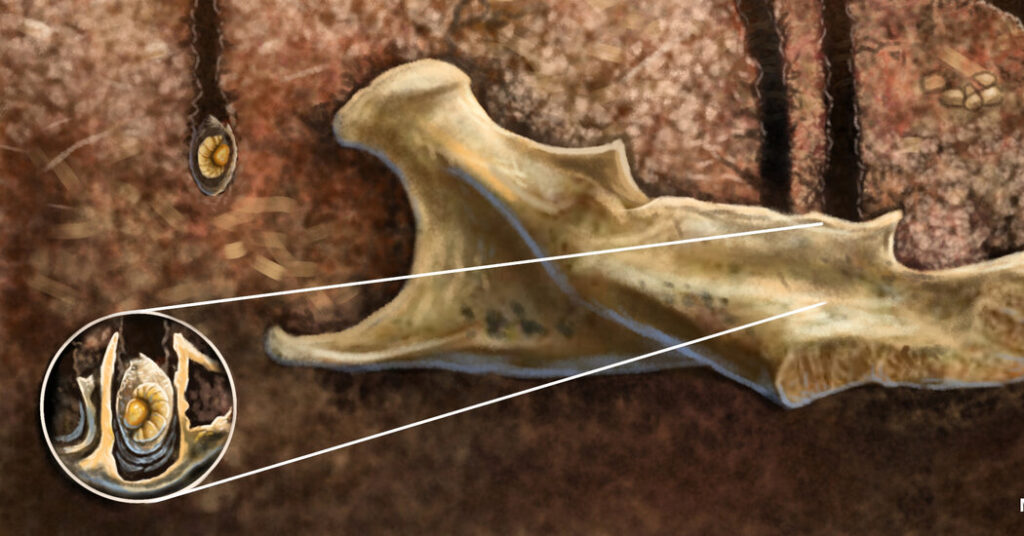
In a cave thousands of years ago, giant owls scarfed down the spoils from their hunts. With eyes that were apparently bigger than their stomachs, the owls regurgitated bone-rich pellets onto the cave floor.
In the process, the birds were unwittingly helping the bees. Scientists analyzing fossils from the cave, in what is now the Dominican Republic, recently discovered odd sediments lodged in the tooth sockets of rodent skulls. In a paper published Wednesday in the journal Royal Society Open Science, the scientists posit that the oval-shaped traces represent the petrified nests of prehistoric bees.
According to Lazaro Viñola López, a paleontologist at the Field Museum in Chicago and lead author of the paper, the cave’s layers of bones were ideal for the bees there. “It was this perfect situation with lots of decomposing fossils that lacked teeth,” he said. “These chambers provided protection for the bees’ nests.”
Dr. Viñola López first encountered the site during his doctoral studies at the Florida Museum of Natural History. A colleague suggested they excavate Cueva de Mono, a cave in the Dominican Republic that a local landowner had unsuccessfully tried to turn into a septic tank. Dr. Viñola López and a fellow doctoral student, Mitchell Riegler, ventured into the cave and discovered thousands of bones, deposited over the past 20,000 years.
So far the team has identified remains of some 50 species of vertebrates, including sloths, lizards, tortoises and even crocodiles. Cueva de Mono is particularly rich in fossils from extinct relatives of hutias, a group of stocky Caribbean rodents. Evidence suggested these partially digested fossils were brought into the cave by the prehistoric relatives of barn owls.
As soil washed into the cave, it buried the jumble of fossils and filled bone cavities with sediment. As the team cleaned the dirt off the bones in the lab, Dr. Viñola López noticed that some tooth sockets contained oddly smooth structures that reminded him of fossilized wasp cocoons.
To describe the structures, the researchers micro-CT scanned the rodent skulls and created three-dimensional digital copies of the sediment structures, which were smaller than the eraser on a pencil.
A closer inspection revealed that these multilayered structures exhibited the caring craftsmanship of a bee.
The vast majority of bees build subterranean nests that range from simple burrows to complex clusters. They often coat their nests in a waxy, waterproof substance that protects larvae and the pollen that they eat.
The structures found in the rodent jaws were strikingly similar to the nests of modern bees. Some even contained grains of ancient pollen. The team also observed nests in the recess of a rodent’s vertebrae and a cavity within a ground sloth’s tooth.
None of the bees themselves were preserved, making it difficult to identify the species that left the nests behind. But according to Phillip Barden, an evolutionary biologist at the New Jersey Institute of Technology who was not involved in the study, the fossilized nests themselves provide a wealth of data on the species’ ecology and behavior.
The researchers propose that a solitary species of bee left the trace fossils, which the scientists named Osnidum, from the Latin words for “bone” and “nest.” The existence of nests in multiple layers of bones reveals that bees were returning to the site’s fossils for hundreds, or even thousands, of years. One rodent’s tooth socket had six generations of nests stacked atop one another.
While bees have been known to craft nests inside mud, dung and even sand-filled snail shells, the Osnidum maker is the first known bee to construct nests within animal bones.
The insects are only the second known bee species to nest in caves. It is likely that they didn’t have a choice according to Mr. Riegler, a coauthor of the new paper who remains at the Florida Museum of Natural History. He notes that the surrounding area sits on coarse limestone, and the little soil that does accumulate is washed into caves like Cueva de Mono.
Dr. Barden isn’t surprised that the bees kept coming back to the cave once they had found a safe place to bury their offspring.
“Any port in a storm,” he said, “or any skull in a cave.”
The post When the Bones Were Good, These Bees Buried Their Babies appeared first on New York Times.