The U.S. military campaign in Latin America is ratcheting up pressure on Colombia, a major nexus of the region’s drug trade, as tensions simmer between President Trump and Colombia’s president, Gustavo Petro.
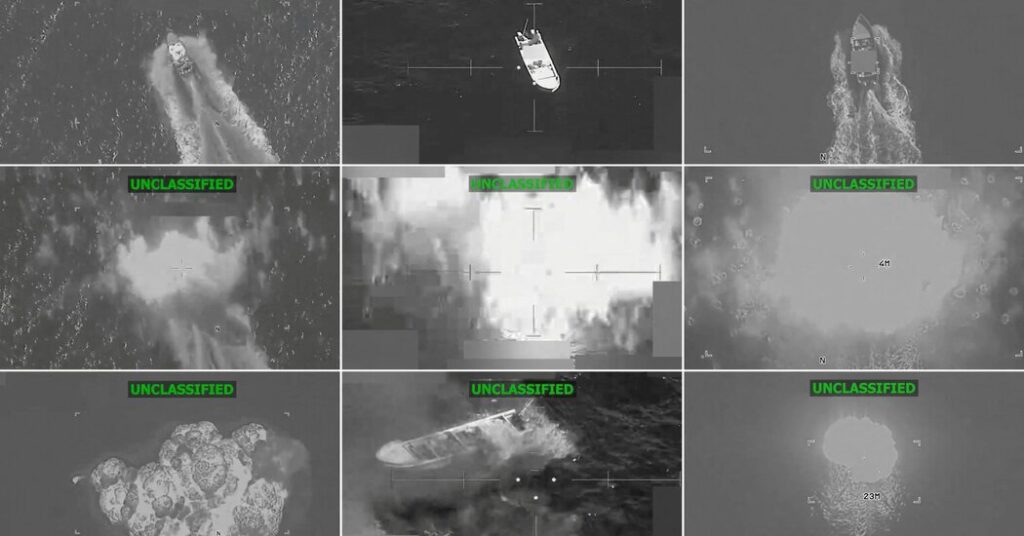
In one of the deadliest days since the campaign began in September, the U.S. military destroyed three boats on Monday in the eastern Pacific that the Trump administration said was smuggling drugs, killing eight people, according to the U.S. Southern Command.
The recent attacks by the U.S. military suggest a shift in geographical focus after the initial strikes in the Caribbean.
All five of the strikes over the past month were in the Pacific, laying bare how the U.S. campaign has pivoted to increasingly target Colombia, which has a long Pacific coastline that experts say is rife with routes for smuggling cocaine. The Trump administration on Tuesday also designated the Clan del Golfo, a powerful Colombian drug cartel, as a terrorist organization.
Out of 25 strikes since Sept. 2, 14 have been in the Pacific and 11 in the Caribbean, resulting in 47 people killed in the Pacific compared with 48 in the Caribbean.
The latest strikes also potentially reflect expanding U.S. priorities and have deepened a feud between Washington and Bogotá.
The U.S. campaign began by striking boats from Venezuela, a minor player in the global drug trade, while Colombia is by far the world’s largest cocaine producer. (Venezuela is also not on the Pacific.)
Mr. Trump has also been lashing out at Mr. Petro after the Colombian leader emerged as one of Latin America’s fiercest critics of the U.S. strikes, saying they amount to murder. Mr. Trump responded by threatening to slash assistance for Colombia, even though a significant portion goes to help the country take on the cocaine industry.
Going further, Mr. Trump last week said Colombia was “producing a lot of drugs” and put Mr. Petro on watch. “So he better wise up or he’ll be next,” Mr. Trump said. “He’ll be next soon. I hope he’s listening; he’s going to be next.”
Similarly to Mr. Petro, a broad range of experts in laws governing the use of lethal force have also called the strikes illegal, arguing that the administration has not shown that an armed conflict exists between the United States and Venezuela.
The same argument could be applied to Colombia, which has a long history of counternarcotics cooperation with the United States. Hitting back, Mr. Petro has said, “Trump is being misled by his inner circles and advisers.”
Mr. Trump has falsely claimed that each destroyed boat saves 25,000 American lives. There were nearly 100,000 overdose deaths in the United States during the 12-month period that ended June 30. But the primary driver of those deaths was fentanyl, which comes from labs in Mexico. Venezuela and Colombia, experts say, play no known role in the fentanyl trade.
Instead, South America produces cocaine. Most of the cocaine that reaches the United States is smuggled from the Pacific Coast of South America, largely from Colombia, but also from Ecuador and Peru. Venezuela is an insignificant producer of cocaine, and the cocaine that is transported through that country mostly goes to Europe.
It is unclear how many of the boats destroyed in the Pacific may have departed from Colombia. The only two survivors to be repatriated to their home countries from the attacks were from Colombia and Ecuador.
While the latest U.S. strikes on boats have been taking place in the Pacific, the broader U.S. military deployment in Latin America is also expanding to include other targets as seen in the seizure last week by U.S. forces of a tanker in the Caribbean that was carrying Venezuelan oil.
On Tuesday, Mr. Trump’s national security adviser and secretary of state, Marco Rubio, and Defense Secretary Pete Hegseth briefed lawmakers about the boat attacks operation and, according to people familiar with the matter, offered a new argument for focusing on Venezuela: The Maduro administration, the officials are said to have claimed, has been hosting drug-trafficking organizations by allowing them to operate on Venezuelan territory.
Two Colombian Marxist guerrilla groups that have financed their militant activities through cocaine trafficking — the National Liberation Army, or the E.L.N., and the Revolutionary Armed Forces of Colombia, a now-defunct group known as FARC — have sometimes operated from camps in the jungles of Venezuela, across the border from Colombia, according to specialists in Latin American crime and narcotics issues.
In October, Venezuela’s government said it had destroyed two Colombian “narcotrafficking terrorist” camps on its territory and had found pamphlets for the E.L.N. at one of them. The Trump administration said a boat it struck on Oct. 17, killing three men, was linked to the E.L.N., which the State Department designated as a foreign terrorist organization in 1997.
Carol Rosenberg contributed reporting from Guantánamo Bay, Cuba, and Charlie Savage and Julian E. Barnes from Washington.
Simon Romero is a Times correspondent covering Mexico, Central America and the Caribbean. He is based in Mexico City.
The post U.S. Boat Strikes Shift to Pacific, Placing Colombia on Watch appeared first on New York Times.