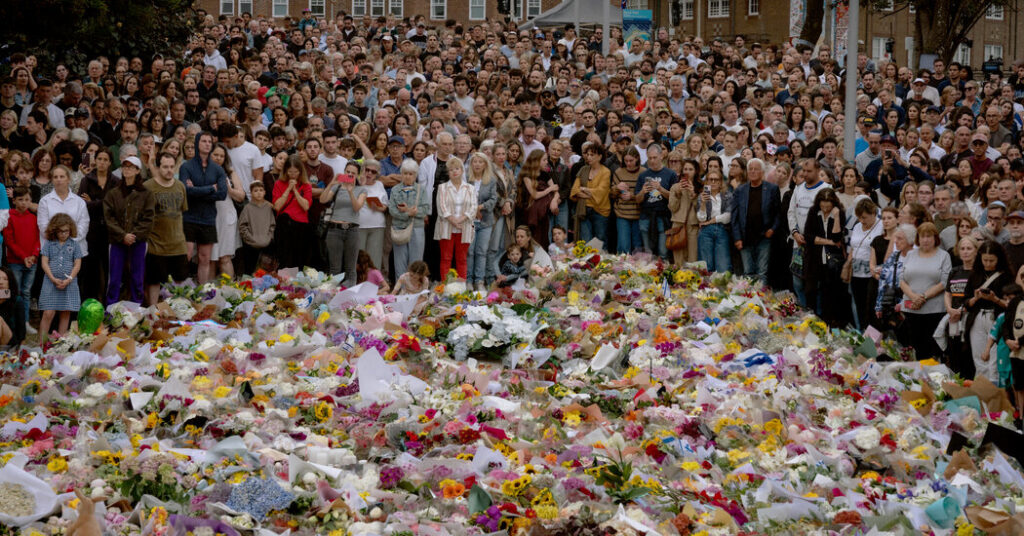
Australia’s prime minister blamed “Islamic State ideology” on Tuesday for motivating a father and son accused of killing at least 15 people at a Jewish holiday event in Sydney’s Bondi Beach this week.
Hours later, he made a hospital visit to Ahmed el Ahmed, a Syrian immigrant who has become a national hero for grabbing a gun from one of the gunmen before being shot in the shoulder.
The two moments captured competing strains of Australia’s struggle to understand the attack on Sunday, the deadliest act of violence on Australian soil since 1996, and what the recent massacre means for the nation’s approach to immigration, antisemitism, gun control and racism.
The authorities identified the older suspect on Tuesday as Sajid Akram, an Indian national who moved to Australia in 1998 and was killed by the police responding to the shooting. His 24-year-old son was born in Australia, officials said. He was reportedly in a coma, and the authorities said two homemade Islamic State flags had been found in the car they drove to the beach.
The disclosures fueled concern about rising antisemitism in Australia, reflected in a string of graffiti and arson attacks over the past 18 months. In a diverse country that relentlessly debates immigration, many are now on edge about Islamist radicalization — and a potential Islamophobic backlash. Fliers online are calling for a “MIDDLE EASTERN BASHING DAY” at a beach south of Bondi where riots to “reclaim” the area occurred 20 years ago.
At the same time, the actions of Mr. el Ahmed, 43, a Muslim shop owner who also immigrated in the 1990s, offered a counterpoint. His mother, in Australia, veiled and speaking Arabic, told reporters she was proud to hear her son was “helping people and saving lives.”
Prime Minister Anthony Albanese called him “a true Australian hero” while standing outside St. George Hospital in front of an Australian flag lowered to half-staff.
Again and again, these rival narratives clash. Villains vs. heroes: Which will the country choose to make dominant? Australia, a country where “she’ll be right” is a mantra of optimism and, sometimes, complacency, faces an enormous challenge to its cohesion.
There are ominous episodes in its past, including a “White Australia” policy that barred nonwhite immigrants until the early 1970s. There are also examples of Australia’s finding solutions in tough times.
After a mass shooting in Port Arthur, Tasmania, killed 35 people in 1996, Australians threw almost universal support toward a gun-law overhaul and buyback plan that pulled thousands of weapons off the streets and banned semiautomatic rifles.
Even the 2014 Lindt Café terrorist attack — when an Iranian-born refugee held more than a dozen people hostage for 16 hours, killing two before being shot by the police — produced good will. Thousands of Australians posted their commute schedules on social media with #Illridewithyou to let Muslim riders know they had a safe companion on trains and buses.
Many Australians now see a similar urge to keep rage from getting out of hand.
“I think the average Australian feels incredibly sad and really worried about the effect this has on not just victims but society more broadly,” said Jill Sheppard, an associate professor of politics at the Australian National University.
What Australians want and will push for, she added, is what they know: stability.
“They don’t love overreactions to things; they don’t like shock,” Ms. Sheppard said. “They are used to stability because it’s part of the country’s institutional DNA.”
Democracy scholars have long argued that extremes stay at the fringe in Australia because of mandatory voting and a nonpartisan election commission that defines districts without gerrymandering. Politicians here have little incentive to fan the flames of emotion when turnout across the spectrum is guaranteed.
The aftermath of this attack reflects that dynamic.
Susan Ley, the leader of the conservative opposition coalition, responded by offering the prime minister “full and unconditional support.”
When another conservative lawmaker, Andrew Hastie, said the Bondi massacre should spur a rethink of immigration policy, Ms. Ley instead suspended a previously planned rollout of a contentious proposal to lower the number of immigrants accepted.
On Monday, she said gun reform “must be on the table.” On Tuesday, she announced a task force to press for stronger actions against antisemitism.
Mr. Albanese maintains that his government has done a lot (banning Nazi symbols and toughening hate-crime laws), but he also said it would do more to confront a documented escalation of antisemitism since Israel’s war against Hamas in Gaza.
Last December, a synagogue in Melbourne was firebombed. In January, two synagogues in Sydney and a child-care center were marked with hateful graffiti, including swastikas, while cars in Jewish areas and Jewish restaurants have also been set ablaze.
After Australia accused Iran of orchestrating at least some of the attacks — and expelled its diplomats — the two major political parties now find themselves in a race to approve recommendations from a July report by a special envoy on antisemitism, while praising emergency medical workers and heroes like Mr. el Ahmed.
He has become the nation’s favorite reprieve, and source of hope.
“The fact that this was a Syrian guy — a Middle Eastern guy who is a national hero — God, what a blessing,” said Simon Chapman, emeritus professor of public health at the University of Sydney and the author of a popular book about the Port Arthur massacre and gun laws. “As soon as I saw his nationality, I thought this is going to be so, so important for dampening down the racist debate.”
Managing the aftermath will still be difficult. Emotions flared instantly in Bondi, where videos showed an older white man stomping on the shooters right after the police shot and brought them to the ground on the footbridge from which they had been firing.
At the house where the police say the gunmen lived in Bonnyrigg, a working-class area in Sydney’s western outskirts, a bewildered delivery driver arrived on Tuesday with an offensive gift for a Muslim family: a half leg of ham. An attached message included a racial slur.
Across the street, Glenn Nelson, a neighbor, blamed the attack on Australia’s immigration policies, which he called too lenient.
“The government’s got their own agenda — keep bringing people in,” he said.
A short drive away, Ahmad Hussein, 55, a Halal butcher, said he felt frustrated by the language that had been used to describe the shooting.
“When a Muslim goes on a rampage or something, it’s a terrorist,” he said. When a person who is not a Muslim does something similar, he said, “it’s a gunman.”
Mr. Albanese seems aware of such tensions. In interviews, he has spoken more softly and slowly than usual — as if raising his voice just a little might incite violence.
Jews worldwide have sharply criticized him for being too inert. In Sydney, too, frustration has often boiled over, sharpening grief with questions about what went wrong.
Ben Wright was at the Hanukkah festival on Sunday, sponsored by Chabad of Bondi, where he is a congregant. He said he saw friends killed as he and his wife dived over their three children.
In an interview on Tuesday, he said many in the community were still grappling not just with loss, but also with conflicting urges about what to do now.
“As an instinct, as someone who was at the event, you want to see radical change,” he said.
“At the same time,” he added, “you know that’s not the answer.”
He called on Australian leaders to start with greater transparency and by scrutinizing their failures as antisemitic violence had intensified before the attack.
For example, the police acknowledged that the younger gunman had associations with Islamic extremists a few years ago. Officials offered little detail on why he had not been ruled a threat.
They have also not explained how the government allowed the older suspect to have guns legally after his son was linked to an Islamic State terrorism cell.
“I feel like that should be public knowledge,” said Mr. Wright, who was at the Hanukkah festival on Sunday.
What he did not want for Australia was the kind of closed-border approach that President Trump put in place for several countries, mostly from Africa and the Middle East, after a refugee from Afghanistan was accused of killing two National Guard troops in Washington last month.
“Just because you lock the border from a country doesn’t mean your locking out all terrorists,” Mr. Wright said. “It also doesn’t mean that all people from a certain background are terrorists — 99.99999 percent of all Muslims are good people.”
Despite fear, despite his own outrage over a massacre of Jews in a country where his grandparents fled after the Holocaust because it was as far as far could be, Mr. Wright said he and the Jews he knows do not want revenge. They just want moral and practical improvement, and a return to Australian stability.
“The Torah tells us there are seven things needed for all of humanity, and if you break them down, it’s being a kind and just person,” he said. “That’s all we want.”
Livia Albeck-Ripka, Yan Zhuang and Victoria Kim contributed reporting.
Damien Cave leads The Times’s new bureau in Ho Chi Minh City, Vietnam, covering shifts in power across Asia and the wider world.
The post After an Antisemitic Atrocity, Australia Looks for a Path Forward appeared first on New York Times.