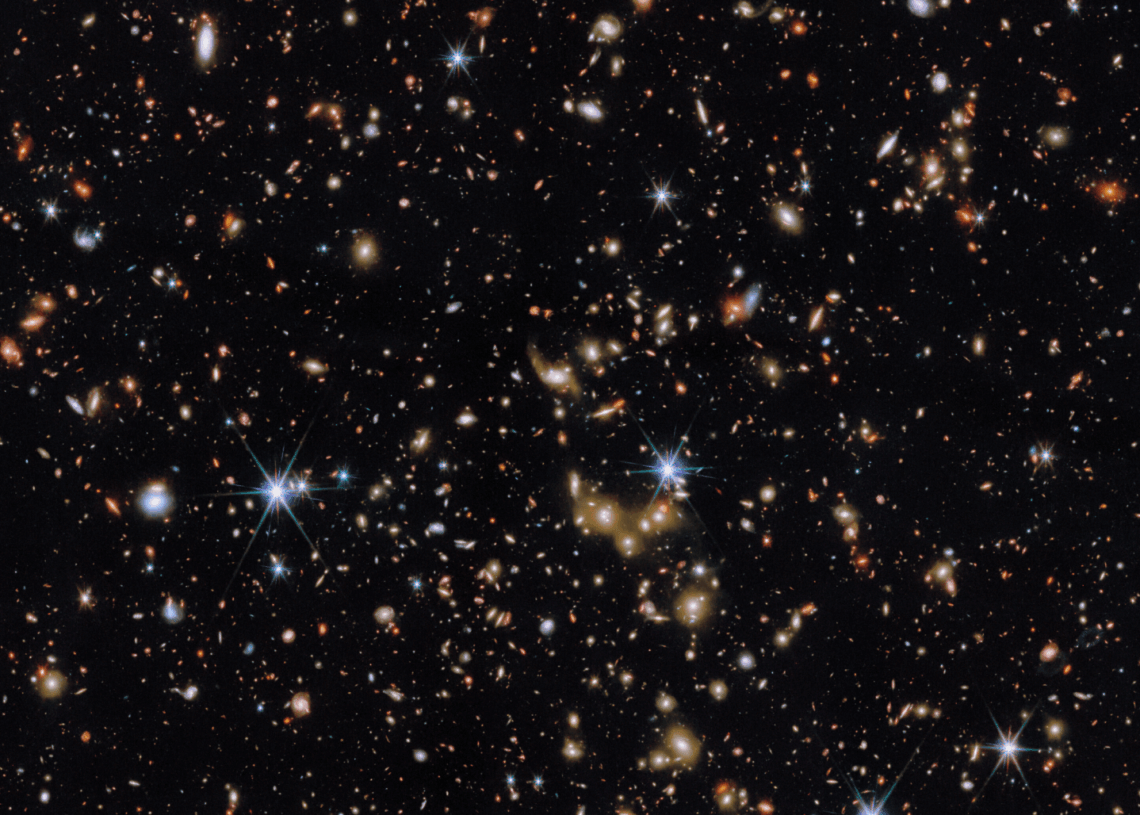
Astronomers have spotted a massive, gargantuan structure out in the distant universe, and it’s spinning. The word “structure” here can be a bit misleading. You hear it, and you think of the Death Star, a giant building or craft out in space created by intelligent beings. That’s not what this is.
Using South Africa’s MeerKAT radio telescope, an international team of researchers led by the University of Oxford has identified the biggest rotating filament of galaxies ever observed. An incomprehensibly vast strand of matter stretching millions of light-years, filled with entire galaxies spinning in coordinated motion, as reported by Reuters and as the researchers detailed in the majestically named Monthly Notices of the Royal Astronomical Society.
That, in cosmic terms, is a structure.
Scientists Discover a 50-Million-Light-Year-Long Spinning Space Object
These filaments are part of the universe’s cosmic web, massive, ahem, structures held together by dark matter. That’s the invisible stuff thought to make up about 85 percent of all matter.
They act like intergalactic scaffolding, guiding how galaxies form, grow, and move. The structure itself is impressive, but what’s particularly fascinating about it is its synchronicity.
The researchers essentially took a sample of a “razor-thin” chain of 14 galaxies, measuring about 5.5 million light-years, within the preposterously gargantuan structure. That sample is itself part of a larger filament that spans roughly 50 million light-years and contains around 280 galaxies.
A lot of those galaxies seem to be spinning in the exact direction as the filament itself. Meaning that the structure isn’t just holding the galaxies together but is actually influencing how they rotate.
This is a big deal, because as the studies’ co-lead author, Oxford’s Lyla Jung, told Reuters, “This is the largest individual spinning structure so far detected.”
It was previously believed that these filaments had only a marginal effect on galaxies over short periods. If this research holds up to scrutiny, the opposite might be true. They might shape galactic motion way more than we thought, and over vast timescales.
Something so grand can be hard to wrap your head around. Luckily, Jung explained in a way that we dummies can understand—in the language of theme park rides.
One way to picture it, Jung explained, is like the teacup ride at a theme park. An individual galaxy is like the cart you sit in. That cart spins on its own, but it is itself on a platform that is also spinning. That dual motion is providing researchers with incredible insight into how galaxies get some of their spin from the structures they live within.
The post 50-Million-Light-Year-Long Spinning Space Object Is the Largest Ever Found appeared first on VICE.