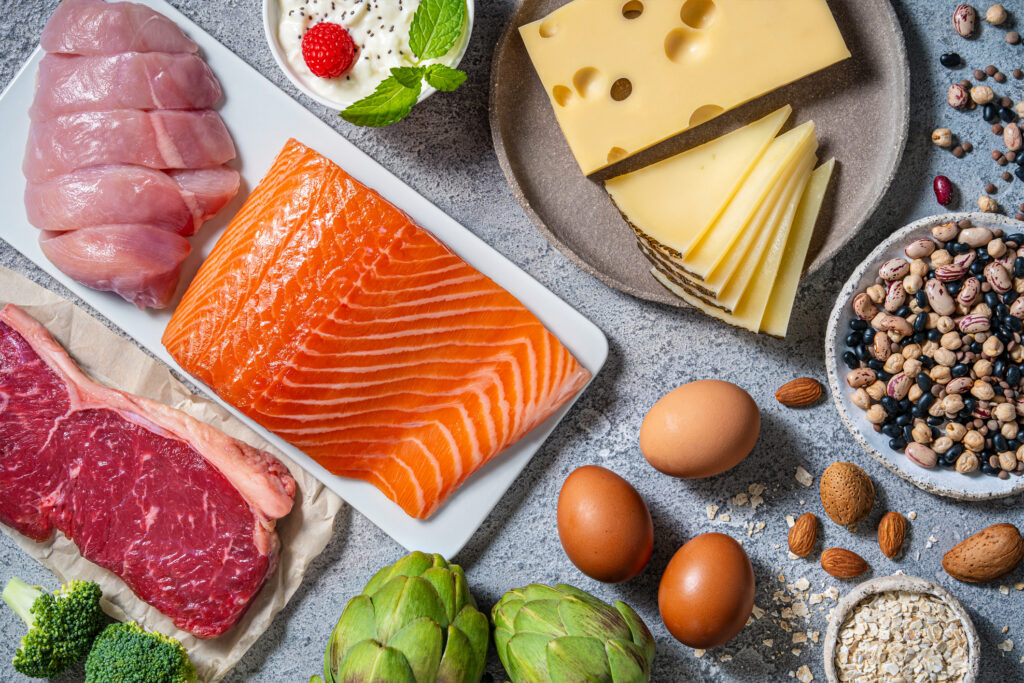
As you get older, your body will invariably begin to shed muscle.
This age-related decline in muscle mass starts at about age 30 and accelerates after you turn 60. It can cause a loss of strength, endurance and mobility. Severe muscle loss in older adults, known as sarcopenia, can lead to sickness, disability and death.
But you can significantly slow or delay muscle loss as you age by eating enough protein and doing resistance training.
That’s according to Stuart Phillips, a professor in the department of kinesiology at McMaster University in Canada and a leading expert on protein, muscle health and aging. Phillips, 59, has spent years studying how exercise and nutrition can mitigate sarcopenia and age-related muscle loss. He has published more than 400 studies and scientific review papers, and his work has been cited thousands of times.
Phillips argues that eating the right amount of protein is a critical part of staying healthy as you age. But he also says that many health influencers recommend amounts of protein that are excessive, which has helped fuel a protein craze, and not beneficial. “Eating more and more protein isn’t necessarily better for you,” he said. “It’s not like there are endless streams of benefits associated with higher intakes of protein.”
The National Academy of Medicine says the amount of protein the average adult needs on a daily basis is 0.8 grams per kilogram of body weight, or the equivalent of 0.36 grams per pound of body weight. That’s about 54 grams of protein for a 150-pound person — or roughly the amount of protein in a 4-ounce chicken breast and one cup of Greek yogurt. Some health influencers point out that this amount — known as the recommended dietary allowance, or RDA — is the bare minimum you need to avoid being malnourished and argue that you should be eating as much as one gram of protein per pound of body weight each day.
Phillips says the truth lies somewhere in the middle. He says that for optimal health, the average adult should aim to eat around 0.54 to 0.73 grams of protein per pound of body weight daily. Eating this amount — along with regular bouts of strength training — can help you build and maintain lean muscle as you age and stave off conditions such as sarcopenia.
We wanted to know how Phillips’s knowledge affects his daily eating habits. So we caught up with him to find out what he eats in a typical day; whether his diet and health advice have evolved as he approaches 60; and what he recommends eating for a long and active life. This interview has been edited for length and clarity.
What’s your overall approach to diet?
My diet would be classified as higher in protein. I eat more than the recommended dietary allowance. But it’s definitely not over-the-top protein. I don’t overdo it on protein.
How do you start your day?
My day usually starts just with a cup of coffee. Then I exercise almost right away. I work out at home for the most part. And then breakfast immediately follows the workout. I’m pretty regimented about that. I’ve always been a morning person. I’m up early, usually around 5 a.m. I don’t need to set an alarm — I’m one of those freaks that just naturally wake up early. I don’t mean to be blasé about it, but it’s easy for me.
But I also go to bed early. I’m usually asleep by 10 most nights. I’m up early, coffee starts it off, I work out fasted almost habitually, and then it’s usually a pretty big breakfast.
What’s your typical breakfast?
I focus on protein at breakfast. I think that it’s the most important meal because you’re breaking a fast. It’s the longest period of the day that you go without protein, which is at least eight hours but probably closer to maybe 10 or 12 hours. My go-to food at breakfast is Greek yogurt. I really like the taste. It’s a great breakfast food. It’s dairy, so it has a lot of calcium. It’s enriched in vitamin D. And it has a number of other important nutrients in there, like potassium, so it’s nutrient-dense. But it’s also rich in protein. I think that it fits well into the breakfast rubric. I drink kefir — fermented milk — as a breakfast drink along with it.
Can you tell us why you like kefir?
Fermented dairy foods like yogurt and kefir consistently show up in studies as being very health-promoting — on par with any higher-protein food.
I get that kefir is probably not for everybody. People say, “Oh, it’s expensive.” But it’s not. I’ve found it pretty cheap, especially in more ethnically focused grocery stores, which I have in abundance because I live near a university. Kefir may be an acquired taste for some people. But it’s a staple for many people around the world.
When I first started drinking kefir, I thought, “Oh, that’s a different taste.” But then I started mixing it in smoothies and didn’t notice it. I buy it from different stores that sell it in different flavors. And I cook with it, as well. It’s pretty versatile. I have three sons who think it’s disgusting. But I like it. I like the texture and the flavor. I’ve essentially just switched it for milk.
Do you add anything to your Greek yogurt?
I generally mix the yogurt with berries, which are usually frozen. Blueberries are one of my favorites, which, again, are not overly expensive if you get them frozen. Sometimes I blend in some oatmeal or granola. I’d say my breakfast is at least 600 to 700 calories and has about 30 to 35 grams of protein.
That’s more protein than most people would be getting at breakfast. I find it has a very good satiety effect. I don’t need a midmorning snack. It takes me all the way to lunch, which is almost always exclusively eaten at my desk.
What’s your usual lunch?
I generally eat it around noon. It sounds so boring, but I pack my own lunch just about every day. It’s usually two slices of multigrain bread, tuna and then at least two or three pieces of fruit, like an apple, an orange or a banana. Or it could be some other frozen or cut-up fruit. There might be one or two cookies in there, as well.
Do you drink coffee during the day?
I used to have a cup of coffee around lunch. But I’ve cut that out to improve the quality of my sleep at night. I try not to consume any caffeine after noon. It’s a struggle. My low is usually after lunch, around 2:30 or 3 p.m. Some days I can almost take a nap at my desk. That’s when I previously would reach for a cup of coffee to pick me up. Now what I try to do instead is to take a brief break from my work and go for a walk. It’s nothing like a cup of coffee, but it helps a lot.
What are your dinners like?
I like to sit down for dinner if I can. I’m traditional. My wife is also an academic. And at least two out of our three sons who still live at home join us for dinner. It’s generally a serving of chicken or fish or beef. These days, we eat a lot more plant-focused meals. Generally, some type of salad. That’s around 6:30 or 7 p.m. That’s generally the end of my eating day.
When you say plant-focused meals, can you be more specific?
I make a lot more meals with beans or legumes, like chickpeas and lentils. My wife and I are big fans. I’m getting older and I want to age well, and I’ve seen the data on plant-focused meals. It’s not every meal. I think that I would categorize myself as closer to flexitarian these days than anything else. But I make a conscious choice to eat more plants.
Can you tell us about your approach to aging healthfully?
My mantra is to talk about four things in terms of aging well: Physical activity, eating well, getting enough sleep and having social connection or purpose.
I think more and more about that these days. I’m looking at the last quarter or third of my life, and I’d like to live that in good health. Maybe my tune will change later. But I have no interest in living to 120 and feeling like I’m 120 years old. I say that now. Maybe if I ever get that far, I’ll feel differently. I’m around older people a lot, and I talk to them about this. Most of them are happy to be six feet above. It’s better than being six feet below. But they know it’s coming. They fear dementia more than anything else. And we know that there’s no treatment for dementia and that lifestyle plays a big role.
I try not to do activities that are going to increase my risk of dementia. I don’t necessarily need to have a long life, but I definitely want to have a healthy life. So some of the dietary choices that I’ve made — such as eating more plant-based meals — are to try to maximize my chances there.
Do you drink alcohol?
I never begrudge anybody a drink. I enjoy wine. I enjoy beer. But I drink far less now than I ever did — probably one or two drinks a week. That’s been a very conscious decision for me because I find that alcohol disrupts my sleep. And as I got older, it was disrupting my sleep to an increasingly greater degree. My one big Achilles’ heel is that I’m not a good sleeper, and so I try to do everything that I can do improve it. I don’t sleep long, but I try to sleep well. Bad sleep is a major contributor to dementia and lots of other health issues.
I travel a lot. I’m at a lot of conferences, and alcohol is a part of that. People go out for meals. I drink a lot more club soda than I ever did. A lot of water. People have noticed and said, “Whoa, what’s going on?” And I say it’s a sleep thing. Plus, I see more and more data showing that no amount of alcohol appears to be safe.
Do you have any favorite sweets or treats?
I love savory foods. If you put some chips in front of me, I’ll eat them. But I don’t feel the burning need to have them. I don’t mean to sound sanctimonious. It’s not a judgment on other people who have a weakness to those foods. My solution to not eating too many chips is to just not buy them. I do a majority of the shopping and food prep in my house. And if I don’t buy them, then they’re not around for me to eat them.
I will say that I’m as vulnerable to overeating as anyone if I’m in front of a buffet. I lived for a bunch of years as a grad student.
What advice do you have for our readers about nutrition and health?
My rule of thumb is that the big picture is what really matters: Physical activity or exercise plus a good diet get so much of the “job” of being healthy done. The rest — supplements, bespoke exercise prescriptions and “superfoods” — are just details. Ignore the noise and focus on the big picture.
Do you have a question about healthy eating? Email [email protected] and we may answer your question in a future column.
The post What a scientist who studies protein and healthy aging eats in a day appeared first on Washington Post.