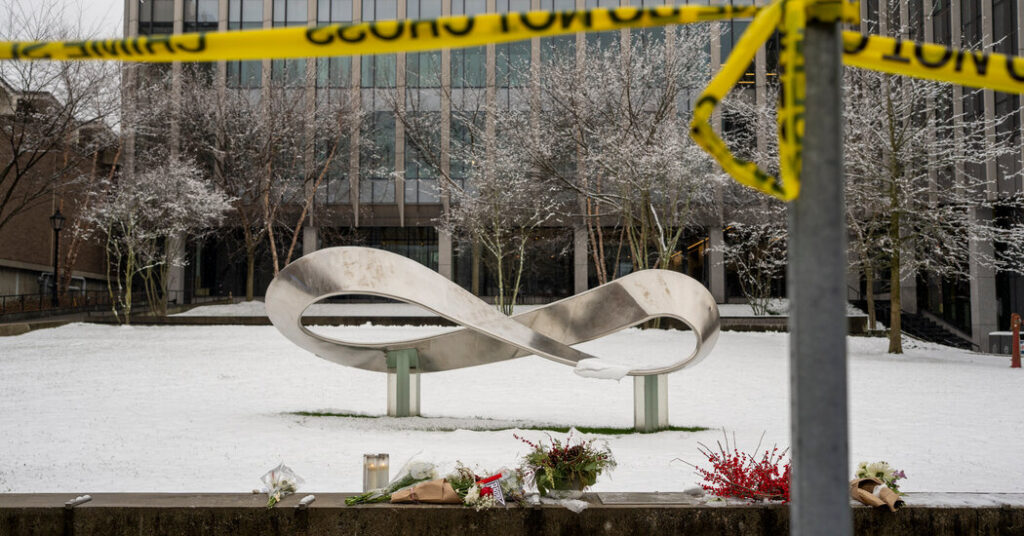
Brown University is an elite school, set high on a hill, with manicured greens and wrought-iron gates.
But one of its special features is that those gates are often open to the larger city of Providence, R.I. — both physically and metaphorically. City residents are invited to attend many events and, students and professors said, some buildings are often unlocked.
Many academic departments are housed on residential streets, in the tidy Victorian houses that dominate the city’s East Side. They sit amid the homes of professors — and Providence’s mayor. Thayer and Wickenden Streets, which are packed with restaurants, cafes and shops, are not just popular student hangouts, but also hubs for city residents.
Those streets were eerily quiet on Monday, as authorities continued to search for a shooter that entered a classroom on Saturday afternoon, killing two students and wounding nine others before slipping out into the December darkness and disappearing.
It had already been an extraordinarily difficult year for Brown. As part of its broader campaign against elite academia, the Trump administration moved to block over $500 million in research funds, then pressured the university to reach a settlement. More broadly, Brown and other selective colleges are facing questions about how well they serve the public interest.
Brown has long maintained a porous boundary between campus and city, part of its commitment to public service. Now, with the university in mourning after the shooting, some students are wondering how to balance that openness with their own safety.
“Here at Brown, we take pride in opening up to the greater Providence community,” said Ayo Lin Ince, a senior who was a teaching assistant for the economics course whose study session was interrupted by the shooter, though she was not present. “Now there’s this new perspective about the potential threat of having such an accessible campus.”
The tragedy at Brown interrupts what some community members described as a short period of relative unity on campus. In the last several years, Brown has seen protests and divisions over the Israel-Hamas War, and then negotiations with the Trump administration, which had accused the university of harboring antisemitism.
Brown and the White House reached a settlement in July, with the university agreeing to invest $50 million in Rhode Island work force development programs. Last month, the university hosted a jubilant celebration of 130 years of Jewish life on campus, with 1,000 attendees.
It is not publicly known what the gunman’s motive might be, and whether it has anything to do with campus politics. Officials have said only that he targeted Brown, not why.
But the shooting took place as leaders at Brown and other Ivy League schools have had to navigate a deeply unsettling climate. Right-leaning critics have said elite colleges are not protecting Jewish and conservative students, and are divorced from mainstream American life. At the same time, many students, faculty and alumni have called on universities to resist efforts to shut down speech and dissent.
Columbia, another Ivy with a permeable urban campus, has locked its gates to maintain security and calm in the wake of pro-Palestinian protests that drew international attention.
In the meantime, the nation’s political divides, and its violence, continue to find their way onto campuses. Charlie Kirk, the conservative activist, was shot and killed on a Utah campus in September. Just last week, one student was killed and another injured in a campus shooting in Kentucky.
Now, at Brown, there are new questions about what more the school can do to improve students’ safety, even as community members describe a strong sense of mutual support and solidarity.
Several students and parents asked why Barus and Holley, the building where the shooting took place, did not require individuals to swipe their I.D. cards at the time of the shooting. They also wondered why there were so few surveillance images of the assailant.
Authorities have said the outer doors of the building were unlocked because testing was taking place inside, and that the building had few security cameras.
On Monday, a university spokesman did not respond to questions about campus security protocols. In a Sunday letter to parents, Christina H. Paxson, Brown’s president, wrote, “My goal is for our community to work together to get through this difficult time and feel safe on our campus again.”
Christopher Ho, a 20-year old junior, said he had hardly slept on Sunday night after hearing that police had released a person of interest in the shooting, and that the assailant was still at large.
Mr. Ho attended Bellaire High School, near Houston, when a student was fatally shot on campus in January 2020. He said he will be looking over his shoulder more in his remaining years on Brown’s campus, just as he did after the 2020 incident.
“I feel like I’ve just lost social trust,” he said.
Like any college with a single-digit acceptance rate and a wealthy endowment, there have long been town-gown tensions between Brown and local residents — over taxes, real estate and policing, among other issues. But because Providence is a small city in the nation’s smallest state, Brown’s influence looms especially large.
Its doctors run the state’s largest hospital. The university contributes $1 million annually to the Providence public schools, where hundreds of students volunteer and professors help train teachers. Student actors perform at Trinity Rep, a celebrated local theater.
In turn, it is not unusual to see members of the general public freely entering campus buildings to attend Brown lectures, film screenings and performances.
Matthew A. Kraft, a professor of education and economics, said it could be difficult to reconcile the university’s values with a more locked-down campus. Increased security measures “come with real costs,” he said. “I think we should have a full conversation about both the protections they afford and the cost to relationships and openness and mental health.”
He added, “I urge us to ask what we can do to reduce gun violence and mass school shootings instead.”
Dara Kass, the mother of a first-year student and an adjunct professor at Brown, said that as an emergency medicine physician, she has long thought about how to reduce threats of violence.
Those thoughts have been far from abstract since Saturday, when her daughter, Hannah, was locked down on campus for hours, barricaded with friends in a bathroom.
Dr. Kass said it was relevant to ask questions about whether the university could do more to “harden” its facilities, whether through locking doors, installing more security cameras or investing in technology that could make it easier to communicate with students and families during an emergency, perhaps through the use of geolocation.
At the same time, she noted that a determined assailant could have still gained access to the building, even with such features in place. And she praised Brown’s culture of engagement with the wider world, noting that her family had recently attended the conference celebrating Jewish life at Brown, which was filled with alumni working in public policy, philanthropy, the arts, media and business.
“I am more committed to the school now than ever,” she said. “You go there and graduate with a sense of opportunity and obligation to give back.”
Bess Kalb, a 38-year-old Brown alumna, said the shooting had “totally shattered” any sense of the campus as a sort of utopia. Still, in a nation with so much gun violence, she said, “This felt like something that was an imaginable nightmare.”
Ms. Kalb, a popular writer with a big presence on social media, has been working from her Brooklyn apartment to connect donors to Brown students who need help leaving campus early amid the manhunt. The donors are paying for Amtrak tickets, airline change fees and Uber rides.
“There are so many first-generation and low-income students who are stranded there right now,” she said. “These students need immediate safety.”
Stephanie Saul and Lauren McCarthy contributed reporting
Dana Goldstein covers education and families for The Times.
The post At Brown, a Shooting Tests a Fragile Trust appeared first on New York Times.