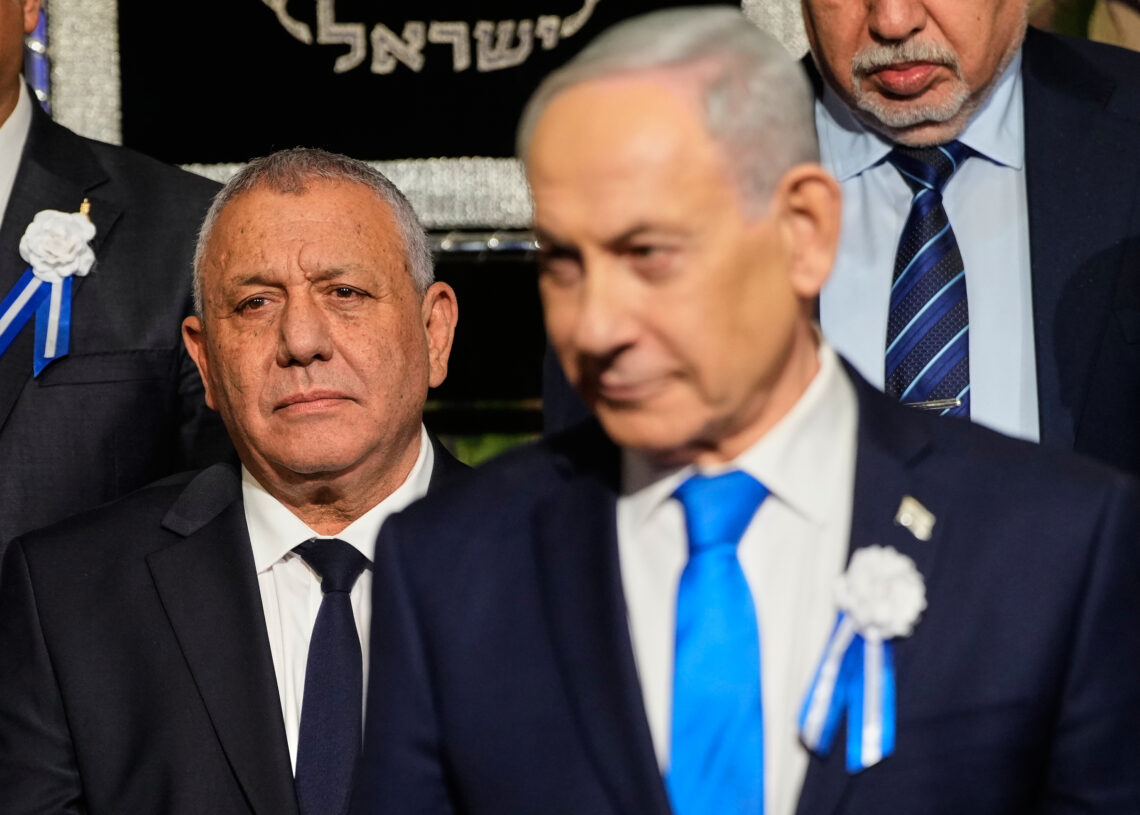
TEL AVIV — Former military chief Gadi Eisenkot called off negotiations Sunday to form a unity government with Prime Minister Benjamin Netanyahu and appeared on the cusp of forming a coalition that would oust Israel’s longest-serving leader.
Netanyahu, serving in a caretaker role, had offered concessions in hope of forging a power-sharing deal, and the two leaders held a two-hour meeting Sunday that began with a security briefing at the Kirya, the Israel Defense Forces headquarters in Tel Aviv, according to representatives for both. It was their first known formal meeting since the Oct. 27 election, in which Netanyahu lost his governing majority.
In a statement after the meeting, Eisenkot’s Yashar party and Netanyahu’s Likud said the talks were “businesslike, with both sides seeking to bridge the substantial differences between them,” the statement said.
But Eisenkot’s party decided not to continue the talks “because of the significant gaps on substantive issues,” a person familiar with the details said, speaking on the condition of anonymity to discuss sensitive coalition negotiations.
The person added that Eisenkot told Netanyahu he is committed to his “change bloc.”
Netanyahu offered Saturday to let Eisenkot serve first as prime minister in a power-sharing arrangement. Eisenkot’s opposition bloc also fell short of a majority in the October vote, but he has been shaping a deal with other factions that could exclude Netanyahu’s Likud party.
Eisenkot’s coalition, including ultra-Orthodox parties, secular nationalists and leftists, could also rely at least in part on support from Arab parties, which won a record 19 seats in the Knesset, where 61 are required for a majority.
Netanyahu, who previously insisted that he serve first in any power-sharing deal, has warned loudly against any deal with Palestinian Israelis. He wrote on X that a unity government was the way to prevent a the involvement of Arab parties, calling them “terror supporters.”
On Saturday night, Mansour Abbas, leader of the Islamist party Ra’am, which represents Palestinian citizens of Israel, recognized Hamas as a terrorist organization in a Channel 12 interview, meeting one of Eisenkot’s conditions for political cooperation — and adding pressure on Netanyahu.
In his post, Netanyahu called for a government made up of “all the parties that see Israel as the nation-state of the Jewish people.” To that end, he would agree for “Eisenkot to serve first as prime minister, and I will serve as alternate prime minister at the start of the term.”
The offer met a demand made by one of Eisenkot’s allies, former prime minister Naftali Bennett, who called on Netanyahu to commit to letting Eisenkot serve first as prime minister.
Bennett’s partner, Yair Lapid, has strongly opposed any deal with Netanyahu, saying that “this is yet another transparent scam by a serial deceiver who has cheated every partner and broken every agreement.”
Channel 14, a pro-Netanyahu outlet, reported that he wants to remain in office for several more months, until the war with Iran becomes clearer and President Donald Trump decides whether to resume military strikes.
Others interpreted Netanyahu’s flexibility as a sign of growing desperation to cling to power, with Eisenkot’s effort to form a coalition government picking up steam.
Eisenkot, a retired general, has signed agreements with Avigdor Liberman’s right-wing Yisrael Beiteinu party as well as the Democrats on the other end of the political spectrum.
On Saturday, following Netanyahu’s statement, Eisenkot spoke with the leaders of all the parties in his bloc to discuss the latest developments. He also met with Liberman.
Eisenkot could also announce a minority government backed by most of his partners in the bloc, as well as by the ultra-Orthodox United Torah Judaism party, with whom he has been negotiating in recent days.
Such a government, which would end Netanyahu’s long tenure, is also expected to win the backing of the Arab parties, Ra’am and the Joint List, even if they do not formally join the government.
Likud, despite losing its majority, won more seats than any other single party. That left Eisenkot under pressure to demonstrate openness to working with Netanyahu, but some analysts said a deal with the longtime leader was unlikely.
“The moment Eisenkot joins such a government [with Netanyahu], he dismantles his own bloc, because Yair Lapid, Yair Golan and Liberman won’t be part of it,” Shalom Yerushalmi, a political commentator for the Zman Israel news site, told Galatz Army Radio on Sunday. “Even if Netanyahu is prime minister for 10 minutes, Lapid won’t join.”
Eisenkot would be breaking his central promise to remove Netanyahu from power, Yerushalmi said, a move most of his voters would oppose.
The post Eisenkot calls off talks to form Israeli government with Netanyahu after meeting appeared first on Washington Post.