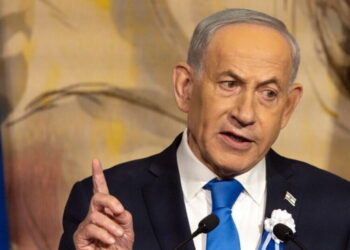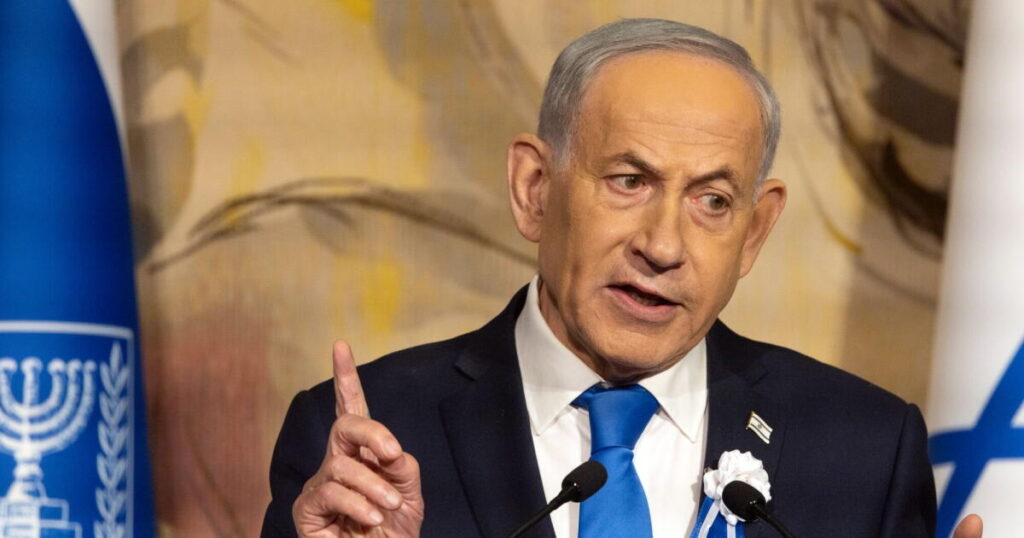
Israeli Prime Minister Benjamin Netanyahu and rival Gadi Eisenkot halted talks on forming a unity government over substantial policy differences following a two-hour meeting on Sunday, according to people familiar with the matter.
Eisenkot told Netanyahu that he remains committed to his partners in the opposition bloc and that the incumbent would be welcome to join the government once it’s formed, said the people, who requested anonymity to discuss matters that haven’t yet been made public.
The two men met in Tel Aviv to discuss a possible unity deal after Netanyahu said on Saturday he’d be willing to forgo the role of prime minister and serve under Eisenkot in the initial rotation of a power-sharing agreement, in a final effort to avoid being left out of the next ruling coalition.
The latest developments further diminish Netanyahu’s prospects of staying on as prime minister. If Eisenkot succeeds in forming a government without Netanyahu’s Likud party, it would bring an end to Netanyahu’s more than 18 years in power across three nonconsecutive stints.
Before Netanyahu’s offer, Eisenkot had been making headway toward that goal by attempting to peel away one of the incumbent’s longtime political allies. The breakdown in unity talks puts renewed focus on those negotiations.
Judging by Eisenkot’s pledges and public statements in recent months, a government without Netanyahu would probably pursue markedly different policies — including establishing a state commission of inquiry into the Oct. 7, 2023, Hamas-led attacks, adopting more narrowly defined military objectives in Iran, and taking swifter, tougher action to curb settler violence in the West Bank.
Likud officials said Sunday’s developments made clear that Eisenkot had no interest in forming a national unity government.
For weeks, the opposition had cited Netanyahu’s refusal to go second in a power-sharing deal as the reason for its failure to form a unity government, said the officials, who requested anonymity. Now that the obstacle has been removed, Eisenkot is digging in on what they described as an extreme position, without elaborating.
Netanyahu’s announcement that he’d be willing to relinquish his long-held premiership in an Eisenkot-led government “for the initial part of its term” was largely met with rejection among opposition leaders.
The exception was former Prime Minister Naftali Bennett, leader of the Beyachad — or Together — party, who’s been engaging with Netanyahu and his representatives through official and back channels to push for unity.
Yair Lapid — another former prime minister who merged into Bennett’s party and whose group accounts for almost half of Beyachad’s dozen lawmakers — broke ranks, dismissing Netanyahu’s offer as “yet another transparent scam by a serial swindler who has cheated every partner and broken every agreement.”
Eisenkot, 66, responded to Netanyahu’s offer by inviting Likud to enter fast-track negotiations: “If Likud is truly ready for genuine unity, I am prepared to test its seriousness over the next 24 hours,” he said in a statement on Saturday.
Netanyahu’s proposal was conditioned on Eisenkot assuming the lead in a power-sharing deal in a few months, during which time the incumbent would seek to resolve an unspecified “security matter,” political commentator Ben Caspit reported Saturday. Such an arrangement would be a nonstarter for Eisenkot.
Netanyahu, 77, has been advocating new strikes on Iran, reportedly pressing President Trump to launch a joint attack to further dismantle Tehran’s nuclear program. Defense Minister Israel Katz also accused Iran last week, in a briefing with Israeli reporters, of seeking to develop chemical weapons and ballistic missiles capable of reaching Europe.
Eisenkot, who met Netanyahu for a security briefing in recent weeks, has repeatedly said that while Iran remains a threat, he’s unaware of any pressing need to strike the Islamic Republic before a new government is formed.
Eisenkot’s initial 28-day mandate from President Isaac Herzog expires on Dec. 6. He’s been pushing to swear in a government before having to seek a possible two-week extension — his final window to assemble a coalition.
Until Netanyahu’s announcement, Eisenkot had been making headway toward forming a government without him, signing coalition pacts with all parties in his bloc except Bennett’s.
Such a government would bring together 48 opposition lawmakers, assuming Bennett joins, and potentially United Torah Judaism, an ultra-Orthodox party and longtime Netanyahu ally disillusioned by his failure to enshrine into law military service exemptions for ultra-Orthodox men.
Securing United Torah Judaism’s support would give Eisenkot’s bloc 55 seats, outnumbering the 46 remaining in Netanyahu’s camp.
Meanwhile, Mansour Abbas, leader of the Arab Ra’am party, indicated on Saturday that he considers Hamas a terrorist organization, appearing to satisfy the last of four conditions Eisenkot has set for parties to qualify for inclusion in his government.
That could pave the way for Ra’am to join the coalition or support it from the outside, bringing Eisenkot’s backing to 63 lawmakers — above the 61-seat majority threshold in Israel’s 120-member parliament.
One scenario floated in local media would see Eisenkot swear in a Cabinet of just five or six opposition party leaders as early as this week or next, while continuing negotiations to bring other parties on board, including Likud, United Torah Judaism or Ra’am.
Altstein writes for Bloomberg.
The post Israel’s Eisenkot, Netanyahu halt unity government talks amid major differences appeared first on Los Angeles Times.