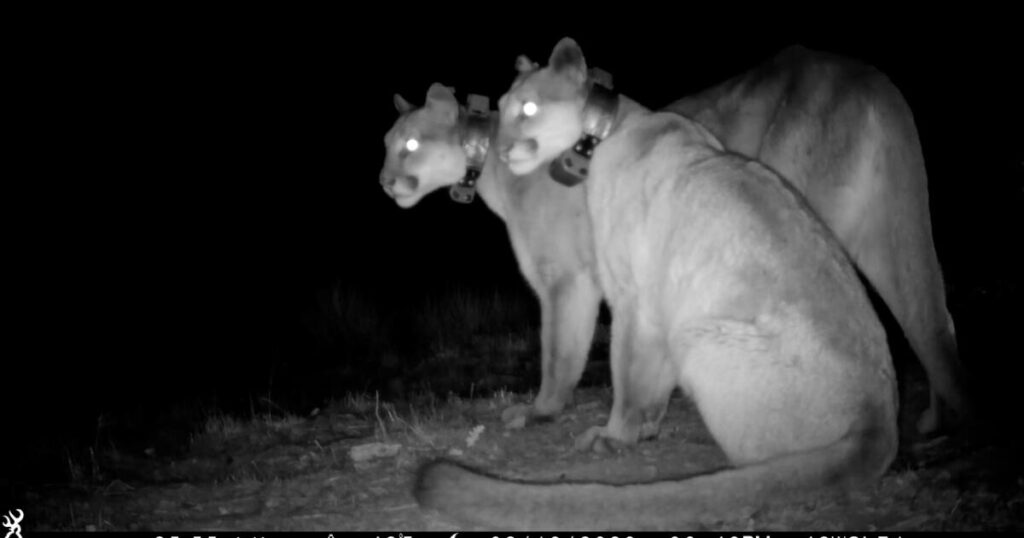
Mountain lions are hard-wired to roam.
When the young cats reach a certain age, about 1 to 3, an instinct kicks in to wander from their birth range and stake out a territory of their own — ideally one with ample food, potential mates and, for the males, no competition from other males.
But for many of California’s mountain lion populations, sprawling subdivisions and busy highways make “dispersal,” as scientists call it, a dangerous and nearly impossible feat.
The problem is so severe that pumas in two isolated mountain ranges in Southern California could go extinct within 50 years. California officials in February listed lions in Southern California and the Central Coast as threatened.
Key to the mountain lion’s long-term existence in these regions is allowing them to do what comes naturally: roam and roam far, from the Sierra Nevada to the Santa Monicas and the Santa Anas and beyond. It’s a driving force behind the $114-million Wallis Annenberg bridge spanning the 101 in Agoura Hills and set to open on Dec. 2.
Scientists have been collaring mountain lions for years, and the GPS tracking data collected on young pumas’ dispersal behaviors offer a rare and detailed look at how they navigate fragmented landscapes. The movements of three young males help illustrate how development has forced them to compete and sometimes make impossible decisions.
P-32
In 2013, a litter of three mountain lion kittens was born in the Santa Monica Mountains. When National Park Service biologists first met and ear-tagged the trio, they were 25 days old. The male was designated P-32, and his sisters P-33 and P-34.
DNA tests revealed the kittens, though healthy, were the result of inbreeding. Their father, P-12, had mated with one of his offspring.
At the age of 17 months, P-33 crossed U.S. 101 at the Conejo grade, moving north through the Simi Hills and on to the Los Padres National Forest. She was the first lion to make such a journey in the Park Service’s 13 years of study in the area.
In April 2015, P-32 would follow in his sister’s footsteps.
To follow his movements, continue scrolling:
“Subadult males are basically hard-wired to undergo these long-distance dispersal events to get away from their natal ranges, which evolutionarily, is a mechanism for avoiding inbreeding and reducing competition among relatives,” said Kyle Dougherty, a wildlife ecologist at the University of Nebraska-Lincoln who led a study analyzing the movements of dispersing mountain lions.
Male mountain lions typically disperse farther than females and require home ranges of up to 500 square miles — an area the size of the city of Los Angeles. P-22, the celebrated puma of Griffith Park, was confined to 8 square miles. Males will overlap with multiple females but typically won’t put up with other males in their territory.
In the Santa Susanas, young P-32 crossed paths with P-38, a large male who dominated the mountains north of Simi Valley.
GPS data showed P-38 was “hot on P-32’s tracks,” according to park biologists, probably forcing the younger lion to cross State Route 126 into the Los Padres National Forest. There, he was met with another competitor.
Park biologists believe an uncollared lion, possibly P-16, may have pushed him out of the area and forced him to make another fateful freeway crossing.
“The unfortunate thing about being a big cat is you have to move to get away from your parents and then upon arrival, you’re fighting for resources,” said Kyle Gustafson, an Arkansas State University wildlife geneticist who has studied California’s puma populations. “In the case of big cats, literally fighting. And the winner survives.”
M-329
In the mountains above Frazier Park in 2023, UC Davis wildlife veterinarians and biologists collared a young male lion as he was making his way from his mother’s home range. They dubbed him M-329.
M-329 made the decision to traverse the freeway relatively quickly — after about five hours — compared with other dispersing lions tracked by the researchers. On average, dispersing lions spent 9 hours near a freeway before leaving the area and almost 20 hours before actually making an attempt, “perhaps suggesting they were seeking suitable times or sites for crossings,” the study authors wrote.
M-329’s journey through the Tehachapis is encouraging because it shows that mountain lions from isolated parts of Southern California and the Central Coast could connect with the larger, genetically diverse populations of the Sierra Nevada — home to some 1,600 lions.
Critically, mountain lions must be able to move from the north to the south.
“It’s clear we need that genetic flow from the Sierras to feed these more endangered isolated subpopulations,” said Fernando Najera, a wildlife research veterinarian and the director of the California Mountain Lion Project at UC Davis.
Using location data from 87 dispersing mountain lions, Dougherty and collaborators from around the state mapped how mountain lions navigate California’s fragmented landscape. The map, researchers said, reflects the decisions young lions make.
Bright shades of blue represent areas that are easier for lions to move through — generally forest and shrubland. Cast in dark shadow are areas more difficult to traverse: urban development, roadways, agricultural land, desert.
In the highly urbanized Santa Monicas and Santa Anas, mountain lions show the lowest documented levels of genetic diversity for the species since the Florida panther population, which almost went extinct in the 1990s.
“California’s mountain lions are so genetically structured that if you picked a random lion out of the state, you could probably tell which region it came from by its DNA,” Gustafson said. “That’s not true in very many states. Part of the reason it’s true in California is the state’s rugged geography and its dense human population.”
The longer a mountain lion population remains isolated, the more signs of “inbreeding depression” begin to emerge, such as kinked tails, deformed sperm and potentially fewer kittens.
The Tehachapis are a narrow strip of habitat, flanked by Central Valley agricultural fields to the northwest and the arid Antelope Valley to the southeast. The 5 and the 58 stand as southwestern and northeastern boundaries, respectively.
Here are M-329’s movements between February and September 2023, when his radio collar failed. He later died, but it’s unclear when and researchers were not able to determine the cause of his death.
A close look at the map reveals “stepping stones” — remnant patches of forest or shrub — which roaming cats can use along their journeys to establish their breeding ranges. Some may be large enough to live in, but too small to find a mate. Other, smaller patches might offer a break from human disturbance or a place to find a deer to eat, Dougherty said.
Even though pumas can use these stepping stones, researchers still stress the need for larger-scale interventions, such as wildlife bridges or underpasses, combined with fencing to funnel them to new territory.
“Mountain lions in California do need some help from people in terms of building crossing structures and preserving the habitat that’s left,” Dougherty said. “They can help themselves to an extent, but habitat in key dispersal corridors needs to be maintained for them to move through these more developed areas.”
Since the late 1980s, scientists have warned that California’s habitats have a connectivity problem.
Paul Beier was one of the first to study mountain lion movement in the state, collaring dozens of animals in the Santa Ana Mountains through the early ‘90s. Cut off from the Eastern Peninsular ranges by Interstate 15, the roughly 780-square-mile Santa Anas to the west are not large enough to sustain their diverse wildlife population.
In a 1993 paper, Beier suggested lions there might die out within several decades — and likely within 100 years — due to small population size and the effects of inbreeding if connectivity between the two mountain ranges was not restored.
Decades later, state agencies and the Nature Conservancy are planning wildlife crossings along some of the state’s most formidable barriers, such as the 15 in Temecula and State Route 58 in the Tehachapis.
Sites for potential crossings are carefully evaluated. In planning the new Annenberg bridge spanning the 101, National Park Service biologists placed cameras around Liberty Canyon and monitored the movements of pumas, deer and other species to identify suitable habitats to link.
“We don’t want to build a crossing and then have a gas station built on one side,” said Trish Smith, a senior ecologist at the Nature Conservancy. “That defeats the purpose of the whole crossing in the first place.”
Also at play are the predators’ natural instincts. Mountain lions try to stay hidden and follow landscape features like drainages or ridgetops.
Smith added that although the Annenberg bridge is a “great way to launch these projects,” not all crossings need be so grand. In many places, retrofitting drainage structures — such as a tunnel under a highway — could create passageways for pumas and other species.
“Although the focus is on mountain lions, it’s a lot more than that,” Smith said. “All species will benefit, and it’s the mountain lion that’s leading the way on that.
“The mountain lion is our ambassador for securing connectivity across the state.”
Pumas probably use most bridges and culverts big enough for them to fit through, said Fraser Shilling, director of the UC Davis Road Ecology Center. The connectivity problem for lions, he said in an email, boils down to “the sheer number being killed on highways.”
An estimated 780 pumas — 18% of the state’s population — are killed on major California roadways each year, according to an analysis by the UC center. The report suggested the “unrelenting assault” of traffic collisions could lead to the regional extinction of species such as the Santa Monica Mountains’ lion population.
“Dead lions don’t connect and lead to smaller populations,” Shilling said.
Fencing off high-collision roadways, the report argued, is the best defense against roadkill.
M-202
M-202 was born far from sprawling cities and busy highways.
For the first 16 months of his life, the young lion roamed the Eastern Sierra before embarking on his quest to establish a territory of his own.
Some genetic diversity can be restored even if small numbers of mountain lions are able to move freely into isolated populations. Research conducted by John Benson, an associate professor of wildlife ecology at the University of Nebraska-Lincoln, suggests that just one newcomer per generation in these small populations may be enough to maintain genetic diversity and stave off local extinction, a phenomenon known as “genetic rescue.”
In a desperate move to save Florida’s panthers, wildlife officials there relocated eight female lions from Texas into the swamps and prairies in the southern part of the Sunshine State. The population rebounded — though the benefits of translocations alone may be short-lived, scientists reported last year.
In more than 25 years of study, National Park Service biologists Seth Riley and Jeff Sikich have documented several mountain lions that made it into the Santa Monicas. None made a bigger impact than P-12, the father of P-32.
After crossing the 101 from the Simi Hills, he sired at least eight litters of kittens and became the mountain range’s king, his domain spanning the Oxnard Plain to Will Rogers State Beach. P-12’s arrival brought about some genetic rescue for the population, until he began breeding with other close relatives.
M-202’s story ends in a mystery.
Back in the mountains after his detour in the Central Valley, the cat from Mammoth Lakes journeyed northwest.
As fall set in, he roamed the foothills of the high Sierra for the next two months. His collar last pinged on Nov. 17, 110 miles from home.
The post Isolated by highways, young California mountain lions often face deadly quests to find a home appeared first on Los Angeles Times.