The first quake came with a jolt.
But a succession of aftershocks from Saturday’s magnitude 5 temblor under Santa Monica Bay, about 3 miles off the coast of Hermosa Beach, has kept many residents on edge.
There are have been more than 100 aftershocks since the first quake, and that number is expected to rise.
Scientists said the aftershock sequence seemed pretty active. Some have been felt over a wide area, including a 4.5 magnitude at 11:41 a.m.; a magnitude 4.0 at 2:08 p.m., a magnitude 3.9 at 2:27 p.m.; and a magnitude 4.0 at 8:08 p.m. The aftershock at 11:41 a.m. caused Manhattan Beach to close its pier as a precaution and the Redondo Beach Harbor Patrol to inspect its pier by boat. The beach at Hermosa Beach was closed to determine whether its pier was structurally safe.
“This is on the robust side,” said Caltech seismologist Lucy Jones said. “The reality is that aftershocks vary considerably.”
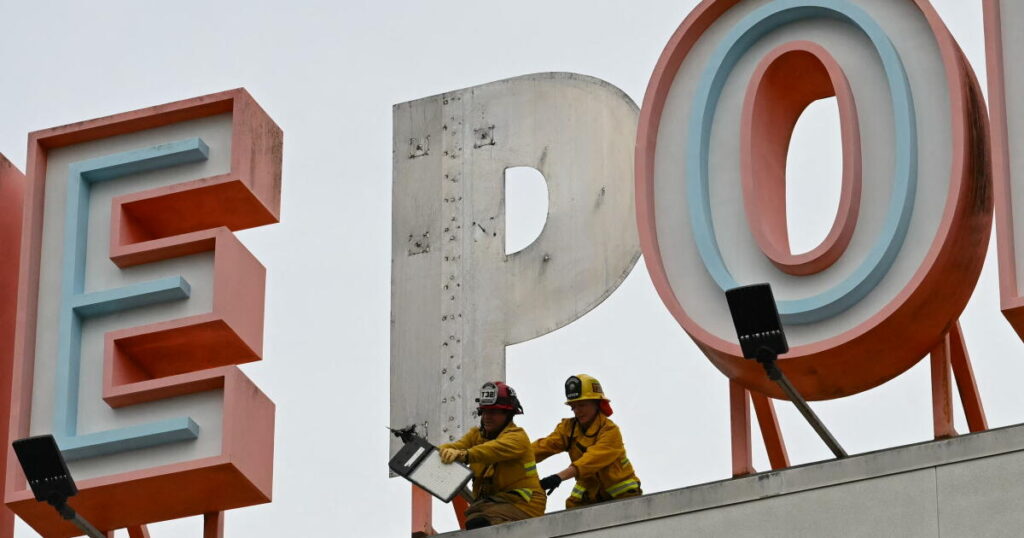
Some damage has been reported. At The Point restaurant and retail plaza in El Segundo at Pacific Coast Highway and Rosecrans Avenue, some signage fell off and firefighters were seen in front of a damaged “P” letter of the shopping center’s name. Manhattan Beach said the city’s building inspectors have issued some red tags — indicating a building is unsafe to enter — and yellow tags, indicating significant damage. At least one chimney fell during the quake, and at Los Angeles International Airport, glass shattered and a ceiling tile fell.
All the aftershocks have been in the same general location as the magnitude 5 quake, and Jones said that, while the number of aftershocks “is a bit more active than average,” it is still “well within the normal range.”
For instance, a magnitude 5 earthquake in San Benito County, near California’s Central Coast, on Nov. 19 had hundreds of aftershocks, Jones said. But the magnitude 3.9 earthquake the next day centered in Commerce — and felt widely throughout the L.A. region — had none.
Quakes trigger other quakes. Jones has saidthere is a 5% chance of any quake has an aftershock becomes larger than the main shock, which instantly makes the new, more powerful quake the new main shock, and the earlier quake a foreshock.
“The ability of one earthquake to trigger another is confined to very close to where the first earthquake happened, and we’re seeing these all in the same location,” Jones said shortly after Saturday’s 11:41 a.m. aftershock.
“We pretty clearly have a main shock here, and we would consider this just a … relatively robust aftershock sequence, and expect it to to continue,” Jones said. And “when you have a big aftershock, it will have its own aftershocks.”
It’s likely that aftershocks in the magnitude 3 range would be expected to persist in the next week or two, Jones said Saturday afternoon.
Saturday’s quakes are probably too far away to be considered connected to a magnitude 3.9 quake on Nov. 20 that was centered in Commerce and rattled the L.A. region.
There’s only a slim chance any particular earthquake will trigger something far worse. But it can happen.
One memorable earthquake about seven years ago involved a sizable temblor that ended up being a foreshock to a much more powerful quake.
On July 4, 2019, at 10:34 a.m., a magnitude 6.4 centered near Ridgecrest, in the Mojave Desert, rattling millions of people across California. Just about 34 hours later, on July 5, 2019 at 8:19 p.m., a magnitude 7.1 quake ruptured nearby, and became the largest quake in Southern California since the 1999 magnitude 7.1 Hector Mine earthquake, which was centered in a different part of the Mojave, according to the USGS.
Scientists observed how earthquakes following the magnitude 6.1 Joshua Tree temblor April 22, 1992 — strong enough to rock high-rise office buildings in downtown Los Angeles more than 100 miles away — kept on migrating to the north. It began “the most substantial earthquake sequence to occur in California in the last 40 years,” according to a study published in 1993 and co-written by Jones and Egill Hauksson, a Caltech geophysics research professor. The Joshua Tree quake is believed to have triggered on June 28, 1992, the magnitude 7.3 Landers earthquake in the Mojave Desert, strong enough to send shaking to Denver; a few hours later, a magnitude 6.3 hit Big Bear.
A toddler died during the Landers earthquake; he had been sleeping at a slumber party at the home of a friend when the upper half of the fireplace — a wall of bricks and decorative rock — collapsed and struck the boy in the head.
And the earth was shaking in the months before the Oct. 17, 1989, earthquake in the Santa Cruz Mountains memorably caused significant damage in Santa Cruz County and the San Francisco Bay Area, killing 63 people, including 42 motorists who died in the collapse of the Cypress Freeway in Oakland and five people just outside a brick office building in San Francisco’s South-of-Market area who were crushed when bricks rained down from an upper floor.
There had been a magnitude 5.4 quake two months earlier and a magnitude 5.3 in June 1988. Jones has said many scientists believed those quakes — not foreshocks, but something called “preshocks” — were related somehow to the Loma Prieta earthquake.
It’s too early to say for certain which fault Saturday’s quakes were on. They probably occurred on the Palos Verdes fault or on a secondary reverse fault that splays off the main Palos Verdes fault, according to USC Earth sciences professor James Dolan. The Palos Verdes fault runs along the coast of Los Angeles and Orange counties and has the potential to cause a magnitude 7.8 earthquake.
Specifically identifying a fault that a quake ruptured on under seawater can be challenging, Jones said.
“This part of Southern California has quite a few faults running through it,” said USGS geologist Kate Scharer. Massive faults in the general area that ruptured Saturday are the ones “that help basically uplift the Palos Verdes Peninsula.”
The post Aftershocks keep rattling Los Angeles. How long will the earthquakes keep coming? appeared first on Los Angeles Times.