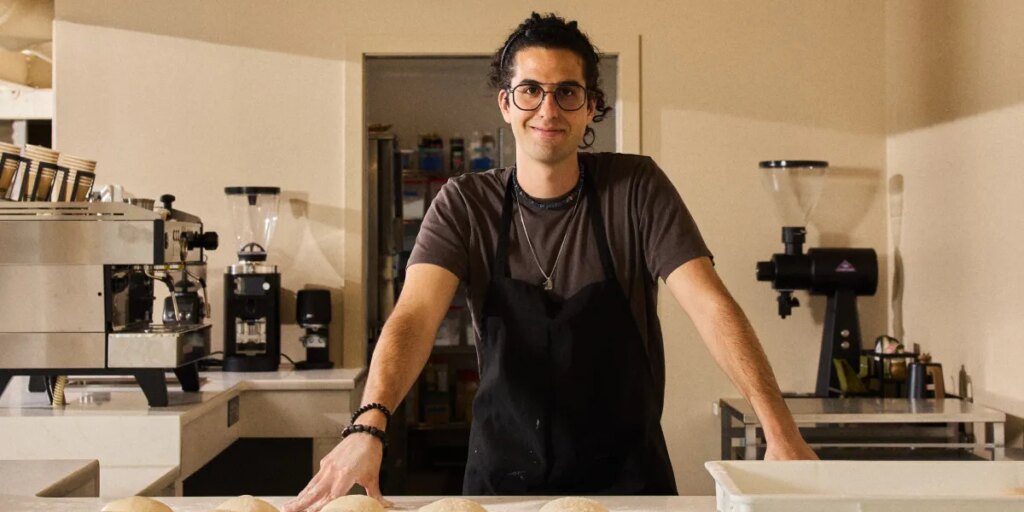
Saif Manna started selling cookies from his college apartment kitchen, mixing every batch by hand because he didn’t have a stand mixer. Five years later, the 27-year-old runs Manna Bakery, a Philadelphia bakery-café with around 20 employees.
The bakery brings in about $120,000 a month, Manna told Fortune, and he projects $1.8 million in revenue in its first year with a permanent storefront.
His growth wasn’t driven by a big advertising budget or a carefully orchestrated social media strategy. It came from meeting customers face-to-face, building relationships with other small businesses, and finding ways to expand production without taking on costs he couldn’t afford.
That discipline carried through to the storefront. In a business where “every dollar counts,” as Manna puts it, he opened for a little over $100,000 after passing on spaces that would have required a buildout of $300,000 or more.
Along the way, the relationships started running in his direction. “So I was no longer asking them, now they were asking me to come,” Manna said, recalling the moment local cafés began reaching out to invite him to sell his pastries.
From apartment cookies to citywide pop-ups
Manna officially launched his business in March 2021, while studying political science at Temple University. He didn’t overthink it: he set up a table in his apartment building lobby or somewhere on campus and sold cookies to students passing by.
“To be honest, at that point, I really wasn’t thinking of permits,” he said. “I was just, you know, a young college student just trying to do what I love.”
Fortunately, his building, home to roughly 200 residents, let him sell in the lobby. Word spread to neighboring buildings, and he began taking orders through Google Forms for pickup downstairs.
At the time, Manna was making less than $2 in profit per baked good. He deliberately kept prices in line with other local bakeries rather than charging a premium or compromising on ingredients to widen his margins.
A turning point came when a customer suggested he take his pop-ups beyond Temple’s campus and recommended several cafés in the city. One was Herman’s Coffee, known for hosting pop-up vendors.
Manna found the owner’s contact information and asked to sell his pastries there. Despite a packed schedule, he secured a date and showed up with pastries baked in his apartment kitchen.
Other café owners saw the lines and began inviting him to their shops through Instagram. Manna said the arrangement benefited them, too, since customers who came for his pastries often bought coffee as well.
By 2023, farmers’ markets were inviting him in. Some had waiting lists stretching for years, Manna said, but demand for his pastries helped him secure a spot, first at a small market in Germantown and then at larger ones across the city.
The markets gave him something the rotating café pop-ups couldn’t always provide: a consistent place for customers to find him every week. “We became part of people’s weekly or weekend habits,” he said.
Manna eventually was selling 800 to 1,000 pastries in just three hours at a market. In 2026, Philadelphia magazine named his extra-brown-butter chocolate chunk cookie the best cookie in the city.
Selling the story behind every pastry
Ask Manna about one of his pastries, and you might get a whole family story. Take his Batata Hara.
“One, I would inform you that I love potatoes,” he said.
Growing up, whenever his family went out to eat on weekends, he insisted his father order Batata Hara. “It was this garlicky, little spicy potato,” he recalled.
Everyone in the family would fight over it, except his older brother, who hates potatoes. Manna jokes that he has to love them twice as much to make up for it.
His chicken sumac bun, one of his earliest savory creations, was inspired by musakhan, a Palestinian chicken dish his grandmother used to make with slow-cooked onions, olive oil, sumac, and spices. Manna adapted it into a bun customers could eat without the mess of the original.
Manna, who calls himself a storyteller, believes there’s more to a pastry than how it tastes. “They’re not just coming to eat, but they’re also coming to learn. They’re coming to experience,” he said.
He credits those stories and personal connections with building loyalty: customers learned not only what he was selling but the history behind the food and the person making it.
As the business expanded, he found a way to preserve that experience without explaining every pastry himself. He keeps a document detailing the stories and inspirations behind his products and sets aside time each month to teach employees about them, so staff can share those stories with customers.
Borrowing a pizzeria’s kitchen at 2 a.m.
As sales grew, Manna’s apartment kitchen struggled to keep up. Unlike on workdays, he could only stretch it so far.
Instead of renting a commercial kitchen, he had another idea. Restaurants aren’t cooking around the clock, he reasoned, so their kitchens sit empty for hours when they’re closed.
He thought of his friend Viraj Thomas, owner of Philadelphia’s Char Pizza. The two had met over coffee after Thomas reached out to him, and bonded over running pop-ups and their dreams of opening permanent storefronts.
It started with a simple favor. Manna asked Thomas if he could use the pizzeria’s large commercial mixer, since his small home mixer could only handle so much dough. After trying it once, he realized how much easier his life could be.
“I just need to mix one time instead of mixing ten times,” he said.
That one-time favor became a weekly arrangement. Manna began using the mixer twice a week, then asked to use the restaurant’s larger oven as well. Eventually, he was preparing and baking pastries there five days a week.
The schedules fit. Char didn’t open until 4 p.m., while Manna woke up at 2 a.m. to bake when the kitchen was empty. With the pizzeria only four blocks away, he could run back and forth between his apartment and the kitchen throughout the day.
The arrangement cost substantially less than renting a dedicated commercial kitchen, where Manna said rent could run around $2,000, depending on the space.
He applied the same thinking to the menu. While he was still working with a small oven, Manna built the menu around what he could realistically produce, pairing items that needed to be baked fresh with products he could prepare a day or two ahead. That let him offer more variety without baking everything on the same morning.
As demand grew, he began hiring. The first hire was his now-wife, Stefaniya Surikova. “She was a free hire though,” Manna laughed. “I didn’t need to pay her actually.”
He gradually added bakers until a team of four was producing pastries for the farmers’ markets. But even with the extra help and access to a commercial kitchen, the operation was reaching its limits.
“I was working 18 hours a day, you know, every day of the week,” Manna said. On days he wasn’t baking, he handled inventory, sourced ingredients, and managed the business’s administrative side.
“When I started to work 18-hour days every single day, I realized that I can’t survive doing this for very long.”
Waiting two and a half years for the right space
Farmers’ markets kept overhead relatively low. Manna paid for a spot and needed fewer employees to sell out during a short sales window. A permanent bakery would mean rent, a larger payroll, equipment maintenance, and other ongoing costs.
But the demand was there, and he was running out of room to grow. A storefront would give him more space to produce and serve customers daily.
Manna spent more than two years searching, passing up locations that would have required substantial renovations or stretched his budget. He estimated a buildout could easily cost $300,000 or more, money he didn’t have.
Eventually, a space on West Berks Street, formerly occupied by Essen Bakery, became available. It already had much of the equipment he needed. “The space was basically ready,” he said. “I just had to get a few chairs and opened it.”
He bought the existing equipment at a significant discount. Manna told Fortune that the total cost of opening the storefront, including equipment, renovations, and maintenance, was a little over $100,000. He financed it mostly through a loan, supplemented by savings from his pop-ups.
“I guess some people may call it, you know, you got lucky,” Manna said. “But when you learn that I waited two and a half years for this moment, I was just patient.”
“The most important business decision was to wait for the right place,” he said. He had considered other properties that would have left him carrying much more debt, potentially hurting the bakery’s profitability for years.
“Food businesses, again, like I said earlier, the margins are slim. Every dollar counts,” he said. “And so if you put yourself in a large debt from the beginning, it just makes things so much more difficult to manage.”
It’s a familiar sequence for bakers who prove demand before signing a lease. In London, sisters Annabel and Emily Lui turned a Soho pop-up into the foundation of Cutter & Squidge, a bakery business now generating close to £8 million in annual revenue.
Manna signed the lease on March 1, 2026, and opened the bakery on July 30. Since then, he has built his team to around 20 employees.
The bakery currently operates four days a week, a decision Manna said was driven by staffing capacity and quality control rather than an effort to create artificial scarcity. He plans to expand to five days and eventually six as the team grows.
Manna said the business generates approximately $120,000 in monthly revenue, or about $1.44 million annualized. His $1.8 million first-year projection includes plans for another farmers’ market pop-up, a curated pantry inspired by his grandmother, workshops, and supper clubs.
For entrepreneurs starting with limited resources, he advises making the most of what they already have and building relationships within their communities. “Go out and meet people, network people within your industry,” he said.
That’s what he did when he asked Herman’s Coffee for his first pop-up in the city, rather than waiting for someone to offer him an opportunity. “People like to help.”
And don’t be afraid to get creative. For Manna, that meant using a pizzeria’s kitchen during its off-hours, and even using his rooftop as a walk-in fridge in the winter.
“Do what you can with what you have,” he said.
The post He sold cookies from his college apartment. Now this 27-year-old’s Philadelphia bakery brings in $120,000 a month appeared first on Fortune.