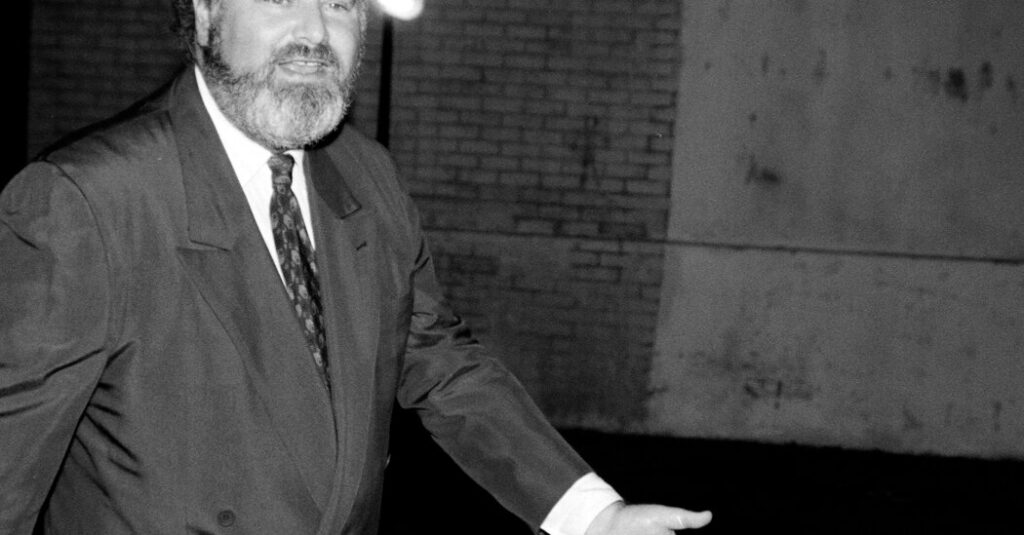
The actor and director Rob Reiner and his wife, Michele Reiner, were found stabbed to death in their Los Angeles home on Sunday. Their son Nick Reiner is being held without bail on suspicion of murder. Stephen Stromberg, an editor in Opinion, convened an online written discussion with Opinion’s columnists Jamelle Bouie and Ross Douthat and the Opinion writer Michelle Cottle to discuss Rob Reiner’s life and work.
The conversation has been edited for clarity.
Stephen Stromberg: When you think of the films that defined an era and still hold up, many by Rob Reiner come to mind. And the harder you look, the more you see his influence. He helped start the careers of John Cusack, River Phoenix and Meg Ryan. Lines from his movies entered the lexicon. What is his legacy?
Ross Douthat: We’re living through the decline of the Movies (capitalization intentional) as a central force in our culture, even if Hollywood continues to churn out genre sequels, Oscar contenders and direct-to-streaming entertainments. Reiner’s career shows what we’ve lost.
From 1984 to 1992, he directed six movies that were mass-market classics: “This Is Spinal Tap,” “Stand by Me,” “The Princess Bride,” “Misery,” “A Few Good Men” and “When Harry Met Sally …”. He hit multiple genres in that period — coming-of-age drama, rom-com, horror, courtroom procedural — and popularized another one: mockumentary. No remakes. Quotable scenes and lines. Sex, romance and kid-friendly adventure. Big moments for big stars but plenty of room for a Mandy Patinkin or a Kathy Bates to walk away with a film. This is what Hollywood used to know how to do and (just as crucially) what audiences used to reward. We might never see Reiner’s like again.
Jamelle Bouie: Reiner embodied a type: the workmanlike director of actors who didn’t have a particular style — I wouldn’t describe him as an auteur — as much as he had a unique process, one that rewarded close collaboration with his chosen players and led him to shape his films around the emotional needs of his characters, rather than subject everything to plot and story. You could think of Reiner as Sidney Lumet, if Lumet had been a comic actor rather than a dramatist.
Stromberg: Could Reiner have done any of this if he had started out now? The monoculture is gone. Media infrastructure and consumption habits are different. As Ross points out, so much of Hollywood’s output is now material recycled from old franchises or building on stories and characters we already know.
Douthat: Jamelle’s description of the workmanlike aspect of his craft is important. A director can still sometimes make a big culture-grabbing movie, but the filmmakers who do it tend to be, if not true auteurs, at least figures with distinct personal brands and fan bases and pretty recognizable styles. You can always identify a Christopher Nolan movie, even as he roves across subjects in a way that lets him stand out in a fragmented film environment. You wouldn’t say that about Reiner. He was more in the tradition of the old studio-system directors who were more versatile. But I’d rather rewatch “When Harry Met Sally …” than “Inception” or “Tenet” most days of the week.
Bouie: To go back to Lumet, both he and Reiner began their careers in theater before moving to television. Lumet was a director for CBS, and Reiner acted throughout the 1960s and 1970s, most memorably as Michael “Meathead” Stivic on “All in the Family,” while writing for television. The point is that both Lumet and Reiner developed their habits as directors while working in a medium that demands a certain amount of speed, discipline and efficiency.
And through television they were able to work their way up to the silver screen. There was a clear path — a pipeline through which people could cultivate and develop their skills before moving to the big leagues. That pipeline is greatly diminished in any number of ways, and it is the main reason I think a Reineresque career is probably not possible except for the luckiest people in the business.
To second Ross: There is a lot to say about the versatility of studio-system directors — of the ability to move between genres and styles. There just aren’t many people working in that mode these days. Steven Soderbergh comes to mind.
Stromberg: I recall Reiner saying that he was not great at anything but was very good at many things, which made him a successful director. Michelle, what’s your assessment?
Michelle Cottle: I challenge anyone to top my affection for Reiner’s early work. I can quote “When Harry Met Sally …” almost in its entirety. “Men and women can’t really be friends.” “No one thinks he’s ever going to leave her.” “What could be worse than Mr. Zero knowing?” “But Baby Fishmouth is sweeping the nation.” But after about 1992, it was all downhill for Reiner. I’m guessing few people could name more than a couple of the movies he made after “Misery.” Do we think the industry and the moviegoing public left him behind? I’m guessing there were other directors who started strong and then went off a creative cliff.
Douthat: You’re not going to give us the contrarian defense of “North,” Michelle? But, yes. It’s not a perfect comparison because Francis Ford Coppola was more auteurish and (at times insanely) ambitious, but there’s some parallel between his drop-off after “Apocalypse Now” and Reiner’s later work.
Cottle: The trivia tidbit I learned Monday is that Michele Reiner was responsible for the perfection that is “When Harry Met Sally …” Rob Reiner was originally planning an ending in which the two main characters do not wind up together. It would have been an entirely different movie. But the romance gods intervened. He saw Michele, then working as a photographer, on the set. They fell in love and got married just months later. Their whirlwind romance, as the story goes, convinced him that romantic happy endings are a thing. Absent that, I’m not sure what kind of movie “W.H.M.S.” would have been. But there is no way it would have been the ultimate rom-com classic.
Stromberg: OK, I have a question about “W.H.M.S.” Its thesis is that men and women cannot be friends. How has that held up?
.op-aside { display: none; border-top: 1px solid var(–color-stroke-tertiary,#C7C7C7); border-bottom: 1px solid var(–color-stroke-tertiary,#C7C7C7); font-family: nyt-franklin, helvetica, sans-serif; flex-direction: row; justify-content: space-between; padding-top: 1.25rem; padding-bottom: 1.25rem; position: relative; max-width: 600px; margin: 2rem 20px; }
.op-aside p { margin: 0; font-family: nyt-franklin, helvetica, sans-serif; font-size: 1rem; line-height: 1.3rem; margin-top: 0.4rem; margin-right: 2rem; font-weight: 600; flex-grow: 1; }
.SHA_opinionPrompt_0325_1_Prompt .op-aside { display: flex; }
@media (min-width: 640px) { .op-aside { margin: 2rem auto; } }
.op-buttonWrap { visibility: hidden; display: flex; right: 42px; position: absolute; background: var(–color-background-inverseSecondary, hsla(0,0%,21.18%,1)); border-radius: 3px; height: 25px; padding: 0 10px; align-items: center; justify-content: center; top: calc((100% – 25px) / 2); }
.op-copiedText { font-size: 0.75rem; line-height: 0.75rem; color: var(–color-content-inversePrimary, #fff); white-space: pre; margin-top: 1px; }
.op-button { display: flex; border: 1px solid var(–color-stroke-tertiary, #C7C7C7); height: 2rem; width: 2rem; background: transparent; border-radius: 50%; cursor: pointer; margin: auto; padding-inline: 6px; flex-direction: column; justify-content: center; flex-shrink: 0; }
.op-button:hover { background-color: var(–color-background-tertiary, #EBEBEB); }
.op-button path { fill: var(–color-content-primary,#121212); }
Know someone who would want to read this? Share the column.
Cottle: Honestly, these days it feels like it depends in part on what circles you run in and what level of friendship you’re talking about. Mike Pence famously wouldn’t dine alone with a woman who was not his wife, which feels like it could put a limit on serious friendship. And it’s hard to imagine some of the more sexist Trump-world bros taking women seriously enough to be true friends with them. Then again, I’ve always had male friends — just friends.
Bouie: Well, most of my closest friends are women, for whatever that is worth.
Douthat: I think the thread-the-needle take is that of course men and women can be friends but that there is a layer of complication. The decline of the Hollywood romantic comedy very clearly tracks with a general cooling in male-female relations in the Western world. The question of whether men and women can fall in love or prefer one another’s reality to digital substitutes maybe looms larger than the question of cross-sex friendship nowadays.
Stromberg: Of course, because it’s 2025, politics has entered this week’s story. It took less than a day after Reiner’s stabbing death for President Trump to claim his killing was “reportedly due to the anger he caused others through his massive, unyielding and incurable affliction with a mind crippling disease known as TRUMP DERANGEMENT SYNDROME.”
Reiner was a liberal political activist. “The American President” was a film about politics and the precursor to “The West Wing.” But it was really a love story. Were his films political? Should this be a lens through which to view his work?
Cottle: I’m not sure which element of his response I found most on brand for Trump — making stuff up, behaving without class amid a human tragedy or making this all about him.
Most of Reiner’s most beloved films were from an era when movies didn’t immediately get swept up into politics. “A Few Good Men” would no doubt provoke a massive flame war today. Although these days, so would the rodents of unusual size from “The Princess Bride.” I cover politics for a living, so it might surprise some people that I find the tendency to view every cultural offering through the latest hot political lens to be exhausting.
Bouie: I would not call Reiner a political filmmaker. As you note, “The American President” was a romantic comedy set against the backdrop of White House politics, not a political film (as evidenced by the fact that, in real life, it would have been a scandal for the president to be in a sexual relationship with a lobbyist). But Reiner’s films are infused with a liberal sentimentalism — a belief in truth, justice and the American way, you might say — that always felt a bit anachronistic, even in the 1990s. You could compare him with another filmmaker of his generation, Robert Zemeckis, whose acid cynicism and anarchic sensibility offset his nostalgic and sentimentalist impulses.
Douthat: I think the Aaron Sorkin-written speech at the end of “The American President” tries very hard to make it a political film, but you need to see that speech mostly as a prequel to Sorkin’s own “The West Wing.” Overall, I agree: Reiner was liberal in his politics when his movies seemed to call for politics, but he did not make movies to satisfy his political impulses or treat his directing career as an extension of his activism. And the fact that his death provoked such an extraordinary bit of political nastiness from the president doesn’t change — and, if anything, emphasizes — the fact that Reiner’s legacy belongs to a different realm entirely.
Stromberg: Time for some lightning-round questions. Favorite Reiner movie?
Cottle: “W.H.M.S.” Duh.
Bouie: “This Is Spinal Tap.”
Douthat: Hard to decide, but someone has to pick “The Princess Bride.”
Stromberg: Favorite Reiner movie moment?
Bouie: “Why don’t you just make 10 louder and make 10 be the top number and make that a little louder?” “These go to 11.”
Cottle: Maybe the morning after Harry and Sally finally get together, when they are on separate phone calls with their respective best friends, Jess and Marie, who are together in bed. There are overlapping conversations, shifting mood and amazing dialogue. Such perfect choreography. Then everybody hangs up, and Marie says to Jess, “Tell me I’ll never have to be out there again.” Jess replies, “You will never have to be out there again.”
Douthat: These might not be my absolute favorites, but let me put in a plug for his acting appearances — from Tom Hanks’s pal in “Sleepless in Seattle” to Jordan Belfort’s dad in “The Wolf of Wall Street.”
Stromberg: Reiner work that was most influential on the culture?
Cottle: Any chance I can cheat and go all the way back to Reiner’s acting performance as “Meathead” on “All in the Family”? That whole show was groundbreaking, and his character as a foil for Archie Bunker was amazing.
Bouie: As much as I love “Spinal Tap,” the answer to this is “The Princess Bride.”
Douthat: I think “When Harry Met Sally …” both began and defined the silver age of romantic comedies. Not just the various Meg Ryan movies, but also a lot of Julia Roberts and lesser imitators were downstream from its success.
Stromberg: Best line from a Reiner movie?
Bouie: “Well, this piece is called ‘Lick My Love Pump.’”
Cottle: The one I find myself using the most in my day job comes from “Spinal Tap”: “These go to 11.”
Douthat: Vizzini, in “The Princess Bride,” with the columnist’s credo: “Have you ever heard of Plato, Aristotle, Socrates? Morons!”
Stromberg: The Reiner film people should watch right now?
Cottle: I’m going to veer off course and say “The Princess Bride.”
Bouie: “This Is Spinal Tap.”
Douthat: I haven’t watched “Stand by Me” in a long time, so that’s the one I’m most likely to watch right now.
Cottle: Ross, I had my now-20-year-old daughter watch it just a couple of years ago. She loved it. And for my money, it is by far the best Stephen King adaptation ever. (And I have watched a lot of Stephen King adaptations.)
Stromberg: Thanks, folks. We have our assignments.
The Times is committed to publishing a diversity of letters to the editor. We’d like to hear what you think about this or any of our articles. Here are some tips. And here’s our email: [email protected].
Follow the New York Times Opinion section on Facebook, Instagram, TikTok, Bluesky, WhatsApp and Threads.
The post ‘Reiner’s Career Shows What We’ve Lost’: Three Opinion Writers on His Legacy appeared first on New York Times.