President Donald Trump has signed more executive orders in less than a year of his presidency than he did in his entire first term — repeatedly bypassing Congress and forcing the courts to grapple with the constitutional bounds of his power.
Trump on Monday signed an order instructing fentanyl to be designated as a “weapon of mass destruction,” the 221st executive order of his second term. Since his inauguration, Trump has used the orders to impose sweeping tariffs, seek retribution against his perceived enemies and weigh in on cultural issues big and small, from challenging immigration laws to regulating water pressure from showerheads.
One third of Trump’s executive orders have been explicitly challenged in court as of Dec. 12, a Washington Post analysis of data from nonprofits CourtListener and JustSecurity found.
American presidents have consolidated executive power to skirt Congress since the beginning of the 20th century. But Trump has accelerated the trend that intensified in recent decades amid a decline in legislative activity and rising partisan brinkmanship.
Trump supercharged that trajectory by repeatedly bypassing a Congress that his party controls. The approach has allowed for swift results in a way legislating rarely affords, but it has also left some of his most prized achievements vulnerable to court challenges and potential reversals by future administrations.
Among the 11 orders aimed at punishing Trump’s political enemies, almost three-quarters have been challenged.
“While President Trump brilliantly took immediate action to quickly reverse Joe Biden’s catastrophe causing Americans four years of pain, many of these policies are expected to be codified by Congress, ensuring the President’s popular policies keep America great for future generations,” said White House spokesperson Taylor Rogers.
Almost a quarter of Trump’s executive orders have targeted trade or broader economic policy. Other major categories of executive orders include the U.S. DOGE Service and the federal bureaucracy; changes to the military and foreign policy; and issues related to race and culture.
The pace of Trump’s actions has strained the administration’s capacity to follow through in some cases, said Mike Howell, who was a Homeland Security official during Trump’s first term.
“Implementation is the issue,” said Howell, who now leads the Oversight Project, which began as a research arm of the Heritage Foundation. “The volume [of executive orders] makes it difficult to caretake every one of them.”
Rogers, in response, said, “In record time, President Trump has delivered on more promises than any other president in modern history.”
Courts have at least halted Trump from unilaterally changing federal election-registration rules, banning care for transgender people and punishing law firms who have represented causes or clients that he opposes. A majority of Supreme Court justices appeared skepticalof Trump’s tariffs during oral arguments last month, and the high court saidit would hear a case examining Trump’s ban on birthright citizenship.
“It’s important to differentiate that some of his EOs are messaging vehicles,” said Marc Short, a longtime top adviser to former vice president Mike Pence. “He learned that he can control a narrative by inviting the press corps into the Oval Office, discussing an issue and signing an executive order.”
Last summer, Trump muscled Congress into passing his signature policy bill, which codified tax cuts, increased the child tax credit and added funding for border security and the military.
As only the second president to serve nonconsecutive terms, Trump had four years to learn from the missteps of his first presidency and prepare for his second.
“This is a president who spent four years out of power, brooding about things he wanted to get done in his first term that he never got done,” said John Malcolm, president of the Heritage Foundation’s legal institute. “He was going to be darned if he was going to let grass grow under his feet when he started his second term.”
A share of his executive orders were drafted in the years between his administrations, when staff now in his cabinet worked at organizations such as the Heritage Foundation and America First Policy Institute (AFPI). Will Scharf, the president’s staff secretary, and Stephen Miller, Trump’s deputy chief of staff, are also known to have major influence over the orders.
A White House official who spoke on the condition of anonymity to discuss internal processes said that every executive order is “fully vetted and reviewed” by the White House Counsel, Scharf’s office and Miller.
Executive orders aren’t explicitly mentioned in the Constitution, but presidents have relied on similar unilateral actions since the country’s founding. George Washington issued directives that would qualify as executive orders today, and Abraham Lincoln used one to deliver the Emancipation Proclamation, said Douglas Brinkley, a professor of history at Rice University. By the early 20th century, Theodore Roosevelt was wielding executive orders to bypass Congress and broaden presidential authority.
Franklin Delano Roosevelt, who governed during multiple national emergencies, signed more than 3,700 executive orders during his tenure — embracing executive actions to stabilize the economy during the Great Depression, expand federal government programs and mobilize the military during World War II.
“In a time of war, you know you can do extraordinary things,” Brinkley said. “So Trump wants to create a wartime atmosphere with what he considers an invasion of undocumented workers.”
Trump’s embrace of executive orders represents a dramatic evolution. As a candidate, he repeatedly criticized former president Barack Obama for relying on the executive tool.
“We have a president that can’t get anything done,” Trump told an interviewer in January 2016, “so he just keeps signing executive orders all over the place.”
While many presidents reserved signing ceremonies for legislation, Trump often will invite the news media to the Oval Office for the signing of executive orders multiple times a week — relishing the spotlight and often seizing the opportunity to make norm-breaking statements and attack his critics.
Trump began the first day of his second term with a dramatic ceremony onstage in the Capital One Arena, where he signed orders to rescind dozens of former president Joe Biden’s executive actions, freeze federal hiring and grant TikTok a reprieve from an expected ban.
A crowd of his supporters roared with applause as he showed them his massive signature on each action. He then grabbed the markers off the desk and began throwing them one by one into the crowd, as people caught them like flyballs at a baseball stadium.
He has signed an order banning transgender athletes from girls’ and women’s sports teams while surrounded by female athletes in the East Room. He signed a flurry of orders that removed regulatory barriers for artificial intelligence at a tech conference hosted by the popular venture capital podcast “All In.” And when he signed an executive order on foster care last month, he passed the document to first lady Melania Trump who then also added her signature in marker.
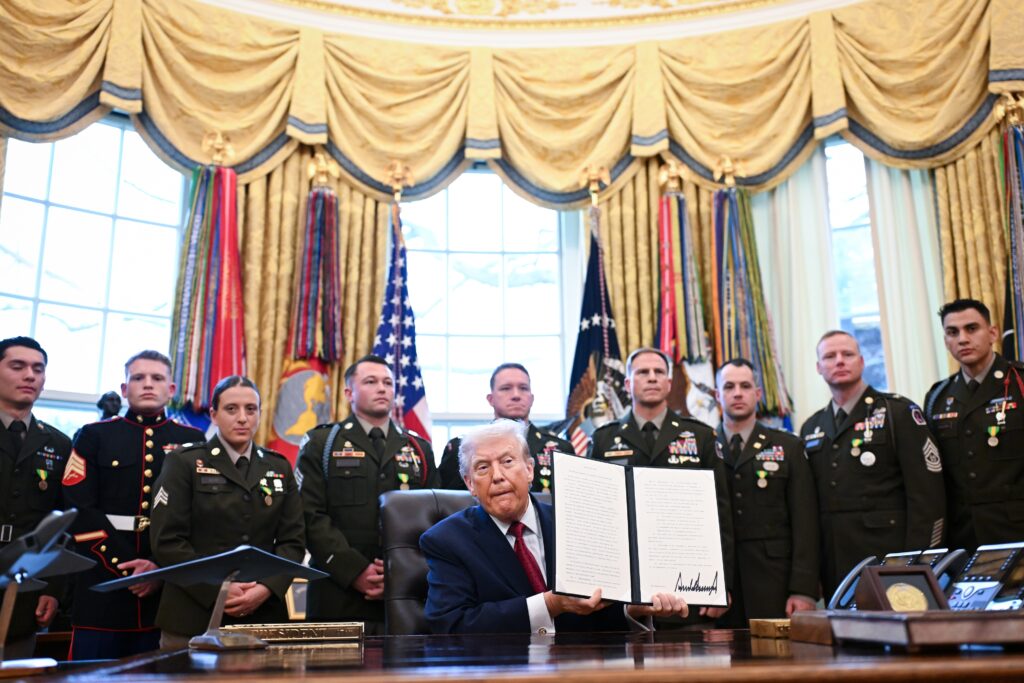
When Trump signed the fentanyl order on Monday, he asked service members who had just been awarded the “Mexican Border Defense Medal” to surround him at the Resolute Desk.
“How about gathering around me and we’ll hold this up?” Trump said, hoisting his 221st executive order before the reporters gathered in the Oval Office. “Let’s take a good picture.”
Methodology
The Post manually classified all executive orders according to the primary topic. To determine which executive orders had been challenged in court, The Post started with examining legal cases challenging Trump administration actions tracked by JustSecurity. This was supplemented with Post research that identified whether the case was challenging an EO.
The post Trump has signed more executive orders in 2025 than in his entire first term appeared first on Washington Post.