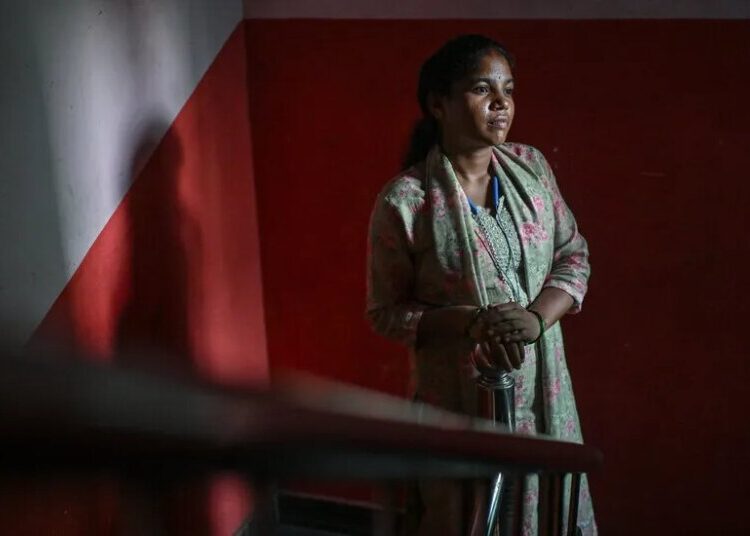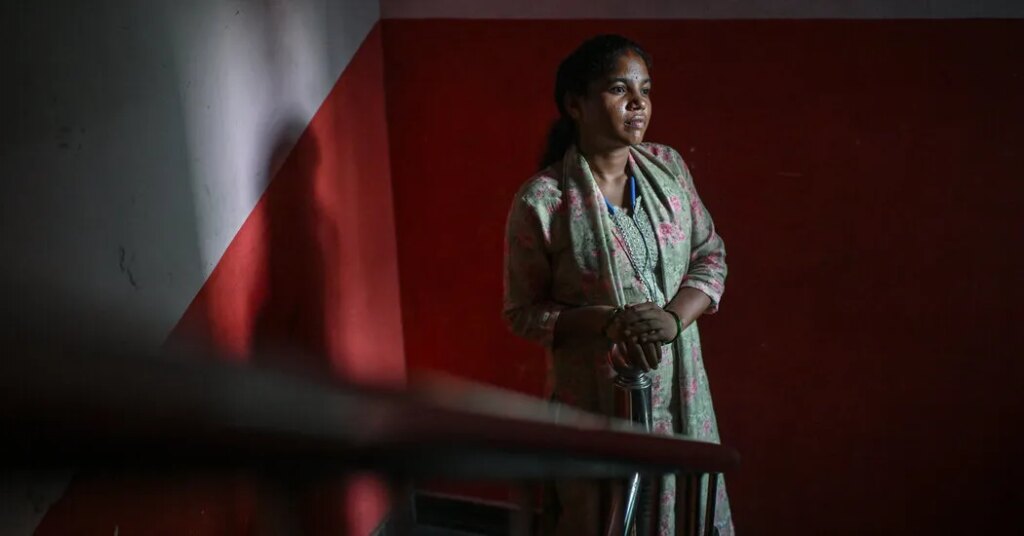
The government clerk job meant everything to Shivani Tirkey.
She had spent years trying to land the role in the Indian state of Jharkhand, picking herself up many times after missing out amid the cutthroat competition for government jobs. The 25-year-old had been raised in a village, but her academic smarts and effort finally paid off, enabling her to break the cycle of poverty and prejudice that follows those at the bottom of India’s hierarchical society.
When she arrived for her first day of work in January at the imposing government secretariat in the state capital, Ranchir, she said it felt like the “gods had opened the skies.” She could support her ailing parents and finally plan a family with her husband, a coal miner.
Then, her future was thrown into doubt.
The Jharkhand state government, in the face of widespread protests over allegations of cheating and irregularity on the entrance exams for government jobs, announced in August that it was canceling the results of the tests and fired roughly 3,000 employees, including Ms. Tirkey. They, in turn, took to the streets in protest.
“We were employed, sitting in this high office of the state government till yesterday,” an overwhelmed Ms. Tirkey, dressed in a blue kurta and her eyes welling up, said at the time. “Today, we are sitting on the streets like dogs.”
The chaos in Jharkhand has become emblematic of a broader crisis facing India and its youth, which bubbled to the surface this summer. A wave of protests — prompted by the scrapping of a national examination for medical college — rattled the government of Prime Minister Narendra Modi. There are too few jobs for India’s aspirational and educated young people. The opportunities they do have are far from equal, in a process marred by corruption and mismanagement.
There is also a deeper structural crisis holding India’s youth back, analysts say. The education system that helped fuel earlier growth is unable to offer meaningful paths to upward mobility. Many young people compete for seats in cheaper public universities, which churn out millions of graduates. But the economy is still heavily reliant on farming and construction, and is not producing jobs for them.
“This was a ticking time bomb, and we did nothing about it,” said Yamini Aiyar, a public policy scholar at Brown University who has studied India’s education system. “The competition is insane because we don’t have a growth model that is job-heavy.”
While India’s economic growth offers riches for a small elite at the top, there is stagnation for everyone else, analysts say.
But what is playing out in Jharkhand reveals another problem that infuriates young people: Despite the demand for jobs, tens of thousands of government positions remain vacant — some for as long as a decade. Some analysts say this may be the result of politicians who promise jobs on the campaign trail being unable to deliver when they reach office — an emblem of how disconnected governments have become from the challenges facing the youth.
“Once you bring people into permanent government jobs, the wages and liabilities for the state budget are huge,” Ms. Aiyar said. “And it’s politically completely untenable to go to an election saying these positions, you know, are not relevant in today’s economy.”
Supriyo Bhattacharya, a spokesman for the regional party that rules Jharkhand, said there were about 60,000 vacancies in the state of 40 million. But he denied that the high number of unfilled posts was about costs, blaming it instead on a chaotic recruitment process.
A Family Lifeline
Young men and women, Ms. Tirkey among them, organized demonstrations the morning after they got their termination notice.
“It’s not alms we ask for,” they shouted, carrying placards. “It’s our jobs we ask for, with dignity.”
After a few days, they won a temporary reprieve: A court put a hold on the job cancellations until the authorities provided evidence of irregularities in the exams.
But with one stroke, the government had undone the hard-earned hope of a more certain future.
Some, like Rohit Kumar Tiwari, 38, who has two young children, had spent a decade completing the application process, which was repeatedly delayed by allegations of leaks and official investigations.
During that time, Jharkhand’s government changed multiple times. Some hopefuls gave up. Others, like Mr. Tiwari, persevered. As he waited, he worked short-term jobs, at a student coaching center and as a stand-in university lecturer.
“My wife and mother cried their eyes out,” he said about receiving the notice just nine months into his job. “My mother had had an eye operation only a couple of days back and doctors had forbidden her to cry. But nobody could stop her.”
For people like Mr. Tiwari and Ms. Tirkey, government jobs can be a lifeline for the whole family.
Ms. Tirkey grew up one of eight children in a tribal family in the village of Kirto Toli, about 100 miles from Ranchi. Her mother fetched drinking water daily from a well about half a mile away, sometimes squabbling with neighbors who owned the well.
“Whenever we would have a fight with the neighbors, they would rub it in that we are using their water,” she said.
While her sisters married, Ms. Tirkey wanted to turn her education into a better life first. She juggled her studies with work, helping her family farm rice and selling vegetables on the roadside. On a phone that her family had pooled money to buy, she watched coaching videos on YouTube to prepare for the government exams. Her mother was paralyzed after a stroke in 2018 and her father’s medical bills were piling up. The farm wasn’t enough. And the Covid lockdown was a breaking point.
“The government was asking us to stay at home. There was no money at home,” she said. “One day, a cop came with a stick and beat me out of the corner where I was selling the vegetables. It was utter humiliation. I came home, banged the vegetables against the wall and swore to myself that no matter what happens I will get a job, any job that gives me and my parents a decent life.”
She first set her eyes on a job as a constable for one of India’s paramilitary forces. She saved for sneakers to exercise. But the girl who had walked miles to school during her first 10 years narrowly failed the physical test twice. So she applied to be a government clerk.
With a salary of about $500 a month, the job brought her some peace. First, she solved her parents’ drinking water problem.
“I had sworn to myself that I would bore a well for them from my first salary,” she said. “And that is what I did.”
Then she turned to her own goals.
She had fallen in love with someone she had met at a local festival in 2018. They agreed they would only get married after her studies were over and he found a job in a coal mine, which was in another state, hundreds of miles away. About four months after Ms. Tirkey started her government job, the couple married at a simple tribal ceremony.
“My only expectation of him was to let me work,” she said. “It worked out. He visits me once a month, and I really love him.”
She found a two-bedroom apartment to rent on the outskirts of the city, for about 10 percent of her salary. She liked that it had separate rooms for bathing and the toilet. She borrowed a small gas cylinder for cooking from a friend, and bought items to furnish the home: a wooden folding cot, a pressure cooker, a mattress, a chair and a stool.
“I had come here with a small bag of clothes,” she said. “Everything you see here I bought after coming here and getting my salary.”
On the evening the court gave its reprieve, she made her way home. On the way, she bought some vegetables, haggling over the price of eggplant.
She made black tea for herself and sat to iron her clothes for Monday, when she would be returning to work.
The court case is continuing, and Ms. Tirkey is still going to work, but she said she was scared of losing it all. She and her husband have postponed plans to have a child.
“I want to break this cycle of struggles,” she said. “This job is not just a ticket for a better life for me and my parents, but also for my future generations.”
The post It Took Her Years to Land a Government Job in India. Then It Got Canceled. appeared first on New York Times.