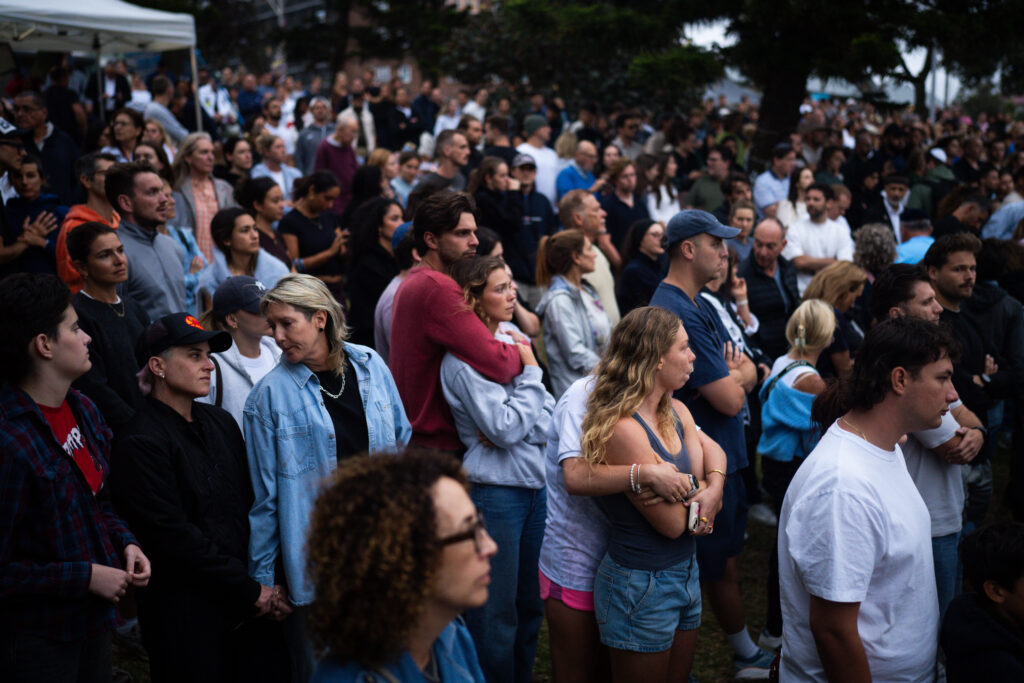
Australia is quickly moving to tighten its already-strict gun laws in the wake of Sunday’s mass shooting targeting a Hanukkah celebration at Bondi Beach, one of Sydney’s most famous destinations, that killed 15 and injured dozens of others.
Its National Cabinet, consisting of Prime Minister Anthony Albanese and the leaders Australia’s eight states and territories, “agreed that strong, decisive and focused action was needed on gun law reform as an immediate action,” according to a readout of their Monday meeting.
“I’m determined to bring in the toughest gun laws in Australia and they will be significantly tightened in New South Wales,” Chris Minns, the premier of the state that includes Sydney, said Tuesday.
Here’s what to know.
What are the proposals to restrict gun ownership?
The cabinet will commission officials to develop options to tighten gun ownership, including potentially restricting gun licenses to Australian citizens, it said.
Authorities have said the gunmen who carried out Sunday’s attack were a father and son. The older man, an immigrant who arrived in Australia in 1998, owned six firearms and had a license through his membership in a local gun club. The father, identified by police as Sajid Akram, 50, was killed. Australian media named the son as Naveed Akram, 24, who was taken to hospital in custody.
The father arrived in Australia on a student visa but converted it to a partner visa in 2001. At the time of the attack, he was living in Australia on a resident return visa, available to current and some former permanent residents, Australia’s Home Affairs Minister Tony Burke told reporters.
Sajid Akram was issued a firearms license in 2023, New South Wales Police Commissioner Mal Lanyon said at a Tuesday news conference. The license permitted him to use category A and B firearms, a basic license which includes the firearms seized by police, Lanyon said. Lanyon previously said there were six firearms registered to the older alleged gunman and that six firearms had been seized from the scene.
The gunmen used at least three weapons — two sporting-style shotguns and one rifle — according to N.R. Jenzen-Jones, director of Armament Research Services, who analyzed videos from the scene at The Post’s request.
The younger alleged gunman was born in Australia and is a citizen, Burke said.
Australia will also consider limiting open-ended firearms licensing, the number of firearms that can be held by any one individual and the types of guns that are legal, including modifications.
What is the proposal for a national registry?
Australia will look to accelerate the development of a National Firearms Registry, which the cabinet committed to in 2023 but has not been launched.
“Some states and territories, they still have paper records,” Albanese said at a news conference Tuesday. “That obviously makes it impossible to check across boundaries in a quick and efficient manner, and the digitization that is required, we’ve agreed to accelerate.”
Another proposal is to include additional intelligence from law enforcement agencies when making firearm license assessments.
This could empower the police commissioner to recommend against a person’s suitability for a license even if the person did not have a criminal record, Minns said Tuesday.
Australia’s domestic spy agency investigated the younger alleged shooter in 2019 because of his associations with two people who were jailed and also interviewed the father, Albanese said in a television interview.
“One aspect of gun law reform that is absolutely essential in New South Wales, and it will be controversial, is for police to use criminal intelligence, not just a criminal record in determining whether someone should keep a gun license or even be granted a gun license in the state,” Minns said.
National Cabinet will also examine the possibility of further restricting at border entry points firearms and other weapons-type importations, including 3D-printed, novel technology and firearms equipment that can hold large amounts of ammunition, it said, though it did not say if those restrictions related to Sunday’s attack.
What are Australia’s gun laws currently?
The country’s National Firearms Agreement (NFA) between federal, state and territory governments was implemented in the mid-nineties after a mass shooting at Port Arthur in Tasmania state, in which 35 people were killed.
At that time, hundreds of thousands of guns were surrendered to authorities in exchange for compensation and destroyed as part of a massive buyback scheme.
National Cabinet said Monday it would renegotiate the agreement “to ensure it remains as robust as possible in today’s changing security environment.”
Laws on gun ownership differ state by state, but within the limits set down by the national agreement. The agreement banned automatic and semiautomatic firearms, and ruled that applicants for gun licenses need a “genuine reason” to use a firearm other than personal protection to be approved, as well as setting rules for legal firearm storage, licensing requirements and other measures.
Genuine reasons can include sport shooting with a membership to an approved club, recreational shooting and hunting, for farmers and other occupations in which a firearm is required, and for licensed collectors and possessors of heirlooms, according to the most recent agreement updated in 2017.
There are some exceptions to the semiautomatic firearm ban, such as licenses for exterminating animals.
The country has also had a permanent firearms amnesty in place since 2021, allowing unregistered or otherwise unwanted firearms to be turned into authorities without penalty.
How common is gun ownership in Australia?
Some experts have called for reform to Australia’s gun laws before Sunday’s attack.
An analysis by the Australia Institute, a left-leaning think tank, found in January that the number of privately owned firearms had increased by about 25 percent since the Port Arthur massacre, though the population has also increased by almost 10 million over that time.
The analysis found that the average number of guns owned by someone with a license was more than four and that there were more than four millions guns owned by civilians across the country, which contains about 27 million residents.
“When it was established, the NFA marked a significant step forward in Australian gun control policy,” the authors of the report wrote. “In subsequent years, however, the various resolutions contained within the NFA have been inconsistently implemented across state and territories and no jurisdiction has fully complied with the NFA’s resolutions.”
But mass killings in Australia are rare. The Bondi Beach attack was Australia’s third in three decades, defined as a public attack where at least some of the victims were killed at random, resulting in four or more deaths not including the shooter, according to Jason R. Silva, a member of the Regional Gun Violence Research Consortium at the Rockefeller Institute of Government.
The post What to know about Australia’s plans to tighten gun laws after Bondi attack appeared first on Washington Post.