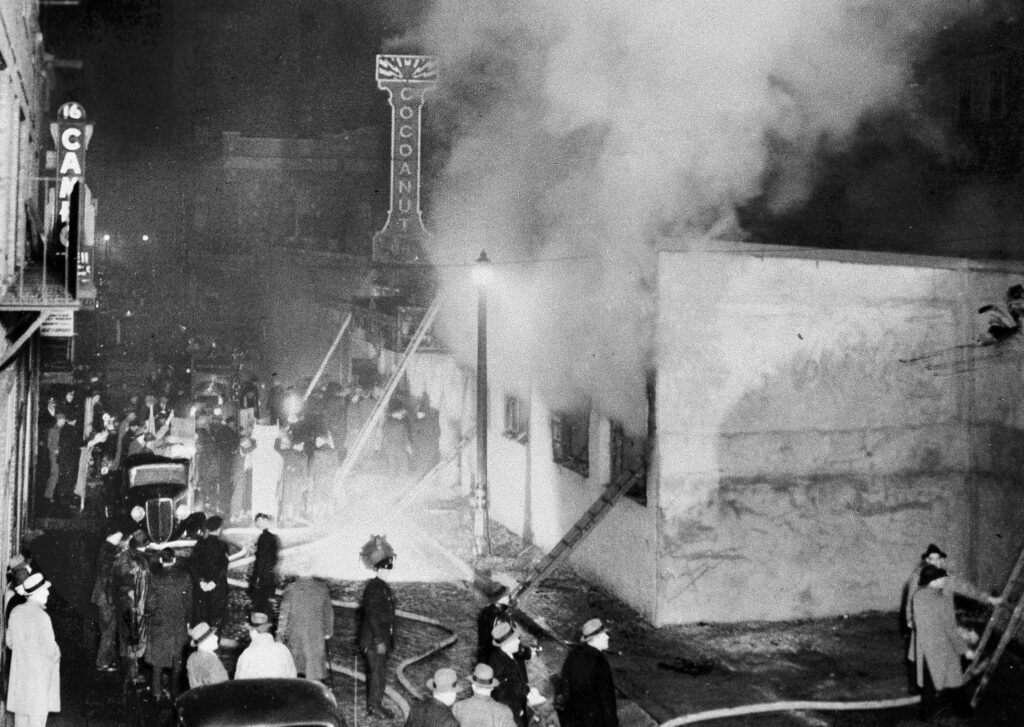
If you had been fortunate enough to have been pulled from the Cocoanut Grove after its papery tropical decor caught flame 84 years ago Saturday, your chances of surviving what’s still the nation’s deadliest nightclub fire would have depended in large part on the hospital to which you were sent.
At Boston City Hospital, burn victims received the then-standard treatment for burn wounds — and suffered the standard mortality rate. But at Massachusetts General Hospital, Oliver Cope, the acting chief of surgery, tried something different.
An estimated 1,000 people, more than double the Boston venue’s legal capacity, had packed the building on the evening of Nov. 28, 1942, when the fire broke out. (The crowd would have been larger, and the disaster likely still greater, had Boston College won its football game that day. We’ll get back to that.)
The flames spread quickly from the basement Melody Lounge to the main level of the building, the size of a city block. Panicked patrons jammed the front entrance revolving door. Six of the nine other exit doors were locked, apparently to prevent guests from skipping out on their tabs. Some doors were behind curtains, or opened inward, useless before a stampeding crowd. To get to the victims, firefighters had to break through walls.
A call for ambulances drew responses from not only the city but also suburbs and military installations. City officials warned the hospitals of mass casualties.
They were ready. Since the Japanese bombing of Pearl Harbor the previous December drew the United States into World War II, both Boston City and Mass General prepared emergency plans for more attacks, according to Mass General. Each received grant money to study burn injuries, and laid in supplies. The city of Boston had rehearsed a disaster response only the weekend before.
Of the Cocoanut Grove victims taken to Boston City that Saturday night, 114 were alive Sunday morning.
First, they were administered morphine, a powerful opiate that was hardly sufficient for the excruciating, sometimes lethal standard treatment.
Multiple people were required to hold each writhing patient still enough for the doctors to proceed. They cut and scraped away burn blisters and dead tissue. Then they applied tannic acid.
The goal was to turn the surviving skin into an infection-resistant leather. Even when successful, recovery took months. The disfiguring scars were permanent. A third of the Cocoanut Grove victims so treated still died.
Of the victims taken to Mass General, 39 survived the first night. Cope, a professor of surgery at Harvard Medical School, saw an opportunity. He’d been thinking about burn wounds since Pearl Harbor, and had hypothesized a treatment that would likely be less traumatic than tanning — and possibly more effective.
Under his direction, patients were given penicillin, an early use of the antibiotic, to protect against bacterial infection. Then their wounds were wrapped in petroleum jelly-infused gauze, not scraped or tanned, and left to heal.
It worked: All 39 patients survived to discharge, and the so-called soft treatment became the new standard. It was used for Allied soldiers during the war and further refined in the ensuing decades.
“The 171 victims who made it alive to Boston City and Mass General hospitals became subjects in the most comprehensive clinical trial in the annals of burn treatment,” author Barbara Ravage wrote in Burn Unit: Saving Lives After the Flames. “New ideas were tried, old methods discarded, and the agenda for burn research was set for the next quarter century.”
Even with the treatment breakthrough, 492 people, more than the Cocoanut Grove’s legal capacity of 460, died as a result of the fire.
It could have been worse. The B.C. Eagles, 8-0 and ranked first in the nation entering the day, had planned to celebrate an undefeated season at the venue that night. But they were stunned that afternoon by archrival Holy Cross in one of college football’s greatest upsets, a 55-12 rout at Fenway Park that dashed their national championship hopes. They canceled the party.
Barnet “Barney” Welansky, the Cocoanut Grove’s owner, was convicted in 1943 of 19 counts of involuntary manslaughter. The case established that a business owner could be held accountable for failing to meet an appropriate duty of care to his customers. He was sentenced to 12 to 15 years in prison but released after four with cancer and died a short tine later.
The fire and its aftermath led also to reforms in fire codes and enforcement, and advances in the understanding of grief and post-traumatic stress disorder.
While it was “catastrophic,” physicians Jeffrey C. Schneider and Coleen M. Ryan wrote for Harvard Medical School in 2013, it “nonetheless served as an engine for research and innovation that has since saved many more lives than were lost — a fitting memorial” to those who died or whose lives were forever changed.
Photo Almanac is an occasional series from The Washington Post, using photo archives to understand where we are today by examining where we’ve been.
The post Hundreds died in the Cocoanut Grove fire. What doctors learned saved many more. appeared first on Washington Post.