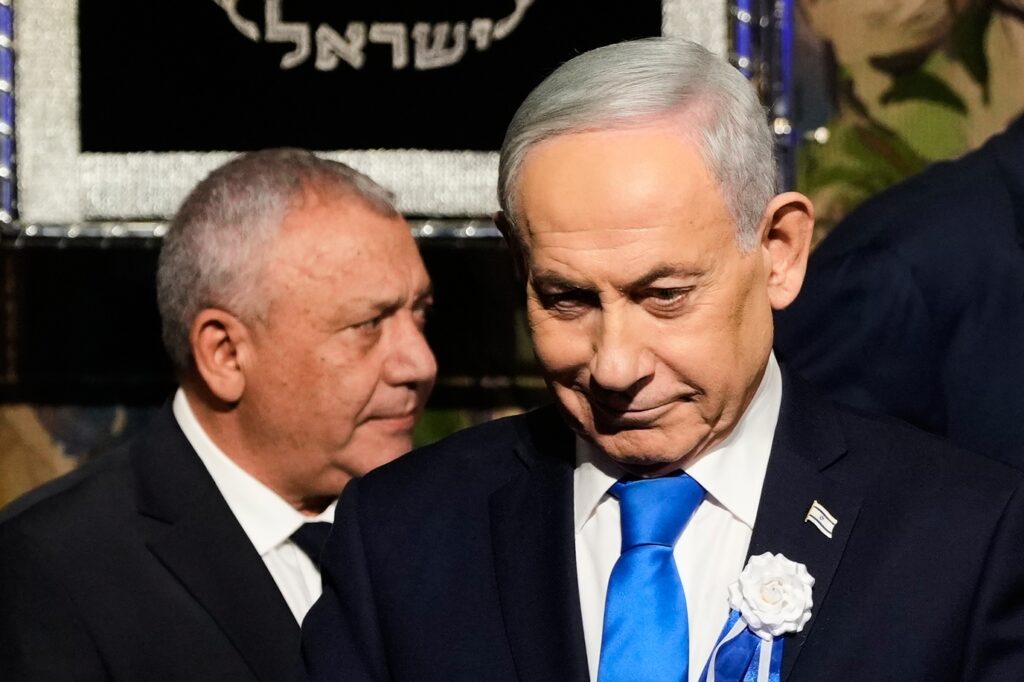
Israeli Prime Minister Benjamin Netanyahu offered Saturday to let his rival, former military chief Gadi Eisenkot, serve first as prime minister in a power-sharing arrangement, a major concession that comes as Netanyahu is scrambling to stop Eisenkot from forming a coalition that would force Netanyahu and his Likud party out of office entirely.
In a post on X, Netanyahu said the “immediate dangers that threaten our very existence” compelled him to give up his claim as the head of the largest parliamentary party to go first in a rotation arrangement. Netanyahu and Likud have been calling on opposition leaders to join them in a power-sharing “unity government,” and abandon their attempts to build a coalition that would include left-wing and possibly Arab parties.
“Naturally, I should lead the unity government or at least be first in the rotation,” Netanyahu said.
“But given the gravity of the existential danger and the possibility that a government will be formed that lacks the ability to confront it, my responsibility as a leader requires me to set everything aside, including the principle of the largest party, and agree that Gadi Eisenkot will serve first as prime minister, while I will serve as alternate prime minister at the beginning of the term.”
The offer meets a demand made by one of Eisenkot’s allies, former prime minister Naftali Bennett, who called on Netanyahu to commit to allowing Eisenkot to go first as prime minister or he would throw his support to the broad coalition. Bennett did not make an immediate public response to Netanyahu’s announcement.
Others did. Yair Lapid, a former prime minister who serves with Bennett in the B’Yachad party, called it“yet another transparent scam by a serial deceiver who has cheated every partner and broken every agreement.”
Avigdor Liberman, leader of the secular nationalist Yisrael Beytenu party, had warned Friday that such an offer would be “merely a ploy.”
Distrust of Netanyahu runs across nearly every party in the opposition bloc. Liberman, Bennett and Lapid all served in his cabinets before breaking with him. In 2020, Netanyahu formed a unity government with rival Benny Gantz, serving first. Netanyahu exploited a budget loophole, causing the government to fall and prompting new elections before Gantz could start his term.
Netanyahu’s offer comes as Eisenkot’s efforts to complete a coalition are picking up steam. He has signed agreements with Liberman’s right-wing party as well as the Democrats on the other end of the spectrum.
He is expected to rely on support from Ra’am, an Islamist party that represents Palestinian citizens of Israel. The party’s leader, Mansour Abbas, was expected to recognize Hamas as a terrorist organization Saturday night, meeting one of Eisenkot’s requirements for partnership.
Together, those parties would account for about 63 seats, crossing the threshold for a majority in the 120-seat Knesset.
The post Israel’s Netanyahu offers to let Eisenkot lead first in power-sharing government appeared first on Washington Post.