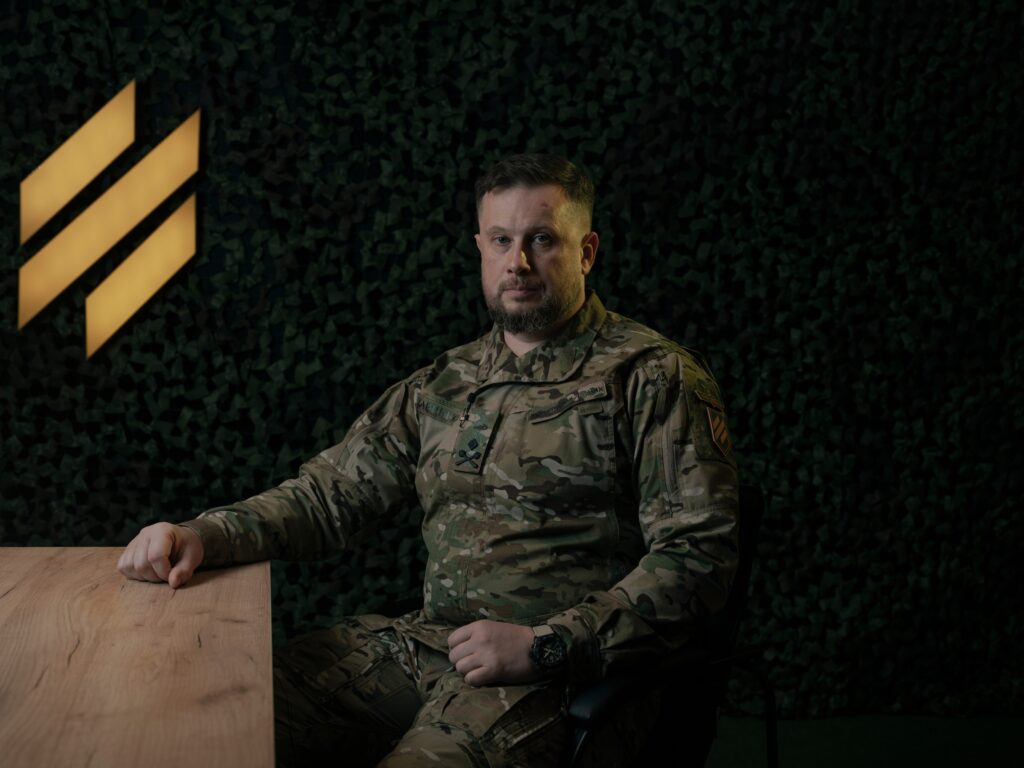
KHARKIV, Ukraine — In an underground bunker on the eastern front, Ukrainian Brig. Gen. Andriy Biletsky drew his red line for any peace deal: A total withdrawal from Donbas, the eastern region coveted by Vladimir Putin and largely occupied by Russia, would be “unacceptable.”
“It would be an absolute collapse, for the president — he understands this perfectly — for the government, and for the self-awareness of Ukrainians,” Biletsky, one of Ukraine’s most powerful and divisive commanders, said in an interview this month.
Biletsky’s uncompromising view — shared, according to polls, by a majority of Ukrainians — underscores President Volodymyr Zelensky’s limited room for maneuver in U.S.-led peace talks in which he is under extraordinary pressure to surrender territory.
As U.S.-backed negotiations resumed this month, Biletsky said that Ukraine was undercut by the Trump administration’s embrace of Moscow. Even before the talks convened, the U.S. negotiators bowed to a key Russian goal by opening a broader discussion of European security. Afterward, Zelensky said they also raised the idea of Ukraine fully withdrawing from Donbas in exchange for NATO membership.
The question of Donbas remains the core irreconcilable difference in the talks, which so far have made little progress but are set to continue perhaps early next month.
Zelensky has insisted that giving up territory will not stop the war, saying that land for peace is based on “abstract words” and “no one believes that Putin will stop if we leave the Donbas.” He has also said the question is so sensitive it must be put to Ukrainians in a referendum, but only if the West first promises concrete security guarantees.
Biletsky said that “the most realistic proposal” was to freeze the war on current battle lines, bowing to the reality of Russian occupation of almost one-fifth of Ukraine’s territory, including Crimea, but not relinquishing Kyiv’s legal claim to it.
“If we withdraw, simply abandoning people and land to their fate, it would be a moral breaking point for the entire nation,” Biletsky said. “Ukraine cannot agree to surrender Donbas.”
A rising force
Across Ukraine, city billboards and village offices are plastered with an image of Biletsky, flanked by his top commanders, his face turned valiantly toward the light — part of a recruitment campaign for the Third Army Corps.
The political undertones are obvious, centering on Biletsky as the lauded leader of the Vivaldi Operation, a top-secret, months-long counteroffensive in which the Third Corps reclaimed 106 square miles of land and thwarted Russia’s push to capture the rest of Donbas.
A former far-right politician without a traditional military career, Biletsky has risen to become one of Ukraine’s most influential generals, overseeing a quarter of Ukraine’s 800-mile front line around Donetsk.
After rising to prominence as an ultranationalist agitator, Biletsky in 2014 brought together a group of nationalist soccer fans and political activists to form a paramilitary force that became the Azov battalion. He stepped down from Azov that year after winning a seat in parliament, and returned to active military leadership in 2022, when he created the Third Assault Brigade, made up partly of Azov veterans.
Biletsky has worked hard to distance himself from his earlier politics, which included his revival of Patriot of Ukraine, an ultranationalist paramilitary group notorious for its violence against minorities.
In 2015, Biletsky claimed in an interview with Ukrainian TV that an essay in which he wrote that the historic mission of the Ukrainian nation was to “lead the White races of the world in a final crusade … against the Semite-led Untermenschen (subhumans),” had been planted by Russian intelligence.
When asked whether his departure from his earlier stance was a political calculation, Biletsky said that he was a proud “Ukrainian nationalist.”
“Ultraright ideas are a bogeyman that the Russians and the ultraleft pin on any conservative politician or person,” he said, his media team listening in from the shadows of the bunker. “A person is defined not by the opinions about him by a third party, least of all one to whom he is not sympathetic, but by his actions.”
The Vivaldi Operation
The battlefield, Biletsky says, is the only way to force Russia’s hand.
He wants to see the “corporate culture” he has fostered at the Third Corps — focused on reducing the paralysis of post-Soviet military bureaucracy, decentralizing command and prioritizing troop welfare — replicated across other brigades.
He credits the success of the Vivaldi Operation to this new approach.
The operation — which was carried out between May and October this year along a section of the front that had been slowly losing ground to Moscow — pushed Russian forces back across the Zherebets river, reclaiming at least 16 settlements and allowing Ukrainian forces to regain control of the higher ground. Disrupting Russian supply and communication lines, it reversed months of Russia’s gains in the area and strengthened Ukraine’s defensive lines.
The operation also led to the capture of thousands of Russian prisoners of war and wiped out Russia’s 144th Motor Rifle Division, Biletsky said. Vivaldi was particularly notable for its strict media blackout and secrecy, a lesson learned after the failure of Ukraine’s much-promoted 2023 counteroffensive.
“We have no advantage in unmanned systems, we are significantly behind in artillery, and we are significantly behind in personnel,” Biletsky said, explaining that they exploited the element of surprise and misdirection to get the upper hand. “And yet, despite all that, we were the ones on the offensive.”
Vivaldi’s gains were marginal in the wider context of this war, but it provoked frustration and even praise from Russia’s military bloggers, who confirmed Moscow’s losses.
“The enemy … has good communications, motivated personnel, and well-trained, cohesive units,” Russian blogger Sergei Kotenok wrote on Telegram in late October, referring to the Third Corps. “Their coordination is close to ideal.”
Ukrainian separatist fighter and politician Alexander Khodakovsky, a longtime critic of Biletsky, praised his role in Vivaldi, describing him as “a clearly defined politician” and “a national hero.”
While Vivaldi hasn’t necessarily changed the course of the war, Biletsky’s battlefield prowess has raised his profile in the eyes of many Ukrainians as diplomacy remains stalled.
With little independent information available on the operation, it is difficult to assess the impact of Biletsky’s role. His critics have highlighted the Third Corps’ aggressive management of the narrative around Vivaldi. Biletsky’s decision, meanwhile, to keep the operation out of Ukraine’s main battlefield management system — ostensibly to prevent leaks — has raised alarm bells about a growing autonomy among more powerful commanders.
He argues that the kinds of institutional changes that made Vivaldi a success, broadened across Ukraine’s military, will lead to gains that could give Ukraine the upper hand in negotiations.
“When, after five to six months, it becomes clear that Russia is not only no closer to establishing full control over Donbas but is losing ground, then it will be possible to approach seriously the question of a halt along the front line,” he said.
“We have to make the Russians see that their goal, which they have already narrowed, is out of reach.”
Postwar politics
Biletsky’s effort to expand the Third Assault Brigade into the Third Corps — building it into one of the best-funded and elite units in Ukraine, known for its sleek recruitment campaigns — suggests he is building not just a fighting force but a political platform, analysts say.
He will probably play a significant role in postwar politics in Ukraine, they say, possibly even as a presidential candidate, when a war-hardened electorate might opt for nationalists and soldiers over more traditional politicians.
A recent survey by the Kyiv International Institute of Sociology found that Ukrainians place great trust in military figures such as Biletsky, with 49 percent of respondents saying they trusted him — though a third of respondents said that they didn’t recognize his name.
Though Biletsky’s popularity has risen since 2022, particularly this year, his political prospects are weighed down by Ukraine’s enduring discomfort with far-right figures and political extremes, Ukrainian political analyst Volodymyr Fesenko said. In Ukraine’s last parliamentary vote in 2019, far-right parties won about 2 percent.
Biletsky appears to have become more moderate — or politically savvy — with time. “He’s not as radical as he used to be, and he understands that as a radical nationalist he will have no chance in Ukrainian politics,” Fesenko said.
Regarded as a talented and effective military planner, he has maintained a good relationship with Zelensky, and is careful not to involve himself publicly in politics.
He also managed to steer clear of power struggles that have roiled the presidential administration and the general staff of the armed forces since 2022, most recently with the firing of Defense Minister Mykhailo Fedorov, whose ouster briefly sparked street protests. In 2024, Zelensky dismissed Gen. Valerii Zaluzhny, credited with saving Ukraine in the first months of the invasion.
Zelensky has since tried to foster stronger ties with top military leaders. “It is clear that Zelensky favors these new war heroes. He is betting on them, he supports them, he relies on them. I think that for Zelensky they are an important pillar of his political regime,” Fesenko said.
Zelensky personally visited Biletsky’s Third Corps headquarters in September, to present its commanders with medals. During his last one-on-one meeting with Zelensky in July, Biletsky said he was asked to weigh in on the president’s choices for a new commander in chief of the armed forces.
He was offered the leadership of Ukraine’s ground forces, but told The Washington Post that he declined it because he had “no solution” to Ukraine’s mobilization drive and “did not want to take on something that I would not do better than others.”
The military faces severe personnel shortages that have driven widespread evasion, desertion and public criticism of its mobilization system. Asked whether mobilization had become a politically toxic subject, Biletsky responded that, “in almost every country, after the first year of enthusiasm, mobilization became a very negative, very irritating subject,” arguing that expansion of unmanned systems and drones would alleviate the issue.
When asked whether he had presidential ambitions, Biletsky said that “only completely corrupted people” could be thinking of politics when the country was in an “apocalyptic battle for survival.” He said instead that his priority now is to help reform the army.
“Even if the war stopped, I would like to stay involved in this, because the army will be the main, state-building pillar of the country for the next 50 years,” he said.
Natalia Abbakumova in Riga, Latvia, contributed to this report.
The post This top Ukrainian commander calls withdrawal from Donbas ‘unacceptable.’ He’s not alone. appeared first on Washington Post.