They filed in when the gates opened at 8:30 p.m. — in a red Honda Fit, a white Dodge and a black van with the middle-row seats wrenched out to make way for a crib mattress and a make-do bed of blankets.
L.A. is a city where the crisis of homelessness is often framed in familiar snapshots: Tents under freeway overpasses and encampments along Skid Row. People sprawled and sun-baked on a sidewalk.
But in a city famous for its car culture, roughly 1 in 4 people experiencing homelessness lives in a vehicle. That amounts to roughly 11,600 people a night sleeping in cars, vans or RVs, according to a Times analysis of homelessness data.
In what has become a common response to vehicular homelessness, especially in California, nonprofits and government agencies have set aside parking lots throughout L.A. as sanctioned places for people to sleep in their cars. Santa Barbara is believed to have opened the first lot of its kind in 2004.
Most of these lots are open to the general population. But the one filling up on this Tuesday night was different. It was for women. Most of them arrived alone — two had children.
The lot is run by Safe Parking LA, a nonprofit that manages six of these spaces throughout the city. It is the largest provider of parking lots authorized for sleeping in L.A., according to one study.
In response to requests from women staying at some of their other lots, Safe Parking LA last year opened a women’s-only lot at a public library. Although women represent about a third of all homeless people in the L.A. area, they make up nearly half of the total count of people living out of cars, vans or RVs, according to a survey published in 2022.
As they rolled through the gate, each woman pulled up a digital permit on her phone, but most didn’t need to. A woman named Jasmin greeted each by name and asked them to sign in. In total, 15 cars would park there this night.
People living in their cars in L.A. report higher rates of employment than the general population experiencing homelessness.
But like much of California, L.A. is expensive — and it doesn’t take a lot for some people to find themselves struggling.
“I see myself outside of it sometimes,” Lisa Sellers said of her current situation. “Like I’m observing it.”
Sellers moved to L.A. eight years ago to pursue acting after working as a celebrity stylist. But since the pandemic, acting and production work has been hard to come by. Especially, she said, since so many auditions have moved to self-tapes and her car makes for a lousy setup.
Nights at this parking lot — The Times is not publishing the exact location because of safety concerns for some of the women — are generally tranquil. In the daytime, the construction site bordering the lot shudders to life.
The excavation seems to be rousting rats, which skitter into the lot at night. When Sellers gets out of her car to use the bathroom, she stomps her feet to make sure no rats get close.
Before Sellers started sleeping in her SUV, she’d rented a one-bedroom apartment in the Baldwin Hills/Crenshaw neighborhood for almost seven years. It had a small patio where she liked to drink tea.
But after suffering years of extreme fatigue, debilitating headaches and skin lesions, she began attributing her health problems to what she said was mold in the walls and gases released from a broken sewer line.
She alerted her landlord and several city departments, but little was fixed, she said, and the health problems persisted. She ended up in the hospital last year and never went back to living in her apartment.
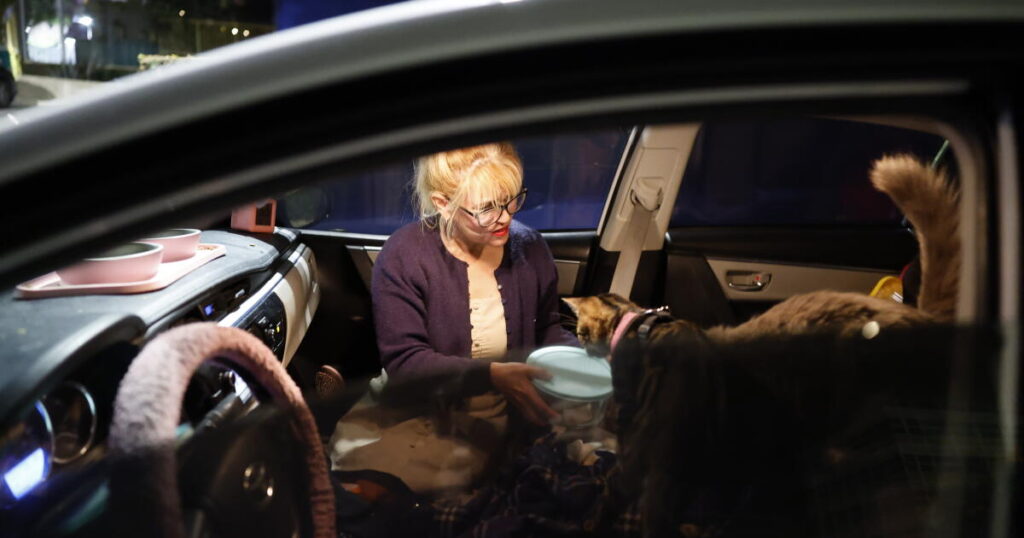
Some of the other women who arrived at the lot this night have pets.
Just before 9 p.m, Old Man escaped from a white Toyota Corolla. The 12-year-old orange cat is one of two that Lynn, a woman in her 50s, lives with in her car. (Because of the stigma associated with homelessness, The Times agreed to withhold the last names of Lynn and another woman interviewed for this article.)
Lynn had been living with her father when, she said, she learned he’d been coaxed into taking out a mortgage after having paid the previous one off. While she tried to find legal help, she was also struggling with medical problems, including nerve damage and fatigue.
When she couldn’t sort out the financial problem with the house, it was foreclosed on. Lynn moved out in 2023. She spent a large chunk of her savings on hotels before moving into her car full time.
Lynn grabbed the cats’ water trough from behind the front seat and used a hand-washing station to refill it. The other side of the back seat floor was taken up by the litter box.
She’s been sleeping at the women’s parking lot most nights since late August.
As a regular, she takes note of who is parked one night and gone the next.
“It does bum me out when I see the cars return night after night,” she said. “[But] when you don’t see a car return, you just hope nothing happened to them.”
Making sure nothing happens to them is part of Alma Falcon‘s job.
Falcon is a caseworker for Safe Parking LA. She arrived at the lot around 8 p.m., as she does every Tuesday, so she can meet with some of the women in person. She brings pamphlets about housing providers or job training programs.
Falcon calls the women who sleep at this lot “the girls.”
She started her career at 19, working in a drug rehab center on the weekends.
She went on to work in an adult rehab center and with survivors of domestic violence. But, she said, some of the first people she ever worked with were girls and maybe, in her mind, they’ve always stayed that way.
By 9 p.m., many of the women were getting ready for bed. One parked next to Lynn flossed her teeth while standing behind the open back door of her SUV. Another changed into leopard-print-and-black pajamas.
For some at this lot, it’s their first time experiencing homelessness. That’s true for many people who end up living in their cars.
Sandy had been homeless once before, she said, for a couple of months in the 1990s. This time, she’s been homeless since the summer, when she had a falling-out with her half sister, whose house she was living in.
Now Sandy lives out of her white sedan with six cats: Midnight, Mino, Marvel, Cupid, Toothless and Sebastian.
Sandy is 64 but looks younger, her voice wistful. A blood disorder keeps her platelet count low and tires her quickly, making it hard to work, she said. She keeps a plastic tray of medications in her glove compartment.
Many shelters or other forms of temporary housing don’t accept people with more than one pet, so Sandy and Lynn have had a harder time finding a way out of their cars. For Sandy, giving up her cats is a nonstarter.
At 10 p.m., she grabbed her toothbrush and a bottle of water and headed to one of the portable toilets. Later, she said, she’ll lie down in the passenger seat of her car and watch YouTube videos on her phone before falling asleep. She’s learning French.
“My heart is to live in France,” she said.
Across the lot, a frangipani bush with its waxy leaves and fragrant flowers sprouted between two rows of parking. One woman walked between the cars, offering up cinnamon muffins she picked up at a discount — $4 for four.
She soon settled into her van on a bed of blankets, floor insulation and a crib mattress. It was close to 11 p.m.
Aside from the light poles, which dim at night, the parking lot at this hour was lighted by the bank next door.
A man rattled the locked gates of the parking lot, yelling about whether the library was open so he could check out a book.
Seated in the driver’s seat of her car, Sellers ticked through photos on her laptop of the apartment she says made her sick. She’s trying to see if there’s a legal case to pursue.
After leaving her apartment, Sellers crashed with friends but eventually moved into her car full time. She’s been using the lot run by Safe Parking LA since June.
She got some relief this past summer when she was invited to teach a course at the Vogue College of Fashion in New York City. Sellers said she was able to stay with extended family and friends and rented a shared apartment for a couple of weeks.
Back in L.A., she’s been working part time at a nonprofit. She picks up small jobs where she can, including a gig moving audience members around at the Grammys earlier this year.
Although Sellers has an income, it’s unstable. She’s not sure she’d qualify for a lease on a new place. Plus she has expenses to consider, such as paying for gas.
“Even living in your car costs money,” she said.
Jennifer Perez was in the first hour of her shift as the security guard for the parking lot, where she’s worked since it opened.
While she watched over the women, Perez’s two daughters were asleep at home. She makes $18 an hour, while her husband — who operates a lift in a Whole Foods warehouse — earns a couple of dollars more.
It’s enough to afford the $2,300-a-month rent on their apartment in Huntington Park, she said, but “I’m still struggling.”
Perez has a front seat at the lot to who stays and who goes. She remembers a mother with her 4-year-old daughter, the same age as Perez’s youngest, who stayed at the lot earlier in the year.
Perez said she heard the woman moved into an apartment in April after several months at the lot. But there’s always a sense of mystery when someone stops showing up.
“I do wonder, like, what happened?” she said around midnight. She wrapped a blanket around herself and settled into the front seat of her car.
Just past 4:30 a.m., Sandy drove toward the gates with her lights off, so as not to wake anyone.
She likes to get up early to avoid traffic. On Tuesdays and Wednesdays, she drives to the technical school where she’s taking classes and sleeps for a couple more hours in the parking lot there before carrying her toothbrush in her bag to the bathroom.
Other mornings she goes to the park.
She knocked on Perez’s window to ask her to open the gate.
Around 5:30 a.m. the sky started to lighten and another car left. Over the next hour and a half, the women woke, used the portable toilets and drove through the lot’s gates.
Just past 7 a.m., Lynn headed to a car wash down the road to vacuum up any spilled cat litter.
The lot closes to the women at 7:30 a.m. Sellers, who likes to sleep as late as she can, was the last to leave.
The lot would open again for the women that night, just like it does every night.
This article is part of The Times’ equity reporting initiative, funded by the James Irvine Foundation, exploring the challenges facing low-income workers and the efforts being made to address California’s economic divide.
The post Inside the L.A. library parking lot that has become a haven for homeless women appeared first on Los Angeles Times.