Oh yeah, the Sunset Strip.
You can say it with a knowing, leering wink, like a burlesque comic.
You can say it with the relish of a real estate agent contemplating a choice listing.
You can say it with the delight of a fan — of comedy, music, hip restaurants, of shopping, chic hotels, of new books and cool old hangouts.
Say it like a local, or like a tourist, but either way, you probably don’t know the half of it.
The Sunset Strip began as a roadway of convenience, a dirt-road link of something under two miles in the 20-plus miles of Sunset Boulevard from downtown to the sea.
“Strip” had nothing to do with casting off clothes. It was called a “strip” because it connected the city limit of Los Angeles (and of the LAPD’s territory) on the east with the tidy and well-policed city of Beverly Hills on the west.
This month marks 60 years since a moment of civic freakout among teenagers and young Angelenos turned the Strip into a testing ground for the 1960s “youthquake,” and for the forces that didn’t want it there.
For some time, kids had been milling in the street and dancing at clubs past the curfew — 10 p.m. — and probably doing some drugs and underage drinking too. But a national moral panic had set in years earlier, with young people at the core of it.
In November 1964, Los Angeles’ TV channel 9’s nighttime announcers were intoning, “Ten o’clock is curfew time in Los Angeles. Do you know where your children are?”
The 1965 Watts uprising had unsettled Americans well beyond the confines of that L.A. neighborhood; just about any disturbance might wind up getting classed as a “riot.”
So what happened on the Sunset Strip over those November and December weeks in 1966?
Kids had been making the Strip a hangout for a while. It was something like L.A.’s version of San Francisco’s counterculture Haight Ashbury district. A favorite spot was Pandora’s Box, an orchid-and-gold-striped, booze-free coffee joint, and in November 1966, its lease was soon to expire (the place would be swiftly closed after the protests, and, the following year, bulldozed).
Until World War II, curfews for most teenagers in L.A. had been 9 p.m. By 1966, the curfew for under-18s in the city and county was 10, an hour when, as kids pointed out, many movies and school dances hadn’t let out yet. Paired up with the curfews were anti-loitering laws against just hanging out; if you weren’t heading to or from someplace after 10, you could be in trouble.
Some merchants and residents along the Strip weren’t pleased with the congregating kids — “beatniks, Communists and nudists” were mentioned — and shared their disaffection with the Los Angeles County Sheriff’s Department, which patrolled that segment of Sunset Boulevard.
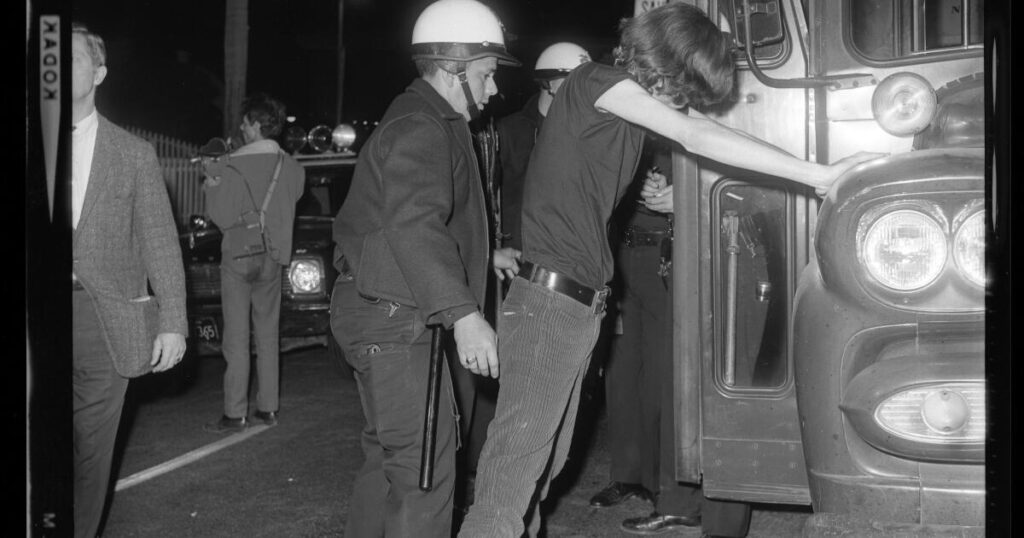
And then, a dozen days before Thanksgiving, fliers appeared on the Strip announcing a rally protesting the curfew. Word got out via rock and roll radio stations, the kids thronged the street, and deputies dropped the hammer on what became known as “the curfew riots.”
That first weekend, a thousand or so teenagers and 20-somethings showed up. Then, The Times reported, after a carload of off-duty Marines wound up in a fender bender, a brawl began and blew up. A few people threw bottles and broke windows. Law enforcement brought out bullhorns to try to clear the street. Some protesters commandeered a transit bus, shooed out the driver and passengers, broke the windows, dented the roof and deflated the tires. A man who tried to drop burning matches into the bus’ gas tank was arrested.
Over the weeks ahead, several hundred were arrested. For law enforcement, it was a moment to counter the counterculture. Los Angeles County Supervisor Ernest Debs called the protesters “misguided hoodlums,” and the sheriff issued a no-tolerance pledge to prosecute lawbreakers and yank the business licenses of anyone encouraging them. He wanted parents held liable for their “failure” to control their children.
When protesters swarmed across the line into L.A. itself, a L.A. Police Department captain, C.W. Crumley, warned that curfews were necessary lest “juvenile prostitution, venereal disease, narcotics” get out of hand — and that police needed a freer hand to stop them.
Within a few days, it all became a “happening.” Ordinary Angelenos drove to the Strip to gawp at the “teenyboppers,” and the news trucks and radio reporters sometimes outnumbered the “hippies.”
As the days wore on, the young protesters were joined by pastors and sometimes even by parents. Now the kids carried signs: “LAPD is not cool to kids” and “We’re your children! Don’t destroy us.” Some teens wore American Civil Liberties Union armbands. The optics were not working in law enforcement’s favor.
In a letter to a Pasadena newspaper, an Altadena man wrote that he’d visited the Sunset Strip to see for himself, and found “a huge number of normal-looking, short-haired boys and a few beatnik types. I was strongly reminded of a college pep rally,” not a riot.
Actor Peter Fonda was picked up by lawmen, who let him go after he explained that he was researching a film. In December, Sonny and Cher showed up at Pandora’s Box, where they had once performed. Both wore white fur — Sonny in shaggy Mongolian lamb, Cher in mink.
All he did, Sonny said, was remind protesters to be peaceful. But a few days later, the Monterey Park City Council indignantly canceled its invitation to the pop stars to ride on the city’s New Year’s Day 1967 float. It invited country singer Buck Owens instead.
The 1966 “curfew riots” gave us one of the era’s best protest songs, which soon became an antiwar anthem. Musician Stephen Stills witnessed what he called “the absurdity” of November 1966, drove home to Topanga Canyon and, in about 15 minutes, wrote “For What It’s Worth,” soon recorded by his new band, Buffalo Springfield. “For me there was no riot,” he said in The Times. “It was basically a cop dance.”
Given the Strip’s history, there was no small element of hypocrisy to the hand-wringing and policing of late 1966.
Once the area’s early 20th-century poinsettia rows had been plowed under and its avocado groves cut down, the Strip’s geography made it ideal for nightlife, legal or louche.
Gambling, illegal drinking, even fistfights were a constant at nightclubs and cafes that began opening their doors in the 1920s. But because the clientele were in black tie or evening gowns, bore famous names or paid eye-watering tabs and gambling stakes, they often weren’t held to account.
The notorious Clover Club was raided and swiftly reopened so often that in 1936, the management felt constrained to tell The Times, “No payoff of any kind to local or northern politicians was made by the club.”
A sampling of the mayhem:
1928: A fire in the Russian Eagle Café sent patrons on the run, chief among them Charlie Chaplin. The White Russian owner of a next-door shop was convicted of arson for gain. He blamed it on … Commies.
1941: At the chic Mocambo nightclub, Warner Brothers’ star Errol Flynn was stabbed in the cheek with a fork wielded by the wife of a gossip columnist. At the next table, actress Marlene Dietrich, encumbered by a plaster cast on a broken ankle, hustled her legendary gams outta there.
1947: Frank Sinatra slugged a gossip columnist outside Ciro’s nightclub. Days later, he was arrested for battery in a radio studio and ended up paying the columnist $9,000 to settle the case.
1949: Mobster Mickey Cohen was standing outside Sherry’s nightclub, not far from the men’s clothing store he owned, when gangland rivals opened up on him with shotguns. A bodyguard was killed, Cohen got nicked, and newspaper columnist Florabel Muir, who had been inside with Cohen, got peppered in the ass, though the newspapers delicately called it “the thigh area.” Muir seemed to attract mayhem on the Strip.
For years, good-government forces had pleaded to keep mobsters off the Strip. In the 1930s, a huge sign on a vacant lot fronting Sunset read, “Close Clover Gambling Joint— Keep Chicago Out of Hollywood.” An Easter Sunday raid of the Clover and other clubs turned up secret mirrored door panels, thousand-dollar poker chips and dozens of patrons who were all, coincidentally, just leaving.
Time and money exerted their own changes. Las Vegas, with its newer, celebrated strip, began drawing the big gambling money and big-name entertainers. The Sunset Strip’s jazz clubs brought a newer, hipper clientele. The dictatorial movie studios — which paired up their stars, sometimes dressed them from the wardrobe department and sent them off to fetch some flashbulb publicity in the elegant nightclubs on the Sunset Strip — were losing their bossy authority.
Television was entertaining people at home. (One bit in “The Lucy Show” has Lucille Ball picked up for violating the Sunset Strip curfew.)
For six seasons in the ‘50s and ‘60s, the TV show “77 Sunset Strip” tried to capitalize on it all. There was never any such address; it’s always “Sunset Boulevard,” and always, colloquially, with the definite article, “the Sunset Strip.”
The most celebrated place on the Strip, the fabulous Garden of Allah, originally “Alla,” on the south side of Sunset between Crescent Heights and Havenhurst, was a grandly exotic apartment complex and private playland, an outpost for uprooted and celebrated Europeans and New Yorkers. It opened in 1927 and was bulldozed in 1959. What stands there now is yet another shopping plaza.
The nightclub Ciro’s became a rock music venue and eventually the legendary Comedy Store.
And the “hippies” who were ruining the Strip became the reinvention and saving of it, with music clubs whose walls heard the history of modern popular music: folk, rock, pop, glam, heavy metal, punk. David Bowie, John Lennon, Elton John, Joan Baez and Bob Dylan frequented the clubs or went onstage themselves.
In 1939, the mayor of Los Angeles let it be known that L.A. coveted the territory of the Sunset Strip. But it was West Hollywood that in 1984 became a city and claimed the Strip — its rugged roots, its high-priced glamour and its sweet tax revenues — as its own.
The post How ‘beatniks, Communists and nudists’ staged a ‘youthquake’ and changed the Sunset Strip appeared first on Los Angeles Times.