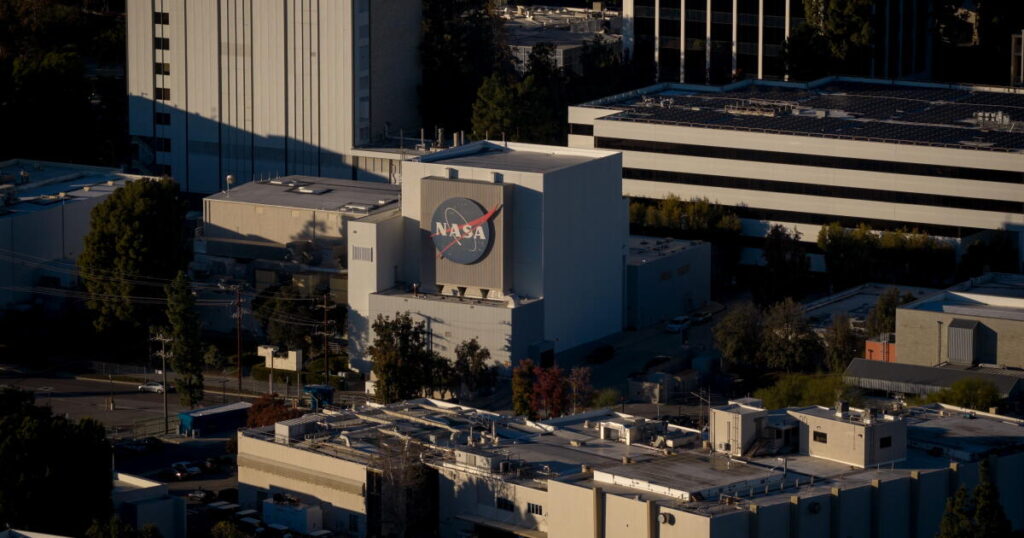
In late October, representatives from more than two dozen companies and universities met with NASA officials on the campus of the Jet Propulsion Laboratory in La Cañada Flintridge to discuss the possibility of taking control of the famed space science center — which up until now has been managed solely by the California Institute of Technology.
Alongside Caltech were academic heavy hitters including the University of California, Texas A&M and USC. The group also included companies that run massive labs for the Department of Energy and a cadre of NASA subcontractors deeply familiar with JPL’s inner workings.
The prospect of ending Caltech’s $31-million-per-year management contract follows the termination of a flagship JPL mission to retrieve dust and rock samples from the surface of Mars. Elimination of the program, which was plagued by delays and billions in cost overruns, triggered multiple rounds of grueling layoffs.
Despite this, NASA Administrator Jared Isaacman insisted the decision to put control of JPL out to bid was not a direct response to concerns over Caltech’s management. “NASA, since I’ve taken over as administrator, has put several major projects in the hands of the JPL team, which I think speaks to our confidence,” he said. “So, it’s theirs to lose.”
NASA’s hiring of a new manager would topple Caltech’s 90-year reign over the Southern California institution — a period that spans the lab’s founding on Halloween in 1936, the launch of America’s first satellite in 1958, the first successful U.S. spacecraft landings on the moon and Mars in 1966 and 1976 and the first human-made probe to enter interstellar space in 2012.
Beyond Caltech, three of the organizations that attended JPL in late October have publicly expressed interest in submitting a formal bid so far: USC, Texas A&M and Associated Universities Inc.
“We have the greatest respect for Caltech and what they have done over the last number of decades with JPL. They’re a tremendous research university,” USC President Beong-Soo Kim said recently. “This is not something, frankly, that we would have considered had the federal government not indicated that this was something that they were open to.”
Texas A&M, which helps run multiple Department of Energy science and nuclear facilities, is also considering submitting a bid. “NASA’s work at the Jet Propulsion Laboratory is closely aligned with areas where the Texas A&M System has significant strength and growing momentum,” a spokesperson said in a statement to The Times. “We are always interested in opportunities that align with our capabilities and serve the nation.”
AUI, a nonprofit that was established in 1946 by nine Northeastern universities to operate a Department of Energy laboratory in New York, confirmed to The Times it was exploring a bid as well. It operates the National Radio Astronomy Observatory, with telescopes across the United States and in Chile, for the National Science Foundation.
The University of California also sent senior leadership members who oversee work with Department of Energy labs, according to public documents, but did not respond to repeated inquiries from The Times.
Battelle Memorial Institute, an Ohio-based nonprofit that serves on the management team for seven Department of Energy labs, sent its vice president for business development and strategic growth to the October meeting, but declined to comment on whether it was considering submitting a bid.
One of the several smaller NASA subcontractors that attended told The Times it had no plans to submit a bid. In bidding competitions for large labs, it’s typical for subcontractors whose work depends on the outcome to provide input during the process.
Caltech does not plan to give up the country’s vanguard of planetary exploration easily.
“The close and enduring partnership among Caltech, JPL and NASA has served America’s preeminence in space exploration remarkably well and continues to do so,” Caltech’s 10th president, Ray Jayawardhana, said as he prepared for his inauguration last month. “I think the value proposition of that partnership is unparalleled and continues to deliver tremendous returns for the nation.”
The competition for control is still in its early stages: NASA has been meeting with interested parties and deciding what exactly it will ask of potential contractors. Bidders, meanwhile, will have to decide whether to enter the race on their own or join forces with other institutions to make a more competitive proposal.
“It’s been under Caltech’s management since essentially inception,“ NASA’s Isaacman said. “From time to time, it’s very helpful to have some amount of competition and see if there’s ways you can improve.”
USC is still weighing whether to submit a solo bid or team up with other interested institutions. AUI, meanwhile, is actively exploring partnerships with other potential bidders. With experience managing large arrays of telescopes, a spokesperson said the nonprofit is particularly interested in bringing its expertise to NASA’s Deep Space Network, an international system of antennas operated by JPL to communicate with space probes — and humans — traveling far from Earth.
NASA plans to officially issue a request for proposals on running JPL in early 2027. Those proposals are expected to be due in late in the year, with NASA selecting a winner in early 2028. Should Caltech lose, the change would occur in October 2028.
While putting the management of a key NASA field center out to competitive bidding is unprecedented, there are examples of it happening at other government labs — most notably at the Department of Energy, where universities and companies have lost long-standing contracts.
Unlike other NASA facilities, JPL was forged by the U.S. War Department in the run-up to World War II. It was part of a larger strategy where the department tapped universities around the country to set up massive research labs for the development of missiles and atomic bombs.
After the war, the department passed many of these university-run labs over to peacetime agencies. JPL went to NASA. The nuclear labs primarily ended up under the Energy Department.
In the decades since, many Department of Energy labs have changed hands through competitions.
For example, the University of California ran Los Alamos National Laboratory in New Mexico for decades. After a series of safety and security incidents — including missing computer disks with classified information and a laser incident that injured an intern — the Department of Energy decided to open the contract for bidding in 2003. The University of California ultimately teamed up with other companies to successfully win control. Today, it is managed by the University of California, Texas A&M and Battelle Memorial Institute.
The government’s competitive procurement process is not a trivial one.
“It’s expensive for the government; it’s expensive for the bidders. It can cost millions of dollars to put together a really good proposal,” said Allison Bawden, managing director of natural resources and environment at the U.S. Government Accountability Office who has studied Department of Energy contract competitions.
Yet, “if you want to see a different type of performance from the contractor or you’re looking for the scope of your work to change,” she said, “just doing a modification of a contract might not get you there.”
Caltech does enjoy a home-field advantage, though, when it comes to managing JPL.
“Caltech, they have the advantage first of all in history, but also of proximity,” said Peter Westwick, a history professor at USC who is not involved in the university’s deliberations on a potential bid. “Anybody who beats them out is going to have to overcome both of those.”
Though USC’s main campus in South Los Angeles is roughly 10 miles farther from JPL than Caltech in Pasadena is, USC boasts closer proximity to the epicenter of Southern California’s aerospace industry in South Bay and Long Beach, including SpaceX in Hawthorne, Kim said.
“If NASA is going to take a different direction, we want to do everything that we can to ensure that Southern California remains central to this new space economy,” he said. “USC is almost ideally situated to help keep that talent in the Southern California region.”
Caltech, however, has managed to stave off existential threats to the lab before.
In the 1980s, the Reagan administration proposed slashing the planetary science missions that had become JPL’s bread and butter. When NASA Administrator James Beggs said such cuts would make JPL “surplus to our needs,” well-connected Caltech leaders convinced Congress and the White House to keep funding Galileo, JPL’s flagship mission at the time to explore Jupiter’s atmosphere.
And even after the loss of the Mars Sample Return mission, JPL managed to restore some faith through the launch of the Roman Space Telescope, which came in ahead of schedule and on budget.
“Caltech is a singular institution that is — across sciences and engineering — preeminent nationally and globally,” Jayawardhana said. “We do very much treasure JPL as a critical element of this ecosystem.”
Times staff writer Jaweed Kaleem contributed to this report.
The post Inside the race for control of NASA’s Jet Propulsion Laboratory appeared first on Los Angeles Times.