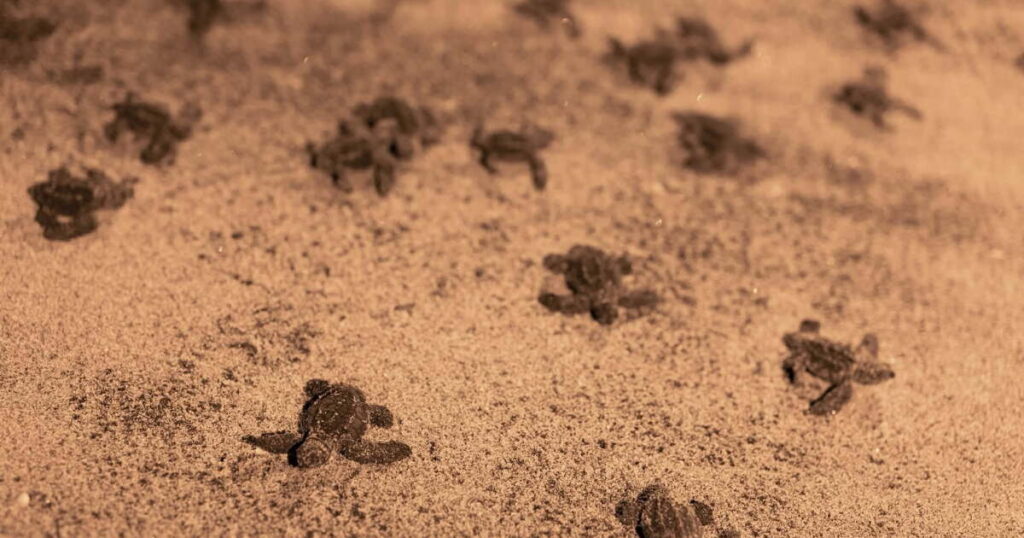
They scuttled to the water under cover of night, instinctively orienting toward the brightest light on the horizon.
Juiced up on nutrients from their yolk sacs, the tiny olive ridley sea turtles crawled with frantic intensity away from the humans who kept watch over their eggs and down the sandy slopes. Then the first gentle wave washed over them, and whoosh — they were gone.
From the moment a surprise nest of olive ridley sea turtle eggs appeared Sept. 16 on Seal Beach, no one was sure if that clutch of eggs, or a second laid on Huntington Beach three days later, would actually result in turtles.
To the best of anyone’s knowledge, no sea turtle of any species had ever attempted to nest on the U.S. West Coast. No one knew whether the eggs were fertilized, or whether conditions hundreds of miles north of their usual nesting grounds were fit for turtle development.
The answers turned out to be yes.
So far, about 100 hatchlings from 208 eggs laid in Orange County and incubated at the Aquarium of the Pacific have been released into the Pacific Ocean.
Now that the first class of native-born California sea turtles has taken to the water, biologists are processing the lessons of this year’s turtle boom and wondering whether this year’s nests are a one-time phenomenon or a sign of things to come.
The U.S. Fish and Wildlife Service, which has jurisdiction over sea turtles on land, has been clear that the decision to move the Orange County nests to the safety of the Long Beach aquarium won’t necessarily be policy for future nests.
Without intervention, high tides in late September would have destroyed both nests. Given the unprecedented circumstances, federal biologists made a last-minute call to save them.
“That situation was atypical, and the Service will individually assess each instance of turtle nesting in California,” a spokesperson said via email.
The service opted not to move a third olive ridley nest that appeared Nov. 1 on San Buenaventura State Beach in Ventura, after determining that local waters at hatch time would be too cold for baby turtle survival. (Mean December ocean temperatures hover around 58 degrees Fahrenheit in Ventura and 82 degrees in Ostional, Costa Rica, one of the world’s largest olive ridley nesting sites.)
High tides in mid-November swamped the nest and exposed the eggs, which were already incubating in sand significantly colder than the species’ usual nesting grounds and thus unlikely to produce hatchlings. Federal biologists removed and destroyed them.
Both approaches — targeted interventions, and letting nature take its course — are used at sea turtle nesting sites, biologists said.
“Nest relocation, supervised incubation and biologist-assisted hatchling release is common practice around the world on sea turtle nesting beaches and it’s been one of the conservation strategies that has helped sea turtles avoid population crashes in several cases,” said Lindsey Peavey Reeves, a senior scientist with the National Marine Sanctuary Foundation who has studied olive ridleys in the eastern Pacific Ocean for 20 years. “This kind of human intervention is not unusual for sea turtles, just for Southern California.”
Aquarium staff decided to keep interference to a minimum during incubation. The eggs stayed in the same styrofoam coolers they’d been gently packed in on the beach. Apart from swapping the opaque lids for transparent acrylic ones, and installing 24/7 infrared camera systems, the eggs were left largely untouched in their climate-controlled nursery.
“The eggs didn’t give us a lot of feedback on how it was going, so up until when the sand started sinking, we had no idea how well the incubation went,” said Dr. Lance Adams, the aquarium’s director of veterinary services. “I felt like a kid waiting for my birthday to come. It seemed to take forever but then happened fast and was over.”
As of Nov. 23, 107 unhatched eggs remained at the Aquarium of the Pacific. Olive ridleys have a 45- to 60-day incubation period. Nov. 18 marked 60 days since the second of the two nests was laid.
Although additional hatching is still possible, few sea turtle nests have a 100% hatch rate.
Sea turtles produce large clutches of eggs in order to “hedge their bets” that at least some will survive to maturity and produce offspring of their own, Peavey Reeves said. Eggs are often poached by predators in the wild, or destroyed when erosion sweeps away the sand covering them.
“Even with perfect nest environment conditions you can still have sea turtle embryos that begin to develop in the egg and then die prematurely,” said Pamela Plotkin, a retired oceanography professor at Texas A&M University. “You can also have eggs that were not fertilized to begin with and have no embryo development inside.”
Two big questions remain: Will there be more sea turtles on Southern California beaches, and will the first turtles released into these waters return someday to lay eggs of their own?
“I know uncertainty and ‘to be determined’ is not satisfying … but it’s the reality,” Peavey Reeves said.
The nests appeared amid extraordinary climate conditions. An extreme marine heat wave and a strong El Niño pushed Southern California early autumn water temperatures closer to those of the turtles’ typical nesting grounds.
“If this super El Niño year created once-off conditions for olive ridleys to nest in Southern California, we may not see this behavior again for at least several years,” Peavey Reeves said.
But the extent of the olive ridley’s northward migration may be even larger than previously believed.
Earlier this month, a member of the public discovered the remnants of a turtle nest on a beach in Carpinteria in Santa Barbara County, nearly 100 miles north of the Seal Beach nest.
Analysis at the Natural History Museum of Los Angeles County determined that the eggs were just days away from hatching when they were destroyed by erosion or some other disturbance, herpetology curator Greg Pauly said, and probably were laid even earlier than those in Orange County.
“What this Carpinteria nest is telling us is that in some situations [in Southern California] we do have conditions that will allow the embryos to fully develop” without human intervention, Pauly said.
It will be 12 to 15 years before any surviving females from the hatchlings released this fall are old enough to reproduce. Female sea turtles of all species typically return to nest on the same beach where they were born. It’s not known for certain how they pull off this navigational feat after thousands of miles of lifetime migration. Evidence suggests that sensory data and cues from the Earth’s magnetic field play a role.
First they must beat formidable odds. Just 1 in 1,000 sea turtle hatchlings survives to adulthood, according to the U.S. National Oceanic and Atmospheric Administration. Already, some of the Orange County hatchlings almost certainly have fallen prey to fish or seabirds.
But anything can happen out there in the sea. There is always a chance that some will defy the odds, survive into adulthood and make their way back to Orange County to lay eggs of their own.
The post After a historic hatch, what’s next for Southern California’s sea turtles? appeared first on Los Angeles Times.